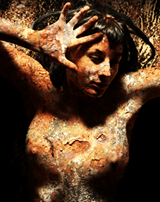
“Rockets”

Published by Neworld Review, Vol. 11 Number 76 (NewWorldReview.net).

***

We ate charred hotdogs and yesterday’s leftovers at the picnic table on Grandma’s covered patio. It smelled like rain even in bright weather. Rot had seeped into the thin layered wood of the awning and up the legs of the paint-chipped table. I chewed my potato salad carefully, spitting pimentos onto the cement floor, but only when my mother wasn’t looking. It was July 5, 1987.

My brother Ben saw me turn and spit. He grinned. “Lolly’s spitting out food!” he yelled, gleeful to be the tattler. He reached into the metal chest cooler behind him and fished a can of root beer from the ice-flecked water.

Our mother stopped talking to Aunt Rena and turned to me. Then she scanned the ground and saw the dozen or so pimentos freckling the cement. “Lorena Grace. If you don’t act like a big girl you will not go to the beach with your cousins,” she said, her mouth turned down in the way we had all gotten used to.

Sometimes she called me her big girl and sometimes she accused me of being little; the conflicting statements left me wondering which one I should want to be. That day, I almost opened my mouth to say so, or some child’s version of that. I shut it and looked at my plate instead. I knew she wasn’t done so I waited, trailing the tines of my plastic fork through the ketchup and mustard smothering my hotdog, swirling one condiment into the other until I had a Spirograph of red and orange and yellow.

“Is there something wrong with the potato salad I spent so long making yesterday morning?” She stressed the word wrong, and for whatever reason, morning, too.

I stopped making art. No answer would be the right one. I knew this even at six years old. So I shoved another bite of dry potato salad into my mouth and chewed, not hunting out the sour-tasting pimentos with my tongue, mashing it together and swallowing. I choked down three bites before she turned back to my Aunt Rena, satisfied that I learned my lesson.

My mother and aunt resumed their discussion of my father, who had stayed inside with my uncles to watch a baseball game on television. Between crunching black hotdog skin and listening to Ben chug soda, I thought I heard my mother whisper something about my father “having a fair.” Immediately excited, I interrupted her to ask if there would be elephants to ride, then, too foolish to stop, I added that I hoped there wouldn’t be painted clowns, or at least not the sad kind. I had been chewing and a pimento slipped from my cheek and stuck to my chin.

She glared at me. “Eavesdropping is for church gossips,” she said. She habitually put down church gossips—still does—and I didn’t want to be lumped in with them. She didn’t mention talking with my mouth full, but I knew that was also bad manners. I slouched, ashamed. I tried to freeze, but my bottom lip betrayed me.

Little puffs of air came from my mother’s nose, and her chest heaved. She didn’t look away.

“Sorry,” I managed, but it was barely a mewl, muffled by the hotdog rind in my mouth. I swallowed the scratchy bite hard and tried again. “I’m sorry.” Aunt Rena saved me by having a very sudden and loud realization that she hadn’t yet told my mother about her bumper crop of heirloom tomatoes. My mother turned back to her and stopped huffing. I was always extra nice to my aunt after that.

Across the table, Ben finished his third hotdog and belched. He wiped his mouth on the back of his hand, trailing an orange smear of ketchup-mustard on his knuckles. He left it there. I thought about telling our mother that he hadn’t eaten any potato salad, with or without pimentos, and adding that I saw him take two dollars from our grandmother’s dresser earlier. Forgiveness by deflection.

But next to me, my mother twisted a paper towel in her lap, tighter and tighter until it looked like a thin white whip. Aunt Rena was still talking; I caught “Early boy” and “Beefsteak,” but my mother didn’t seem to hear her. I decided not to tell on Ben, who belched for the second time without saying “Excuse me.” He got up to chuck his empty plate in the black garbage bag tied to the end of the table. Then our cousin Will came running from the front yard, smacked Ben on the shoulder and yelled “It!”

Ben’s heels kicked up dirt clods as he ran after Will, and they disappeared around the side of the house. Will is my Aunt Rena’s youngest. As boys, when Ben and Will got together they formed a secret club, and I wasn’t allowed to play their games. Another cousin, Jennifer, was there that day, but she was a teenager; all she did was read magazines, stretched out on Grandma’s old fold-out lawn chair in a two-piece bathing suit. When I finally finished my hotdog and hid the rest of my potato salad under a napkin, I ran off to play alone. My mother didn’t notice when I got up.

A flagstone path wound from the patio to the front yard and I followed it, avoiding the cracks between the stones. Closer to the road, a Virgin Mary statue stood weeping, her pale arms stretched out like she was asking the slow-passing cars for help. I posed next to her, mimicking her stance, wondering what the people blurred behind windshields could do for us.

The Pakisandra planted around Mary’s feet spilled outward like tar tipped from a bucket, its thick growth unchecked since Grandpa died two summers before. I waded into the knee-high creepers, liking how my feet disappeared, ignoring the small clouds of gnats I disturbed. I pretended it was quicksand, that Mary was a sad orphan sinking in it, that I had to save her and if I did she would grant me three wishes and then we would become soul sisters. I renamed her Magnolia, since I thought the name Mary was boring. But after a sharp rock I didn’t see slipped into my sandal, I abandoned the game and her.

For a moment, I considered looking for the boys, but they’d only accuse me of being a tag-a-long, like always. I spent a few minutes wishing I had a puppy, or a baby sister, or a mother who’d paint my nails when she painted hers. Like always. Then I wandered into the backyard.

A three-sided fireplace squatted in the corner of the shady lot like a surly toad. A rusted grate rested on its stone walls, cooked on by my uncles but never cleaned. I watched as a crow landed there and pecked at a piece of aluminum foil stuck to the grill. He seemed uncertain, like he wasn’t sure he really wanted the bright piece of metal. He cocked his head, regarding it with his right eye and then his left, adjusted his position, pulled at it and let go. He ruffled his wings, exasperated. He repeated this until a larger crow landed next to him and in one smooth, quick motion, ripped the foil from the grill and flew away. The smaller crow pulled his head back and cawed, indignant or bereft. I felt sorry for him and hurried back to the covered patio; my mother and aunt were gone. I dug in the picnic trash until I found the piece of foil that Grandma had used to cover the fruit salad. I pulled it out and ran back to the fireplace but the crow was gone. I looked up, trying to find his sleek black body in the branches of the walnut trees overhead. I spotted two squirrels but no birds. I crunched the foil into a ball and set it on the grate in case he came back.

Damp dead leaves had collected in and around the base of the fireplace, too wet and thick to burn in the small fire my uncles had started there earlier to cook the hotdogs. I poked the toe of my sandal into the musty pile, flipping back a few layers. Potato bugs scurried away from the light. A curl slipped out of my ponytail when I crouched down to look at them and I tucked it behind my ear. A fat potato bug curled his body into a tight ball when I caught him on the run. I rolled him between my fingertips like a piece of clay. Then I balanced him on a dry leaf, rocking him back and forth while humming “Row, Row, Row Your Boat.” He only fell off the edge twice. I put him back in his wet home and covered him with leaves, patting the top into place like I’d never been there.

I walked around the house to the driveway, noticing where burn marks from last night’s fireworks blackened the concrete. One of my uncles had bought them at a discount shop over the Pennsylvania state line and half had been duds. But we cheered for the ones that lit and whistled, their bright lights reflecting in my father’s glasses. The lawn chairs were still out on the driveway, and I sat in one. The canvas cut into my legs so I moved to the flat concrete. It was warm from the sun but not so hot that it burned, and I lay there pretending to be a pie baking. I would be apple. My mother never made cherry and Dad was allergic to rhubarb.

***

My cousins had gone down to the rock-and-grit beach at the end of the road and I was supposed to go with them. I meant to. My mom had helped me into my stretchy turquoise bathing suit with the neon straps and warned the bigger kids not to let me go in the lake past my waist and not to take their eyes off me. I had grabbed my sand pail and my pink shovel, hung a bright orange towel around my neck. I was going to build a fort for the rocks in my bucket that I had drawn faces on with a Sharpie. There was a whole family and a cat and an elephant. A couple houses down the road, though, lagging behind on short legs, I realized I had forgotten my floaties. I couldn’t go in the water without them—it was a rule. So I turned back. I thought I could catch up after.

The adults were in the kitchen, the sounds of running water and Rod Stewart and Aunt Rena’s laugh coming clear through the screened window. I walked beneath it, crossed the patio and went into the garage, finding my floaties in our beach bag. But one had deflated. It would take forever to blow it up by myself, and I knew my cousins were getting farther away. I walked out of the garage, intending to go in through the back door and find a grownup.

Then I saw Ben crouched low over a cardboard box next to the fireplace. The box had words on it printed in bright yellow. I couldn’t read them—they were too big for me. I recognized the pictures, though. It was the box of leftover fireworks from the night before. My uncles had put it on a high shelf in the garage and told us not to touch it.

“What are you doing?” I asked. I wasn’t tattling. I just wanted to know.

He put his finger to his lips and smiled—he never smiled at me, and now we had a secret. So I smiled too, dropped my floaties and my shovel and my towel and my sand pail, and walked over to him. My footsteps didn’t make a sound on the soft moss.

“What are you doing?” I asked again, whispering this time. I looked toward the kitchen window.

“I didn’t want to go to the beach,” he said. “And Will was scared to get in trouble. I told Jennifer I’d come back to look for you.” He held Grandpa’s old Zippo lighter in his hand, the silver one with the American flag stamped on it. He didn’t ask why I’d fallen behind. I didn’t ask where he’d gotten Grandpa’s lighter.

“Can I do one?” I asked.

“No,” he said. “You’ll mess it up.”

I was hurt.

“I mean, you’re too little,” he said then, “and I think it’s better if I just do it. But you can watch, okay?”

I nodded, agreeing to the terms of being there.

He picked a bunch of firecrackers out of the box. To me they looked like colorful cigarettes all tied together on one end, with a string trailing down by my brother’s knee.

“Get back,” he said. “Watch this.”

I moved a few feet back.

He flicked the Zippo and blue fire spit out near his thumb. He lit the long wick and let the flame dangle for a few seconds. When it was just an inch from the firecrackers, he threw them into the stone fireplace. The noise they made was like loud popcorn. I jumped up and down, giggling.

We both looked toward the house. No one came

“Do it again!” I said, forgetting to whisper. He forgot too and picked something else out of the box. It was bright purple and shaped like a top, with a needle in its center. A wick stuck out of its side.

He pushed its needle point into a raised clump of moss on the ground and lit the wick. The disk fizzed, then spun, orange sparks flying from it in a circle like a UFO getting ready to take off. It broke free of the moss and began to move, first toward me, then away toward my brother. It bounced off his sneaker and sparks hit his ankle before it slowed to a stop against the base of a nearby walnut tree.

I ran over to him. He rubbed at his ankle and I smelled something awful, but he just laughed. I leaned closer. Little blisters bloomed on his skin and the blonde hairs there curled black. I looked at the house and inhaled, ready to yell for our mother. But he grabbed my arm. He said, “One more, okay, Lol? Then we’ll run down to the beach and catch up with Jen and Will.”

I considered my limp floatie. Maybe he would blow it up for me. I exhaled my ready breath and nodded.

He walk-limped to the box and picked up something that was about the size of a Flintstones Push-pop. I thought it was beautiful. It had a pointed top like a castle tower and rocketship fins on the bottom.

“Yeah,” said my brother, but not really to me.

He set it on the ground, pointed end up, working its base into the same moss that had braced the spinning top. He felt around the bottom until he found a coil of string and stretched it across the ground toward him. Then he motioned for me to step back again and pulled the Zippo out of his pocket.

He reached to light it, then looked over his shoulder at me. “Farther,” he said.

I took one step back. He shook his head.

“I want to see,” I whined.

Ben stood and walked over to me, grabbing my thin shoulders. He walked me back and to the left, so I stood next to the fireplace. “Here,” he said. “Stay.”

I stuck out my lip but didn’t move.

He lit the wick and stepped back. The little firework crackled and hissed, then shot up with a whistling sound. I tried to track it in the air, but lost it in the tangled tree branches. Ben couldn’t see it either. Both of us were looking up, hands shielding our eyes, when we heard a pop and roar.

The rocket had come back down, several feet from its launching pad, and straight into the box still half full of sparklers, firecrackers, and snappers. Flames darted from the cardboard and rolled down its sides. Ben turned around and tackled me, flattening me on the damp ground. Then he squished me between himself and the stone fireplace, tucking my head into his chest and pinning it there with his forearm. I couldn’t see and the stone grated against my back. I knew Ben was peeking over the fireplace, watching the display. I could tell by the way he drew in his breath and held it.

I listened to the pinging and popping of the fireworks for what seemed like a long time, imagining their wicks catching one after another as the box burned. I could hear crackling and wondered what color sparks and smoke they gave off. I wanted to look but couldn’t move. Then I heard our uncles cursing and my mother screaming. We were dragged out from behind the fireplace.

Our mother slapped Ben. His head flopped to the side, face turned to the ground. He left it hanging like that.

“What were you thinking!” she yelled, her voice sounding like someone else’s. “She’s just a baby! She could have been hurt!”

Ben cried without making noise; I could tell by the quivering of his shoulders. I thought of the shiny white blisters on his ankle then, but he didn’t point them out. Our father stood to the side, his mouth opening and closing. The two of them looked like actors in a silent film, but then my mother broke in again.

“You know you are forbidden to play with fire Benjamin! You know that! We agreed!” Her voice rose in pitch and volume. There was a looseness about it that frightened me.

I retreated a few steps, back to the safety of the fireplace. I wanted to speak up, to tell her to look at me, that I was fine, that he was hurt and not me. That he had saved me. But my voice wouldn’t work

She kept screaming. “How could you do this? How could you disobey me like that!”

Then she remembered me. I thought she might hug me, or slap me too. I braced myself for either, but she didn’t touch me. “Why in the hell aren’t you with your cousins?” she said.

I pointed to my deflated floatie on the moss behind her, hoping it would do for an explanation. I looked at my father for help, but he was watching my mother.

She walked over to the remains of the cardboard box, its wispy edges curling into white ash. She picked the whole mess up with her bare hands and chucked it into the fireplace, then went into the house through the back door.

Grandma and Aunt Rena followed her, arms crossed tightly over their chests. Our uncles walked into the garage, muttering to one another, and I heard Grandpa’s old fridge clink open. Dad noticed Ben’s leg.

“Christ,” he said. “That needs ice.” He put a hand on Ben’s shoulder and led him over to the patio. Ben sat on the picnic table and Dad scooped a chunk of melted-together ice cubes out of the cooler. When the ice touched Ben’s ankle he cursed. Instead of scolding him, Dad just said “Take it easy.”

I stayed where I was, watching the last of the cardboard box crumble and fall into the damp leaf pile. I wondered if Ben would talk to me when we got home, but figured, like always, that he wouldn’t. I wanted to tell him that going to the beach hadn’t seemed that fun anyway, and that I wouldn’t squeal on him for still having Grandpa’s Zippo in his pocket, or about the two bucks, or about anything else, ever. I wanted to look at his cheek, to see if Mom had left a mark, to say I was sorry, in a way, that she hadn’t hit me instead, or at least, also. I wanted to ask if his ankle still hurt. What color smoke the fireworks gave off. How bright the sparks really were.

“Stations”

Published on redbirdchapbooks.org.

***

Inside the broken-necked chapel, kneeling in the debris of other people’s faith, she held up a stained glass fragment outlining Mary’s perfect suffering.

“I could be like this for you,” she said. “I could mourn you so hard it would bring you back.”

I saw her then, in blue, lips bit ragged and bleeding, eyes luminous with the power of a loss unaccepted. A sunrise or bomb blast would turn the world into her halo.

But there, in the church, she brushed dust from her cheek with a pilled sweater sleeve, then held the colored glass flat between her palms. It disappeared like a street magician’s trick.

She was supposed to wink. I was supposed to clap. But I took her empty hands in my own and to anyone looking through the rafters’ gaps, it would seem like we were praying.

“Heirloom”

Published by Luna Luna Magazine (lunalunamagazine.com).

I bore the scar like an ant,
lighter than its cargo on hard-wire legs.
The mark’s heft and drag
curved my spine into a C that stood for Caisson and kneaded a sweet ache into my shoulder blades.
(I feel it still, calling your name)
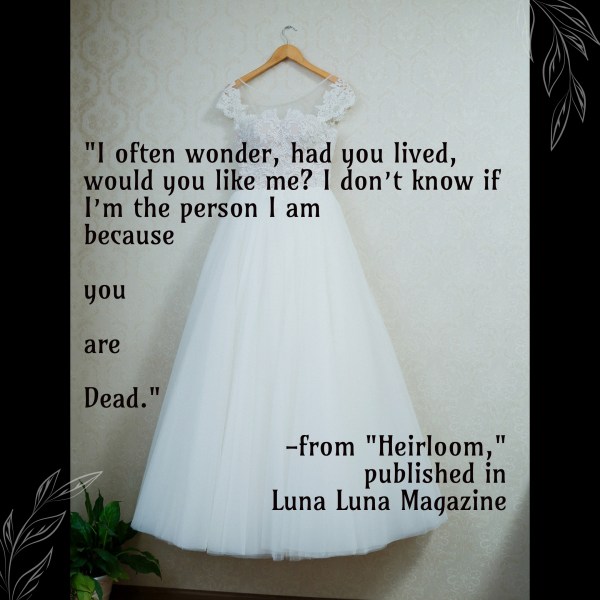
I often wonder, had you lived, would you like me? I don’t know if I’m the person I am because
you
are
Dead.
(catch, rip, tingle)
For years, I worried the scar’s edges with sharp canines to hold off healing. Now it shines like a just-waxed Chevy
and winks in the sun.
It tastes metallic (lick to keep moist; flash to get into clubs).
Your wedding dress is in the attic. Squirrels have made nests in it, pissed, slept, raised
their young in the yellowed lace.

But my ribs expanded to encase this vast hollow,
my extra inch (you were buried in heels—white—before Labor Day) and
anemic breasts that never filled in—
it wouldn’t have fit, I know.

Do you remember walking to church that spring? Everything melting, skipping
cracks in the sidewalk.
You died, but it wasn’t yet autumn.

“Afternoon, 1988”

Published in Allegro Poetry Magazine, Issue #5, themed “Childhood.

For Jeff

I’ve been meaning to tell you:
That day the crayfish darted backward to their silty secrets—
when I caught one with pincers too small to nip my small palms,
when the creek-smell caught in my throat and stuck,
toes squeezing slippery bed-sand,
minnow schools disturbed, winking soft bodies in sunlight,
when I ran across Route 20 and the blue sedan swerved—
I saw your face from the safe side of the road,
but I couldn’t see your chest expand then deflate;
I didn’t understand my weight,
the harsh sounds your voice made, for me.

“Keeping us in suspense”

Published in the Dunkirk Observer and online at observertoday.com.

Editor’s note: Last week writer Rebecca Cuthbert reported about local writer Wendy Corsi Staub’s newest accomplishment, having a Wendy Markham chick-lit book adapted for the Hallmark Channel. This week Cuthbert focuses on Staub’s suspense thriller, “The Black Widow” and the author’s thoughts about writing in that genre.

“The Black Widow,” (HarperCollins) features protagonist Gaby Duran, and concludes Staub’s cyber predator trilogy. Gaby Duran has many qualities that Staub’s dedicated readers will recognize. However, as the author said, the star of this book is also somewhat of a departure from other recent characters.

“Gaby is, like my other protagonists, resourceful, strong, and intelligent,” she said, “(but she is) a little younger than my recent heroines, lives in the city as opposed to a small town or suburbia, and is single instead of married with children, though she once was a wife and mother. Her past is more painful than some – she married the love of her life, but their marriage didn’t survive the tragic loss of their infant child.”

Staub also explored Hispanic culture in writing this novel, and is grateful for the experience. “Gaby also happens to be my first Latina heroine: she’s Puerto Rican-American. I have many Hispanic family members and close friends, so I embraced the opportunity to explore the vibrant culture, and it was a crucial element within the context of this particular plot,” she said.

Staub explained that her recipe for success isn’t so much a recipe as it is knowing her fans, knowing her genre, and balancing expectations with creativity.

“Because I write within a specific genre – domestic psychological suspense – my readers have certain expectations about the kinds of characters who are going to populate the books and what’s going to happen to them,” she stated. “My protagonists tend to be ordinary people whose lives are turned upside down and jeopardized in some way. In real life, when you plug different people into an identical set of circumstances, the outcome is going to be unique every time because of who they are as individuals and how they react to conflict and interact with others. The same is true in fiction.”

Staub said this is not only true of convincing, well-rounded protagonists, but of exciting plots, as well.

“Look at it this way: if I tell you that I woke up this morning and got out of bed – well, that’s not very interesting, is it? You did the same thing. We all did. But the manner in which an event unfolds-and whether others might find it interesting-depends not just upon how it happens, but to whom it happens. Thus, when I conceive a basic plot, I think about how various personality types might behave within the confines of a specific scenario, and how that behavior might influence the plot,” she said.

Staub even gave an example of how drastically circumstances can differ for two characters, influencing the choices they make:

“A happily-married suburban stay-at-home mom with three children is going behave differently than, say, a painfully shy, recently bereaved pregnant widow working two jobs to pay the rent on an inner city apartment,” she said. “Thus, every protagonist I create is unique and comes with a unique background and circle of unique characters with whom she interacts.”

Some of the characters Gaby Duran interacts with – for better or worse – are people she meets online. Staub frequently uses current technologies to help fuel her plots and make her fictional worlds more realistic, but she admitted that these advances in communication can also hinder certain narratives, especially in the suspense genre.

“It’s impossible to write realistic contemporary fiction without addressing technology – or the lack thereof. If you need your characters to operate in a tech-free bubble, then there should be a good reason – like a power outage in a storm, for example – or you set your story in an earlier time or an alternate universe,” she said. “Just as electronic communication can enhance some plots, it can hinder others. For example, in this era of ubiquitous smartphones, it’s difficult to truly isolate a character or setting-always an effective device in a suspense plot – because most people carry or have access to electronics and even the most remote locations tend to have Internet and cell signals. So it’s not easy for a person to disappear without a trace – willingly or unwillingly – without leaving an electronic footprint via the Internet, surveillance footage, banking or credit transactions, or travel security measures. That makes it tricky to create a plot that depends on that particular scenario.”

So how does Staub navigate the tricky waters of writing thrillers in the year 2015, when AAA is always a phone call away and GPS can get any heroine un-lost in a jiffy? By exploring the dangers of the same technology that often makes life so convenient.

“My books tend to feature ordinary people made vulnerable by being in the wrong place at the wrong time,” she revealed. “Technology can create vulnerability because otherwise savvy people can momentarily let their guard down on social media, sharing things that they wouldn’t dream of telling close friends or family in person. That creates the illusion of familiarity. If we trust strangers based on who they appear to be online -overlooking the fact that our perception can be easily manipulated – we become vulnerable. Even when we restrict electronic communication to people we know, we’re assuming that the person on the other end of a text or email is our friend, and not a predator who gained access to the device. I’ve used that very device to create frightening, realistic fiction.”

Staub’s readership is used to heroines who get into trouble and make mistakes – as she says, “perfection is dull!” But it’s those same flawed protagonists who rescue themselves, solve the mysteries, and come away from their battles as stronger, smarter, more capable individuals. Staub credits her upbringing as her inspiration for her heroines, along with the women who populated her formative years.

“I was a little girl in the era of Women’s Lib, and watched my mom, my aunts, and their friends – who were stay-at-home wives and mothers – go on to get college degrees and launch successful careers,” she said. “That left a strong impression on me, and I learned that we traditionally expect women to nurture others, but they must also be capable of taking care of themselves. My own strong sense of feminism and independence is often reflected in my heroines. As a result, my female ‘victims’ are rarely truly victims – they’re strong, resourceful women who try hard to save themselves when circumstances become dire.”

Staub also tries, in her way, to be kind to her villains. They’re not caricatures or stereotypes, but people who, in their pasts, suffered traumas they couldn’t rise above.

“I want my readers to come away with the sense that my novels are complex in part because just as in real life, no character is all good or all bad,” she began, and added, “my villains have usually been victimized somewhere in their past. I don’t believe in creating killers who were born pure evil – you need empathy in order to write scenes from a character’s viewpoint. So I do a lot of research into deviant psychology with each book, and my villains must possess some glimmer of redeeming characteristic in order for me to channel them.”

Whether it’s cyberworld stalkers, heroines’ blunders, dead Smartphone batteries or buried secrets, Staub’s plot twists consistently keep her readers on the edge of their seats, and in line for her newest releases. But even with so many titles to her credit, Staub isn’t slowing down. In fact, the more books she writes, the more ideas she gets for new books.

“I’ve been writing thrillers for over 20 years, so it’s like any other skill – constant practice makes you adept,” she said. “Sustaining the excitement has become second nature to me – if I’m bored when I’m writing something, then I know my reader is going to be bored reading it, so it isn’t hard to gauge the excitement level. Inspiration is everywhere. All novelists have an ingrained “What If” mechanism that’s triggered all day, every day, by what we read or watch, by things that happen to us, by events we witness or even snippets of strangers’ conversations we happen to overhear. I will never run out of inspiration – only time.”

Next week: How Staub’s local connections affect her writing.

“Things my 74-year-old Father Says That Do Not Mean What He Thinks They Mean, With Helpful Notations For Those Who May Be Similarly Confused”

Published in Crab Fat Magazine, Issue #4, page 104.

  1. Cir·cle Jerk \ ’sǝrkǝl, ‘jǝrk \ n: Not a traffic circle, like the one recently built at Routes 5
    and 20 in Irving, NY, right next to the Seneca Hawk smoke shop, gas station, and casual
    eatery (home of all-you-can-eat spaghetti).
  2. Hand Job \ ‘hand, ’jäb \ n: Not a hand-operated tool or piece of machinery, i.e. “Eric, I’m
    already using the nail gun so it’ll have to be a hand job for you” is incorrect, misleading,
    and gross.
  3. Dou·ble-team \ ‘dǝbǝl-tēm \ vb: Not when both dogs beg for one’s sandwich.
  4. Blow Your Wad \ ‘blō, ‘yōr, ‘wäd \ vb, adj, n: Not when one spends all of his/her money
    on one item, and no, “blow your load” isn’t any better.
  5. This Guy’s Jerk·ing Me Off \ ‘ this, ‘gīz, ‘jǝrk-iŋ, ‘mē, ‘ȯf \ pron, n+vb, vb, pron, adv: Not
    when the man selling his lawn mower in the Classifieds won’t accept one’s offer of half the
    asking price, (and no, telling him “because I already have six lawn mowers” doesn’t make
    him more inclined to accept the offer; if anything, it just makes him realize you are a
    hoarder and that you will, in fact, pay the asking price).
  6. Get·ting F’d To Death \ ‘getiŋ, ‘eft, ‘tü, ‘deth \ vb, adj, prep, n: Not when one’s youngest
    children are swearing too profusely at the dinner table for one’s liking, and really, Dad, it
    was at the Seneca Hawk.

“Dear Ms. Bradigan”

Published by Treehouse Magazine

***

Dear Ms. Bradigan,

It’s not that your efforts went unnoticed—the “private” journal only you would read, the soulful “Are-you-okays,” the invitations to visit the school counselor.

It’s that I was ten, or not quite, and my mother had just died, and I felt flayed open, peeled flesh exposed to stinging wind, and even before that, before I was half-orphaned, I was an introverted child.

When you insisted I see the counselor—because swallowed sadness hurts, you said—I talked about my yellow parakeet, who would later get cancer and be put to sleep by my older brother with a pillowcase and an exhaust pipe, which is not at all how my mother died, and for which I was at least prepared, though I loved the bird too, a little, which is why when that tumor grew on his face and he could no longer eat, I said “Do it” without stuttering or regretting the words.

I did not talk to the counselor about the parakeet as a substitute mother, or of you as a substitute mother, or whatever you had hoped I’d say. I did not call myself the parakeet’s mother, or it my baby, because, Ms. Bradigan, it was a parakeet, and because I didn’t understand, I could not measure, I’d not yet tossed a stone into the yawning black hole my dead mother left; I did not know that for the rest of my life I would throw parakeets and miniskirts and seven-dollar bottles of wine into it, never to hear anything bounce off a damp-sounding rock face or hit hard on a silty bottom.

I was not ungrateful then because I didn’t understand gratitude, but would not have thanked you if I did, or not sincerely, because sometimes when you see a potato bug curled into a ball you should just leave it there, let it take comfort in its protective roundness, or, if you must interfere, Ms. Bradigan, pull a curtain of lush green grass away from a stone step and drop the gray ball into the deep, loamy recess where it will be safe from crushing boot heels and predators’ beaks and too many questions about its feelings, which, at that point, Ms. Bradigan, it had not known how to articulate.

All my sincerity,
Rebecca Schwab

“Three Tears in a Bucket”

Published by Slipstream Press, Issue #34, “Rust – Dust – Lust.”

Poetry by: Shanalee Smith, Marc Pietrzykowski, Andrea O’Rourke, Noah Kucji, Harvey J. Baine, Cait Weiss, Courtney Leigh Jameson, Christopher Warner, Quinn Rennerfeldt, Rich Heller, Michelle Valois, Pat Phillips West, David Denny, Leona Sevick, Dawn Corrigan, Michael Walls, Eliese Colette Goldbach, Irena Praitis, Katie Darby Mullins, Mary Kathryn Jablonski, Rachel Squires Bloom, Michael Gatlin, Dan Sicoli, Peter Ramos, Leland James, Les Bares, Bill Edmondson, Ed Taylor, Donna L. Emerson, Alison Stone, F.G. Mulkey, Max Shanley, Lynn Pederson, Doug Draime, Maggie Blake, Paul French, Rebecca Schwab, Katharyn Howd Machan, Jenna-Nichole Conrad, Jody A. Zorgdrager, Nicole Zuckerman, Anthony Seidman, Livio Farallo, Mather Schneider, Yosef Rosen, Terry Godbey, Chelsea Dingman, Jim Daniels, Karen J. Weyant, Katie Longofono, Brian Fanelli, Eric Gelsinger, Jared White, Kimberly Eagen Latko, Bryan Thomas Rice, Janet Warman, John Marvin, Kita Shantiris, Lyn Lifshin, Margo Davis, Carol V. Davis, Aidan Ryan, Lockie Hunter, Beth Bateman Newborg, Regina Murray Brault, Brett Armes, Odessa Denby, M.K. Meder, David Chorlton, and Gerald Locklin.

“Recall”

Published by Rivet: The Journal of Writing that Risks.

***

When constituents expressed, via text message and Facebook, the desire to speak directly to one another even less, the government helpfully stepped in.

“It’s sort of like the Electoral College,” the President explained, via Tweet. “Or the Fifth Amendment.”

They sold mandated Mood Skin™ at pharmacies and supermarkets, offering deep discounts to those who brought documentation of college debt, steep alimony, or hard times.

The Mood Skin™ fit over a person’s real skin, snug but comfy like a ballet leotard, with enough give to allow its wearer to rake leaves or salsa dance or eat a lot at Thanksgiving.

“It will streamline communication!” top sociologists and talk show hosts assured their audiences. “No more pointless ‘How are yous,’ no more explaining how your day went!”

And for a while, things seemed to get better.

Wives avoided bringing up money at the dinner table when their husbands’ Mood Skin™ flushed russet.

Fewer women got hit.

Lovers knew that a cool blue meant “Not tonight, baby,” and no one felt the sting of bedroom rejection.

Stray dogs even learned to seek out people the color of yellow legal pads, which indicated a penchant to pet and the likely sharing of leftover gyros. Yellow meant nice.

But the Mood Skin™ had a shelf life, or the people’s feelings had a shelf life.

Soon the jungle greens and sassy oranges faded, the colors ebbing away until everyone’s Mood Skin™ became tapioca-dull.

No one fought in tavern parking lots or yelled from car windows on expressways. No one kicked the stray dogs and no one took them home. No one held hands with anyone else. Nicholas Sparks stopped writing books.

Exports slowed to a leaky-faucet drip—just Marilyn Monroe calendars and the occasional shipment of Elmo dolls, left un-tickled. Consumerism died alongside economic competition. No one needed retail therapy, and rom-coms were good for nothing.

So like with immigration and the Temperance Movement, the government tried to backtrack. They ordered the glitchy Mood Skin™ returned, peeled off—“As you were,” they said.

Law-abiding citizens turned in their Mood Skin™ for a tax credit. They dropped it into biohazard receptacles set up at police-patrolled polling stations.

Some rebelled and kept it, reserving it like sexy lingerie for when they were in the mood to be in no mood.

The few people who refused to ever wear it came out from their hiding places in barns and bunkers and holes in the ground. They taught workshops on how to say “I’m sad” and “I love you” and “I resent the fact that you used the last of the coffee creamer.” These group sessions included face-stretching exercises in front of hand-held mirrors. The first person to laugh shocked the others back into silence.

Yesterday, I saw a mangy terrier approach an old man in the park. The man pet the dog, and they both smiled.

“Things I’ve Heard Myself Say in ENGL 260: Introduction to Creative Writing”

Published in Meat for Tea: The Valley Review, Volume 8, Issue 2, “Rose Hip.” Purchase on meatfortea.com.

Contributors: Chloe Accardi, Stephanie Baird, Abigail Bautista, Hussein Behneshat, Greg Bogaerts, Jess L. Bryant, Perry Carter, Ruth Dandrea, Arturo Desimone, Robin Wyatt Dunn, Milton P. Ehrlich, Linda Gartz, Nels Hanson, Mikita Hernandez, JoHanna Hochstetler, Matthew Huff, Clinton Inman, Jennifer Juneau, Aunia Kahn, Roy Lotz, Christina Lovin, Denny E. Marshall, John McLaughlin, David P. Miller, Christopher Mulrooney, Jimmy Ostgard, Tom Pappalardo, Charles Rammelkamp, Rudy Ravindra, John Richmond, Thomas Rowland, Richard Skoler, Rebecca Schwab, Gimore Tamny, D. Z. Watt

A WordPress.com Website.

Up ↑