“In Memory of Exoskeletons”

Published by Memoryhouse Magazine, “Albeit” issue.

And there it goes—another shingle chipped off,
chiseled away this time by the righteous cliché of a baby’s stunned
laughter, and
in Trump’s America, I’m lying naked on the banks of a mosquito-clogged swamp
and the hungry bastards are full of malaria,
pink eye and mad cow disease.

He’s not my first nephew,
I wasn’t a great big sister, but watching my baby brother’s baby
shriek joy and kick fat legs is somehow brand new,
a sneaky tectonic shift
that moves everything in my life two disorienting inches to the left.
Vertigo.

I watched a Facebook video featuring a Sulcata tortoise
whose shell had been damaged in a house fire. Chunks missing,
mottled flesh exposed
to cruel breezes and sunshine, but do-gooders made him a 3-D
printed shell
and it seemed to do the trick.

I’ll have to watch less news, drink more, but Darwinism
will eventually claim me, soft and angry
wrapped in layers of beige cardigan sweaters that aren’t helping, and
by then I’ll probably
go so quietly.

“Stretching the Summer Harvest”

Published by Forever Young.

Summertime brings plenty to look forward to for Western New Yorkers—dips in Lake Erie, strolls through Delaware Park, visits to Canalside, and of course, trips to every nearby farmers’ market and U-Pick farm. But because the season never lasts long, sadness sometimes creeps in with all that fresh-picked sweetness. This year, save at least the tastes of summer by drying, freezing, and canning to bring a bit of summer into the colder months. 

Dry it

Drying fruits, herbs, and vegetables is a clever way to keep your favorite flavors shelf-stable for several weeks. Dried fruit can be eaten as a healthy snack, added to trail mixes and cereal, and baked into desserts. Dried tomatoes and peppers are tasty in soups and stews and can be rehydrated for other dishes. And who doesn’t want to stock their own spice cabinet?

It’s not necessary to buy expensive food dehydrators to dry your summer produce; all you need is an oven. Cut tomatoes and large peppers into quarters or eighths; leave smaller vegetables whole. Bake them on parchment paper in an oven set to 200 degrees for four to five hours, turning them every so often and checking for dryness. 

Herbs can be dried the same way or hung upside down. For the second method, pick or cut a handful of rosemary or thyme (or sage, parsley, or oregano), wrap the stems together with wire or twine, and hang the bouquet upside down in a cool, dry place. Keep out of direct sunlight. When the herbs are crispy to the touch, they’re ready. Take them down, crush or break them up, and store them in an air-tight container. 

Tip: Reuse glass baby food jars for an eco-friendly option.

Freeze it

Freezing is wonderful for food preservation, if you’ve got the space. There’s no greater comfort than pulling out a container of homemade spaghetti sauce in the middle of December, heating it up, and reliving the magic of summer tomatoes. Freezing is also a safe way to save soups, sauces, and stews that contain meat. 

No other food preservation method is easier. Put your fruit, jam, or sauce into a food-safe and air-tight container (no glass!), label it, and pop it in the freezer. To avoid freezer burn, make sure the food is wrapped or sealed tightly, without a lot of extra “air space” in the container. 

Tip: Freeze multiple small quantities instead of a few huge containers. They are easier to use and share, and you’ll cut down on thawing time. 

Can it

Save summer in a bottle by canning your own salsa, preserves, or pickles. Local produce (even from your own backyard) always tastes better than store-bought versions, and canned goods make perfect gifts, appropriate for any occasion. For an added personal touch, design your own labels. (“Peggy’s Pickles” will be a hit at Christmas, and “Sweet and Sassy Strawberry Jam” will be everyone’s favorite housewarming gift, guaranteed.)

When canning, it’s important to follow preparation guidelines, including temperatures, measurements, and cook times. Cutting corners can be dangerous; follow trusted recipes and do your research.

Tip: If you’re new to canning, cook one batch at a time, then check for proper seals, taste, set, and texture. That way, you can make any corrections necessary for a perfect second batch. 

The warm weather won’t last long, but with a little planning, the harvest can. This winter, when your friends and family members are pining for fresh raspberries or vine-ripe tomatoes, pop open a jar of summer and pass it around. 

“Tourist”

Published in Anti-Heroin Chic (heroinchic.weebly.com).

Bryant Park, a weekend in May, and I’m far from home, wearing small-town nerd hard in ballet flats and a discount camel coat. My host, a writer, has an appointment and alone, I approach this tiny patch of New York like it’s a tea party I’ve been invited to.

But it’s not, and I haven’t.

I turn into a café, or try to, its shopfront a funhouse maze of 90-degree glass. I run up against a wall, not a door, and bounce back into a businessman. “Good job,” he sneers, and cuts ahead of me. Inside, I order a coffee and moments later, spill it on my new coat. I rush back in, find the bathroom, splash too much water on the stain while someone bangs on the door. I leave for the second time, head into the park, thread my way through crowds of people who don’t look down or at each other, who swarm like ants from a kicked-over hill.

The sunshine is a liar and I shiver, the wet spot on my coat spreading up my shoulder. I spot another bathroom and duck inside, relieved to see hand dryers. I just get to the front of the line, feel the rush of warm air, when an attendant in a uniform yells, voice shrill, “You can’t be doing that in here, Miss!” Heads turn to stare, heat rushes to my face and I back out of the small building like I’ve been caught bathing in the sink.

Outside, I see a pigeon whose foot is caught in a scrap of thin plastic netting. It can barely walk, the injured foot curling in on itself like a tiny fist. I stare, helpless. I have nothing to trap it with, nowhere to take it if I did. I tell a woman pushing a garbage can, point to the area where I saw the pigeon. She says thank you like it’s a question and keeps walking.

The park is filling but I find an empty chair and sit down, alone but so exposed, hoping to hide in plain sight, and cry without sound.

Next to me sits a fat, shirtless man whose entire upper body, bald head too, is covered by a tattooed treasure map. Dotted blue lines cross and recross his skin, landmarks labeled. I want to stare but look away, too late. He sees me.

“Hi,” he says, more of a grunt than a word. He folds his hands on his belly, and I wonder how he can be warm enough. But he seems happy, cat like, with an eye open and then closed again, almost dozing.

I sniff. “Hello,” I say. Then I look back to the grass in front of me, wipe at my eyes.

He doesn’t say anything else and I don’t try to, either. We sit like that for ten minutes, maybe more. Until I’m done crying. I don’t turn my head but I know he is there, breathing slowly. From the corner of my eye I see his belly rise and fall.

Then, face almost dry, coat still wet, I stand. He opens an eye and tips his head, the movement barely perceptible. The eye closes again and I walk away.

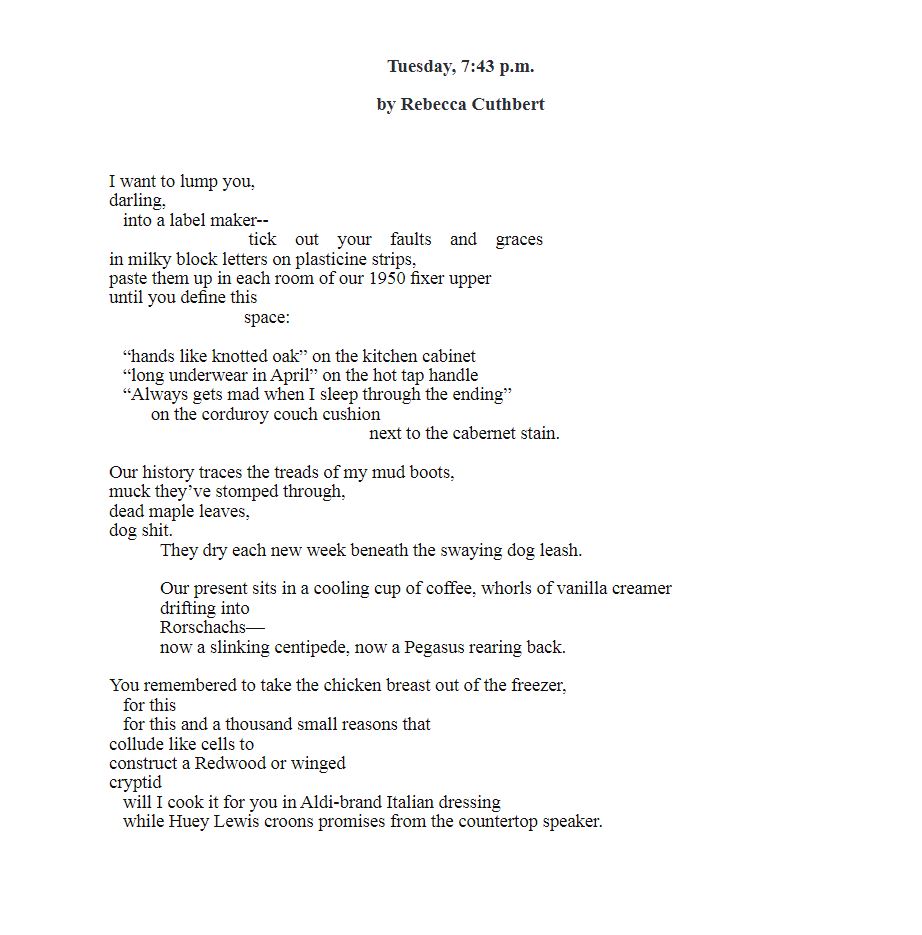
“Tuesday, 7:43 p.m.”

Published by Loud Coffee Press, Volume 2 Issue 1, Winter 2021.

Text:

I want to lump you,
darling,
into a label maker–
tick out your faults and graces
in milky block letters on plasticine strips,
paste them up in each room of our 1950 fixer upper
until you define this
space:

“hands like knotted oak” on the kitchen cabinet
“long underwear in April” on the hot tap handle
“Always gets mad when I sleep through the ending” on the corduroy couch cushion
next to the cabernet stain.

Our history traces the treads of my mud boots,
muck they’ve stomped through,
dead maple leaves,
dog shit.
They dry each new week beneath the swaying dog leash.

Our present sits in a cooling cup of coffee, whorls of vanilla creamer
drifting into
Rorschachs—
now a slinking centipede, now a Pegasus rearing back.

You remembered to take the chicken breast out of the freezer,
for this
for this and a thousand small reasons that
collude like cells to
construct a Redwood or winged
cryptid
will I cook it for you in Aldi-brand Italian dressing
while Huey Lewis croons promises from the countertop speaker.

“‘Bee’ Kind to Pollinators!”

Published by Forever Young.

Every gardener, from the casual petunia planter to the competitive crookneck squash grower, has gotten the memo: make your gardens pollinator friendly, because if we lose our bees, we lose our flowers and our food! But how does that awareness translate to actionable steps we can all take in our own backyards?

Jeff Tome, senior nature educator, marketing director, and “bee guy” at the Audubon Community Nature Center, spends a great deal of time and energy studying these tiny heroes and how to best preserve their numbers.

“What’s fascinating to me is that a lot of times, when people think about bees, they just think about honeybees,” Tome says. “But New York has over 350 different species of bees—there is just an incredible range and diversity of bees in this state.”

Regardless of species, though, all those buzzin’ cousins share the same short list of must-haves. They need steady food sources, constant access to water, places to nest and ride out the cold months, and to not be poisoned with fertilizers and pesticides.

Ring the dinner bell

As for what to plant in your garden, think variety and longevity.

“At the Audubon, we have pollinator gardens and butterfly gardens and native plant gardens,” explains Tome. “When we create them, we are focused on blossoms that last through all three seasons. Bees like a range of flowers, too.”

According to the Xerces Society for Invertebrate Conservation (xerces.org), gardeners in the Great Lakes region can do the most good by providing habitats for bees that are rich in wildflowers. Nectar is bees’ primary food source, and female bees bring pollen home to feed their little ones. Native wildflowers have the advantage of being low maintenance, as well—they require less water than non-native blooms and don’t need to be pampered. Plants like wild lupine, dotted mint, purple coneflower, and calico aster will keep the pollen party going all summer long.

But, notes Tome, don’t forget to think big.

“When you are planting a garden with bees in mind, think about trees and shrubs,” he says. “They like maples and redbuds. Flowering trees are one of bees’ main food sources in early spring.”

Broadening your definition of beauty might also be helpful. Think of it this way: every time you pull out a dandelion, a bee loses its dinner.

“Let the dandelions and violets grow!” says Tome. “Bees often depend on the nectar from all those colorful yard ‘weeds’ to survive.”

Less work for you and more food for them? It’s a win-win!

Provide fresh (shallow) water

This one is easy. All living things need water, but keep it shallow for bees, to reduce their chances of drowning or becoming exhausted by trying to swim. This can be as simple as filling a bowl with pebbles and water or setting out saucers in a few places throughout your garden. Make sure to check them often and refill as needed—bees won’t be the only thirsty visitors this growing season.

Give them shelter

Not all bees live in hives they build themselves. Some species live in ground nests or in hollow crevices in trees or dead logs. Some bees live in groups, while others prefer a solitary lifestyle. Also, bees may spend the winter months in different digs than they move into for the spring and summer, kind of like Western New York snowbirds!

“Bees in New York have different ways of ‘winterizing,’” says Tome. “There is no simple answer to how bees spend the winter.”

To help bees find the shelter they need, don’t do too much cleanup in the fall. If there is a dead log at the edge of your yard, leave it there. If a pile of leaves gets swept against your back fence, don’t rake it up. If you need to cut a tree down, consider leaving the stump alone to decompose naturally.

In warmer months, look for bee activity around trees and yard debris and along the ground, especially  before you mow. If you notice several bees hanging around in one spot, steer clear, and keep pets out of the area. The bees probably have a nest there and disturbing it could lead to stings.

Ditch the poisons

Harmful garden chemicals like fertilizers, fungicides, herbicides, and pesticides are killing bees at alarming rates. Bees are exposed to these toxins directly, through sprays; and indirectly, by eating poisoned nectar and nesting on or with contaminated material. The less clean, green space bees can access, the more their numbers will shrink.

“Forget the pesticides,” says Tome. “If you want bees to have a long life, you can’t poison their flowers and you can’t poison your yard.”

Instead, expand your garden horizons with new knowledge and adjusted thinking. Skip synthetic fertilizers and research natural compost. Plant native species that you won’t need to fuss over. Learn to love the cheerfulness of dandelions. Look up organic pest deterrents and plant insect- and disease-resistant varieties of flowers and vegetables. After all, isn’t the joy of discovery why you fell in love with gardening in the first place?

Creating a bee-friendly garden isn’t as hard as you may have thought. By letting the dandelions grow and leaving the brush pile to rot, it means less work for you! To increase your positive impact, encourage your neighbors to adopt the same practices, so bees feel welcome up and down your street. As a reward, you’ll all have healthier gardens, enjoy more flowers and vegetables, and hear the best song of the summer—the contented drone of bees buzzing around your backyard!

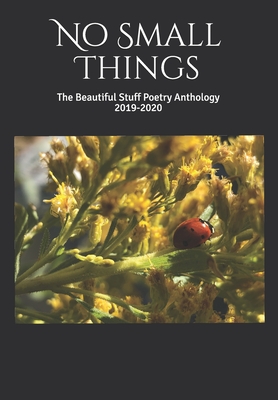
No Small Things: The Beautiful Stuff Poetry Anthology 2019-2020 Ft. “Intermission”

Purchase from bookshop.org.

From the in depth creative journey of The Beautiful Stuff Blog, comes the first contributor-led collection of poetry. Each poem a discussion of what it means to be human in the ways that we perceive our world, move through it, love, suffer, and learn. Each selection has been hand-picked by the veteran poet and creator of The Beautiful Stuff, S. E. Reichert. Enjoy an amazing journey through the sufferings and musings of some of the most talented poets of the year in this heartfelt and charming collection.

“Intermission”

Published by The Beautiful Stuff (thebeautifulstuff.blog).

“It’ll be just like playing house,” she’d said. “You’ll wear slippers, but not cologne. I’ll wear an apron, but only on Thursdays, only in April and June, and not if I’m not at the bus stop.”

She made me a key, but I saw the framed pictures, coffee rings and toast crumbs I didn’t leave.

Her hair smelled like hyacinths. She left the porch light off when she kissed me goodbye, ignored my declarations, told me not to creak the gate.

It’s August now and I sit behind her on the early bus. She focuses on her crossword or stares out the window, and I wonder if she’s pretending now, too.

“Rockets”

Published by Neworld Review, Vol. 11 Number 76 (NewWorldReview.net).

***

We ate charred hotdogs and yesterday’s leftovers at the picnic table on Grandma’s covered patio. It smelled like rain even in bright weather. Rot had seeped into the thin layered wood of the awning and up the legs of the paint-chipped table. I chewed my potato salad carefully, spitting pimentos onto the cement floor, but only when my mother wasn’t looking. It was July 5, 1987.

My brother Ben saw me turn and spit. He grinned. “Lolly’s spitting out food!” he yelled, gleeful to be the tattler. He reached into the metal chest cooler behind him and fished a can of root beer from the ice-flecked water.

Our mother stopped talking to Aunt Rena and turned to me. Then she scanned the ground and saw the dozen or so pimentos freckling the cement. “Lorena Grace. If you don’t act like a big girl you will not go to the beach with your cousins,” she said, her mouth turned down in the way we had all gotten used to.

Sometimes she called me her big girl and sometimes she accused me of being little; the conflicting statements left me wondering which one I should want to be. That day, I almost opened my mouth to say so, or some child’s version of that. I shut it and looked at my plate instead. I knew she wasn’t done so I waited, trailing the tines of my plastic fork through the ketchup and mustard smothering my hotdog, swirling one condiment into the other until I had a Spirograph of red and orange and yellow.

“Is there something wrong with the potato salad I spent so long making yesterday morning?” She stressed the word wrong, and for whatever reason, morning, too.

I stopped making art. No answer would be the right one. I knew this even at six years old. So I shoved another bite of dry potato salad into my mouth and chewed, not hunting out the sour-tasting pimentos with my tongue, mashing it together and swallowing. I choked down three bites before she turned back to my Aunt Rena, satisfied that I learned my lesson.

My mother and aunt resumed their discussion of my father, who had stayed inside with my uncles to watch a baseball game on television. Between crunching black hotdog skin and listening to Ben chug soda, I thought I heard my mother whisper something about my father “having a fair.” Immediately excited, I interrupted her to ask if there would be elephants to ride, then, too foolish to stop, I added that I hoped there wouldn’t be painted clowns, or at least not the sad kind. I had been chewing and a pimento slipped from my cheek and stuck to my chin.

She glared at me. “Eavesdropping is for church gossips,” she said. She habitually put down church gossips—still does—and I didn’t want to be lumped in with them. She didn’t mention talking with my mouth full, but I knew that was also bad manners. I slouched, ashamed. I tried to freeze, but my bottom lip betrayed me.

Little puffs of air came from my mother’s nose, and her chest heaved. She didn’t look away.

“Sorry,” I managed, but it was barely a mewl, muffled by the hotdog rind in my mouth. I swallowed the scratchy bite hard and tried again. “I’m sorry.” Aunt Rena saved me by having a very sudden and loud realization that she hadn’t yet told my mother about her bumper crop of heirloom tomatoes. My mother turned back to her and stopped huffing. I was always extra nice to my aunt after that.

Across the table, Ben finished his third hotdog and belched. He wiped his mouth on the back of his hand, trailing an orange smear of ketchup-mustard on his knuckles. He left it there. I thought about telling our mother that he hadn’t eaten any potato salad, with or without pimentos, and adding that I saw him take two dollars from our grandmother’s dresser earlier. Forgiveness by deflection.

But next to me, my mother twisted a paper towel in her lap, tighter and tighter until it looked like a thin white whip. Aunt Rena was still talking; I caught “Early boy” and “Beefsteak,” but my mother didn’t seem to hear her. I decided not to tell on Ben, who belched for the second time without saying “Excuse me.” He got up to chuck his empty plate in the black garbage bag tied to the end of the table. Then our cousin Will came running from the front yard, smacked Ben on the shoulder and yelled “It!”

Ben’s heels kicked up dirt clods as he ran after Will, and they disappeared around the side of the house. Will is my Aunt Rena’s youngest. As boys, when Ben and Will got together they formed a secret club, and I wasn’t allowed to play their games. Another cousin, Jennifer, was there that day, but she was a teenager; all she did was read magazines, stretched out on Grandma’s old fold-out lawn chair in a two-piece bathing suit. When I finally finished my hotdog and hid the rest of my potato salad under a napkin, I ran off to play alone. My mother didn’t notice when I got up.

A flagstone path wound from the patio to the front yard and I followed it, avoiding the cracks between the stones. Closer to the road, a Virgin Mary statue stood weeping, her pale arms stretched out like she was asking the slow-passing cars for help. I posed next to her, mimicking her stance, wondering what the people blurred behind windshields could do for us.

The Pakisandra planted around Mary’s feet spilled outward like tar tipped from a bucket, its thick growth unchecked since Grandpa died two summers before. I waded into the knee-high creepers, liking how my feet disappeared, ignoring the small clouds of gnats I disturbed. I pretended it was quicksand, that Mary was a sad orphan sinking in it, that I had to save her and if I did she would grant me three wishes and then we would become soul sisters. I renamed her Magnolia, since I thought the name Mary was boring. But after a sharp rock I didn’t see slipped into my sandal, I abandoned the game and her.

For a moment, I considered looking for the boys, but they’d only accuse me of being a tag-a-long, like always. I spent a few minutes wishing I had a puppy, or a baby sister, or a mother who’d paint my nails when she painted hers. Like always. Then I wandered into the backyard.

A three-sided fireplace squatted in the corner of the shady lot like a surly toad. A rusted grate rested on its stone walls, cooked on by my uncles but never cleaned. I watched as a crow landed there and pecked at a piece of aluminum foil stuck to the grill. He seemed uncertain, like he wasn’t sure he really wanted the bright piece of metal. He cocked his head, regarding it with his right eye and then his left, adjusted his position, pulled at it and let go. He ruffled his wings, exasperated. He repeated this until a larger crow landed next to him and in one smooth, quick motion, ripped the foil from the grill and flew away. The smaller crow pulled his head back and cawed, indignant or bereft. I felt sorry for him and hurried back to the covered patio; my mother and aunt were gone. I dug in the picnic trash until I found the piece of foil that Grandma had used to cover the fruit salad. I pulled it out and ran back to the fireplace but the crow was gone. I looked up, trying to find his sleek black body in the branches of the walnut trees overhead. I spotted two squirrels but no birds. I crunched the foil into a ball and set it on the grate in case he came back.

Damp dead leaves had collected in and around the base of the fireplace, too wet and thick to burn in the small fire my uncles had started there earlier to cook the hotdogs. I poked the toe of my sandal into the musty pile, flipping back a few layers. Potato bugs scurried away from the light. A curl slipped out of my ponytail when I crouched down to look at them and I tucked it behind my ear. A fat potato bug curled his body into a tight ball when I caught him on the run. I rolled him between my fingertips like a piece of clay. Then I balanced him on a dry leaf, rocking him back and forth while humming “Row, Row, Row Your Boat.” He only fell off the edge twice. I put him back in his wet home and covered him with leaves, patting the top into place like I’d never been there.

I walked around the house to the driveway, noticing where burn marks from last night’s fireworks blackened the concrete. One of my uncles had bought them at a discount shop over the Pennsylvania state line and half had been duds. But we cheered for the ones that lit and whistled, their bright lights reflecting in my father’s glasses. The lawn chairs were still out on the driveway, and I sat in one. The canvas cut into my legs so I moved to the flat concrete. It was warm from the sun but not so hot that it burned, and I lay there pretending to be a pie baking. I would be apple. My mother never made cherry and Dad was allergic to rhubarb.

***

My cousins had gone down to the rock-and-grit beach at the end of the road and I was supposed to go with them. I meant to. My mom had helped me into my stretchy turquoise bathing suit with the neon straps and warned the bigger kids not to let me go in the lake past my waist and not to take their eyes off me. I had grabbed my sand pail and my pink shovel, hung a bright orange towel around my neck. I was going to build a fort for the rocks in my bucket that I had drawn faces on with a Sharpie. There was a whole family and a cat and an elephant. A couple houses down the road, though, lagging behind on short legs, I realized I had forgotten my floaties. I couldn’t go in the water without them—it was a rule. So I turned back. I thought I could catch up after.

The adults were in the kitchen, the sounds of running water and Rod Stewart and Aunt Rena’s laugh coming clear through the screened window. I walked beneath it, crossed the patio and went into the garage, finding my floaties in our beach bag. But one had deflated. It would take forever to blow it up by myself, and I knew my cousins were getting farther away. I walked out of the garage, intending to go in through the back door and find a grownup.

Then I saw Ben crouched low over a cardboard box next to the fireplace. The box had words on it printed in bright yellow. I couldn’t read them—they were too big for me. I recognized the pictures, though. It was the box of leftover fireworks from the night before. My uncles had put it on a high shelf in the garage and told us not to touch it.

“What are you doing?” I asked. I wasn’t tattling. I just wanted to know.

He put his finger to his lips and smiled—he never smiled at me, and now we had a secret. So I smiled too, dropped my floaties and my shovel and my towel and my sand pail, and walked over to him. My footsteps didn’t make a sound on the soft moss.

“What are you doing?” I asked again, whispering this time. I looked toward the kitchen window.

“I didn’t want to go to the beach,” he said. “And Will was scared to get in trouble. I told Jennifer I’d come back to look for you.” He held Grandpa’s old Zippo lighter in his hand, the silver one with the American flag stamped on it. He didn’t ask why I’d fallen behind. I didn’t ask where he’d gotten Grandpa’s lighter.

“Can I do one?” I asked.

“No,” he said. “You’ll mess it up.”

I was hurt.

“I mean, you’re too little,” he said then, “and I think it’s better if I just do it. But you can watch, okay?”

I nodded, agreeing to the terms of being there.

He picked a bunch of firecrackers out of the box. To me they looked like colorful cigarettes all tied together on one end, with a string trailing down by my brother’s knee.

“Get back,” he said. “Watch this.”

I moved a few feet back.

He flicked the Zippo and blue fire spit out near his thumb. He lit the long wick and let the flame dangle for a few seconds. When it was just an inch from the firecrackers, he threw them into the stone fireplace. The noise they made was like loud popcorn. I jumped up and down, giggling.

We both looked toward the house. No one came

“Do it again!” I said, forgetting to whisper. He forgot too and picked something else out of the box. It was bright purple and shaped like a top, with a needle in its center. A wick stuck out of its side.

He pushed its needle point into a raised clump of moss on the ground and lit the wick. The disk fizzed, then spun, orange sparks flying from it in a circle like a UFO getting ready to take off. It broke free of the moss and began to move, first toward me, then away toward my brother. It bounced off his sneaker and sparks hit his ankle before it slowed to a stop against the base of a nearby walnut tree.

I ran over to him. He rubbed at his ankle and I smelled something awful, but he just laughed. I leaned closer. Little blisters bloomed on his skin and the blonde hairs there curled black. I looked at the house and inhaled, ready to yell for our mother. But he grabbed my arm. He said, “One more, okay, Lol? Then we’ll run down to the beach and catch up with Jen and Will.”

I considered my limp floatie. Maybe he would blow it up for me. I exhaled my ready breath and nodded.

He walk-limped to the box and picked up something that was about the size of a Flintstones Push-pop. I thought it was beautiful. It had a pointed top like a castle tower and rocketship fins on the bottom.

“Yeah,” said my brother, but not really to me.

He set it on the ground, pointed end up, working its base into the same moss that had braced the spinning top. He felt around the bottom until he found a coil of string and stretched it across the ground toward him. Then he motioned for me to step back again and pulled the Zippo out of his pocket.

He reached to light it, then looked over his shoulder at me. “Farther,” he said.

I took one step back. He shook his head.

“I want to see,” I whined.

Ben stood and walked over to me, grabbing my thin shoulders. He walked me back and to the left, so I stood next to the fireplace. “Here,” he said. “Stay.”

I stuck out my lip but didn’t move.

He lit the wick and stepped back. The little firework crackled and hissed, then shot up with a whistling sound. I tried to track it in the air, but lost it in the tangled tree branches. Ben couldn’t see it either. Both of us were looking up, hands shielding our eyes, when we heard a pop and roar.

The rocket had come back down, several feet from its launching pad, and straight into the box still half full of sparklers, firecrackers, and snappers. Flames darted from the cardboard and rolled down its sides. Ben turned around and tackled me, flattening me on the damp ground. Then he squished me between himself and the stone fireplace, tucking my head into his chest and pinning it there with his forearm. I couldn’t see and the stone grated against my back. I knew Ben was peeking over the fireplace, watching the display. I could tell by the way he drew in his breath and held it.

I listened to the pinging and popping of the fireworks for what seemed like a long time, imagining their wicks catching one after another as the box burned. I could hear crackling and wondered what color sparks and smoke they gave off. I wanted to look but couldn’t move. Then I heard our uncles cursing and my mother screaming. We were dragged out from behind the fireplace.

Our mother slapped Ben. His head flopped to the side, face turned to the ground. He left it hanging like that.

“What were you thinking!” she yelled, her voice sounding like someone else’s. “She’s just a baby! She could have been hurt!”

Ben cried without making noise; I could tell by the quivering of his shoulders. I thought of the shiny white blisters on his ankle then, but he didn’t point them out. Our father stood to the side, his mouth opening and closing. The two of them looked like actors in a silent film, but then my mother broke in again.

“You know you are forbidden to play with fire Benjamin! You know that! We agreed!” Her voice rose in pitch and volume. There was a looseness about it that frightened me.

I retreated a few steps, back to the safety of the fireplace. I wanted to speak up, to tell her to look at me, that I was fine, that he was hurt and not me. That he had saved me. But my voice wouldn’t work

She kept screaming. “How could you do this? How could you disobey me like that!”

Then she remembered me. I thought she might hug me, or slap me too. I braced myself for either, but she didn’t touch me. “Why in the hell aren’t you with your cousins?” she said.

I pointed to my deflated floatie on the moss behind her, hoping it would do for an explanation. I looked at my father for help, but he was watching my mother.

She walked over to the remains of the cardboard box, its wispy edges curling into white ash. She picked the whole mess up with her bare hands and chucked it into the fireplace, then went into the house through the back door.

Grandma and Aunt Rena followed her, arms crossed tightly over their chests. Our uncles walked into the garage, muttering to one another, and I heard Grandpa’s old fridge clink open. Dad noticed Ben’s leg.

“Christ,” he said. “That needs ice.” He put a hand on Ben’s shoulder and led him over to the patio. Ben sat on the picnic table and Dad scooped a chunk of melted-together ice cubes out of the cooler. When the ice touched Ben’s ankle he cursed. Instead of scolding him, Dad just said “Take it easy.”

I stayed where I was, watching the last of the cardboard box crumble and fall into the damp leaf pile. I wondered if Ben would talk to me when we got home, but figured, like always, that he wouldn’t. I wanted to tell him that going to the beach hadn’t seemed that fun anyway, and that I wouldn’t squeal on him for still having Grandpa’s Zippo in his pocket, or about the two bucks, or about anything else, ever. I wanted to look at his cheek, to see if Mom had left a mark, to say I was sorry, in a way, that she hadn’t hit me instead, or at least, also. I wanted to ask if his ankle still hurt. What color smoke the fireworks gave off. How bright the sparks really were.
“Wedding Quandary: Tech or Tradition?”

Published by Buffalo Spree Magazine.

When it comes to wedding planning, dress, color scheme, and menu decisions are the same as ever, but when it comes to music, invitations, and registries, brides and grooms now have techier alternatives to consider. And the choices aren’t always easy, given that both traditional and tech options have advantages.

Band or DJ?

Great music can keep a party moving, while humdrum tunes can have guests stifling yawns by 9p.m. While bands and DJs remain popular choices, creating a wedding playlist and streaming from a device is now a viable alternative. In choosing, couples should factor in budget, personal taste, and ambiance, as making the right decision means prioritizing these items.

Consider what you want and how much your budget can afford, knowing that the higher you go, the less you’ll have for other wedding needs. Borrowed & Blue’s (borrowedandblue.com) Audra Jones, in “Bands v. DJs: Which Is Right for Your Wedding?” notes that “wedding bands are, on average, significantly more expensive, typically running from $3,000 [to] $10,000.” Check local and new bands, too; their costs may be significantly less.   

“Few things can energize a crowd quite like live music,” says Jones. “There’s just something about the beat of the drum and the energy of the musicians that puts everyone in a good mood and gets feet tapping!” Live musicians are also great when you’re going for an overall wedding theme or mood. Roaring Twenties wedding? Island luau? Cinderella’s ball? No problem. Most musicians will even dress the part to add flair to the evening. And, Jones notes, even folks who don’t dance enjoy a live show.

For more varied sound, or to hear songs as recorded by your favorite artists, a DJ fits the bill. You can provide playlists, as well as specific instructions: e.g., do not play the “Chicken Dance” no matter how many times your second cousin requests it. If your venue is small, consider that a DJ’s equipment likely takes less space than a band. DJs are more affordable than bands, and can take breaks without leaving the party sans music.

Band or DJ, do your homework. Don’t sign a contract until you’ve checked out a performance or event. Pay attention to how they read a crowd; they should know when it’s time to pick up the tempo and when to pull back for a cozy slow dance. Also make sure you get along; whoever provides your music should understand the vibe you want for your special day.

Hooking up your own device and streaming music for the reception is by far the most affordable route, but preplanning is critical. Do you need WiFi? Are the speakers at the venue adequate, or do you need to bring or rent your own? Is someone capable in charge of setting it up? Remember that a dead battery, glitchy reception, or a forgotten cable could mean no music at all. Do a test run—do two—and have backup to avoid mishaps.

Paper invitations or e-vites?

When considering paper vs. electronic invitations, it again comes down to budget and preference. E-vites are much less expensive—often pennies on the dollar, in comparison—and there’s no additional cost for postage. When you hit “send,” off they go, and replies come back just as fast. Some wedding apps will even keep track of responses for you, which makes planning a snap.

But, as Eliana Dockterman highlights in Time’s (time.com) “With This App, I Thee Wed,” “Going high-tech sometimes means sacrificing formality. Even the most beautiful online invitations can send a more casual message.” She then quotes Jacqueline Whitmore, an etiquette expert who says invitations set the tone for the wedding: “If you get a beautifully engraved invitation in the mail where someone took the time and money to hire a calligrapher, that notes the wedding is much more formal. If you send out an e-vite, that sends another message. Maybe the wedding is less formal.”

If you or a friend have some skills, a cost-saving in-between option is designing your own invitations, and printing them at home. Also consider how you want to save mementos of your big day. E-vites can be added to a wedding website or online album, whereas paper invitations can be framed or pasted into a wedding scrapbook.

“Stuff” or money?

The old gift registry debate—is it impersonal to provide a preselected list of “gifts”?—has been replaced by a new one: does the couple ask for gifts from the registry or contributions toward a honeymoon, house, or (gulp) paying down student loan debt. Registering for “wrappable” gifts can be a lot of fun—browsing through your favorite store with a scanning gun that makes you feel like a superhero, or sitting with a laptop, clicking all the kitchen gadgets and throw pillows—but if your apartment is a studio, your cooking skills max out at pouring cereal, you can’t imagine ever needing a linen napkin (monogrammed or otherwise), and you’d really like to go to Hawaii, money might seem a lot more practical.

Linda Marx, for the New York Times, claims in “Passing on Wedding Gifts, Millennials Prefer Cash,” while it was once considered tacky to ask for money, younger generations are changing the etiquette. “When it comes to registering for gifts, a generational sea change has developed, with more and more millennial couples asking their guests to consider holding the gravy ladles and shelving the dishes in favor of gifts of a very different sort,” says Marx, who says they prefer “cash, home-repair gift cards, and lavish honeymoon experiences.”

But it’s not just twentysomethings who don’t want crystal and china. Couples who get married later in life may already have all they need—hutches and silverware drawers are full, houses are furnished, and walls are decorated. So, gifting an experience may be more appreciated. Many registry websites have buttons guests can click to fund honeymoon trips: e.g., they can buy the newlyweds a whale watch tour, a salsa dancing lesson, or tickets to a show.

As Marx says, “The wedding-gift concept has morphed into doing what makes the couple happy.” That may mean a new blender, or not. Whatever you choose, remember your manners. Give guests different price options, so those with less disposable income can still contribute. And, if Aunt Gert gives you a slow cooker you didn’t ask for, tell her it’s just what you needed, and try making some chili cheese dip in it. You’ll never be sorry you did.

A WordPress.com Website.

Up ↑