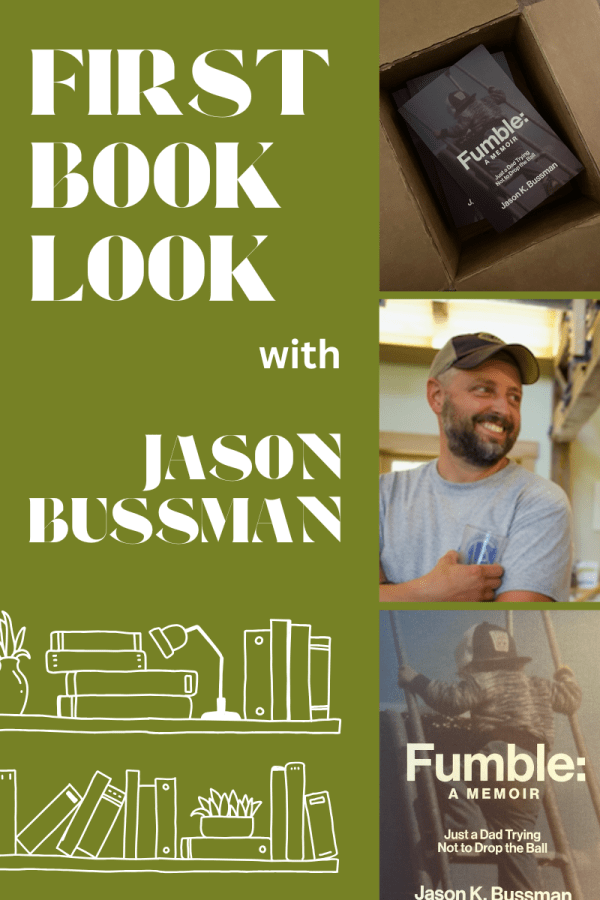
FIRST BOOK LOOK: Jason Bussman’s FUMBLE

First Book Look is an ongoing interview series that gives new authors a chance to talk about their debut titles.


Q: What is your new book called, and what is it about?

A: Fumble: Just a Dad Trying Not to Drop the Ball is a memoir about moments in my life when I have either dropped the ball or stumbled in some way as a parent. The first half of the book consists of standalone essays from fatherhood: moments when I learned a valuable lesson on how to interact with my kids. The second half is a compilation of moments from my childhood when I learned something. The hope is that these stories help shine a light on the dad I wrote about being in the first handful of essays. These two halves are separated by a halftime of sorts: two stories in which my wife is the key piece. 

Q: What was your biggest challenge in writing this book or in getting it published? 

A: The biggest challenge for me was perseverance. The constant state of rejection that you live in as a writer is something overwhelming and can be very unbearable. Luckily for me, I have a solid support system in place both at home and from my friends and colleagues. I just had to keep telling myself: all you need is one person to like it. Once that happens, everything clicks. And it happened. 

Q: What are you hoping readers will get from your story? What do you hope to leave them with?

A: I hope these moments I share are relatable to families: both parents and kids. By embracing my fumbles, I am hoping that people can laugh and embrace their own moments when they may have stumbled as a parent, or a son or daughter, brother or sister. This light-hearted look in the mirror of a memoir is hopefully something that one can walk away from with a smile on their face. 

Q: What has been your favorite part of being a new author, so far? 

A: I have had several conversations on some of the questions I raise in this book, and I find that is one of the most rewarding parts of being published. The conversations about telling my daughter to stand up to the boy who pulled her hair because he “likes” her, or whether or not I truly believe that a Star Wars character was as powerful as I think she was. The amount of support I have received from my community, colleagues, and family has been extremely humbling. 

Q: What are you working on next? 

A: Book Two of the Bussman Saga is currently in progress. I have a working title and a list of moments that I am hoping to convert to another collection of standalone essays. This one will be almost completely centered around me as a stumbling and bumbling father and husband. I also have an idea for one of my unpublished essays to become a much larger book-length piece centered around me as a fifth-grader. But that’s not ready to talk about quite yet….

WEBSITE: jasonkbussman.com

FACEBOOK: Jason K Bussman

INSTAGRAM: @jkbussman

SUBSTACK: @jkbussman

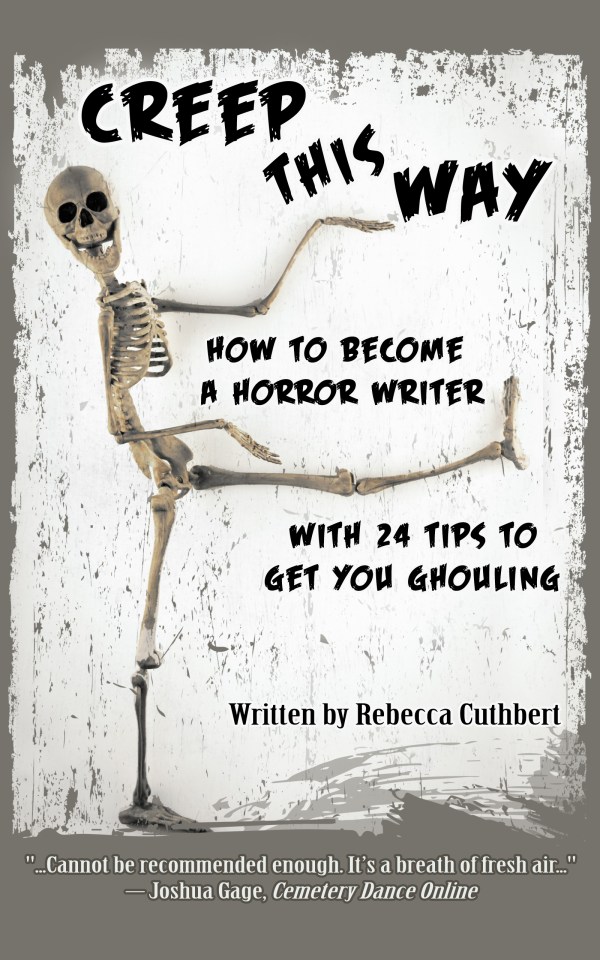
CREEP THIS WAY has launched!

Today I am excited to share that CREEP THIS WAY: How to Become a Horror Writer with 24 Tips to Get You Ghouling, is officially out in paperback and ebook format from Seamus & Nunzio Productions.

If you would like to get a copy for yourself, here’s the link!

CREEP THIS WAY is half memoir, half craft text, with advice on how writers can get a foot in the door of the horror genre. Lots of the advice and vignettes are relevant to all writers, though, and Christopher Ryan (the publisher) and I hope that many writers at all levels will find something useful in the book’s pages.

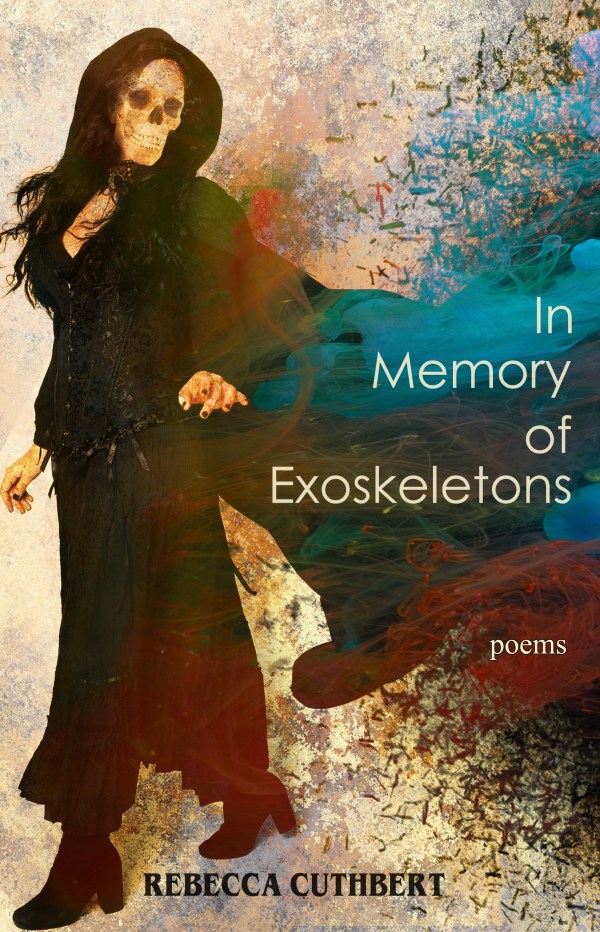
As with my first book, In Memory of Exoskeletons, anyone who reviews CREEP on Goodreads or Amazon will be entered in a drawing to win a copy of my hybrid collection, Self-Made Monsters, set to be released this fall from Alien Buddha Press.

An in-person book launch celebration is planned for March 28th on the SUNY Fredonia campus, hosted by the Department of English. The event will include a reading and book signing, with copies of CREEP THIS WAY available for purchase, along with copies of In Memory of Exoskeletons, The Start (RebellionLit), Soul Scream Antholozine (Seamus & Nunzio), The Crow’s Quill (Quill & Crow Publishing), and poetry broadsides. Swag free with book purchase, of course!

Submission Etiquette for Writers & Editors

Most writers and editors have received more than their fair share of less-than-polite treatment: from getting ghosted to being cursed in social media posts to finding angry email replies in their inboxes. Recently, I have been stunned by a mean rejection email and disappointed by the sound of crickets in the wake of follow-up queries. I thought it would be helpful to ask seasoned writers and editors for their thoughts, in hopes that this little blog post can help us all be kinder to one another. (Also, reading this is better than learning through trial and error, as I have!)

Manners for Writers:

Follow submissions guidelines. Yes, we all make mistakes, myself included–overlooking a detail or not double-checking the news from one of those submissions round-ups–but do make an effort to read the rules and follow them.

From Leon Perniciaro, Editor of Haven Spec Magazine and reader for Uncanny Magazine: “[M]ake sure you follow our guidelines, whether for Uncanny or Haven Spec, and make sure that the cover letter is addressed to the right person and that you get people’s names and pronouns right.”

Do not respond to rejections, unless it’s a “Revise & Resubmit” situation. Take the R and move on.

From Alexis DuBon, co-editor of No Trouble at All by Cursed Morsels Press: “Please don’t respond to rejections. Don’t ask why. Don’t ask for feedback that wasn’t offered. Once a story is rejected, the interaction is over and your story is free to send back out. If you’re curious how it could be improved, seek out beta readers who will give you honest and helpful suggestions. This is not the job of an editor who has rejected hundreds of other stories that they also haven’t given feedback on. It’s only fair.”

From Evelyn Freeling, editor of Les Petites Morts by Ghost Orchid Press: “[Responding to rejections with] demands about why your story was rejected, why it took so long to get a response, etc.–isn’t okay. At the end of the day, most editors also have day jobs so be respectful of their time and energy.”

And if you do get an R&R, appreciate it for the opportunity that it is.

Perniciaro: “If you get a rewrite request, work through the story in good faith (editors can always tell half-assed edits!) and don’t be afraid to ask clarifying questions.”

-Do not tweet (X?) or post about a specific editor who rejects your story. I admit it was super hard not to publicly post the name of the press who told me writers like me are a dime a dozen. (I absolutely told my friends in a closed thread!) By the next day I didn’t feel so bad about it, and I would have regretted a public tantrum.

DuBon: “Authors, please don’t tag publishers when tweeting about story rejections. It’s super awkward.”

Be patient. If the press or publication states that the wait time might be eight months, give them eight months. Give them nine. Then send a polite query if you still haven’t heard back–and to make it easy on them to answer you, include the title of your submission, its genre, and the date on which you sent it.

From Julie Stevens, editor of Deathcap & Hemlock: “I suppose just being a bit patient with us is my favorite thing. I have batches of acceptances to publish and so sometimes people scheduled later on don’t hear from me for a bit.”

Include reader advisories if and where the editors ask for them. Lots of folks call these “content warnings,” though at work (I teach college creative writing classes) I learned that the word “warning” is problematic, as it implies readers may not be in control of their own feelings and reactions. The word “advisory” is neutral and acknowledges the reader’s power of self.

Send only edited, proofread work. Mistakes and typos distract editors and slow down reading. Swap drafts with writer friends so they can catch what you didn’t.

Ask before announcing. This is another thing I had to learn along the way. Sometimes editors want to make their own big TOC announcements, or perhaps they haven’t made it through all the subs yet, so putting the news out there yourself can step on their toes.

Perniciaro: “[I]f you get a story accepted, shout it from the rooftops as soon as the editor gives you the go-ahead! They are just as excited to see your story out in the world as you are.”

Manners for Editors:

Communicate with authors. Fortunately, many editors are already great at this. Those who aren’t might find good advice here.

Jonathan Gensler, author (stories in Cosmic Horror Monthly, Soul Scream Antholozine 2, etc.): “I appreciate it when they notify you that your submission has been received (not all do that, even in this digital age); I appreciate knowing if/when a first reader has passed a story along for a second round of consideration; and if a story doesn’t quite make it to publication, but was close, I appreciate any notes about what might have made the story a better contender.”

Freeling: “Because I’m a writer, I did try to provide generalized feedback [for rejected Les Petites Morts submissions] on why the piece was being rejected–typically it was pacing, atmosphere, or not meeting the call somehow–not erotic enough, not directly or obviously inspired by a fairy tale/myth/folklore. I also tried to name something I did enjoy about the piece in every rejection because again, I’m a writer and I know rejections sting.

Perniciaro: “For Uncanny, we try to respond to every submission within 30 days, either with a hold notice or a pass. For Haven Spec, we try to reply within 10 weeks, and at this point, we manage that for about 95% of submissions. Some months are tougher than others, though.”

Stevens: “My very first submission as a writer a few years ago was one where I got no response, and only found out when I saw the TOC on Twitter. I can’t do much about the sting of rejection but I absolutely would never want to put someone in that position–it did not feel like my work had been valued. I read every word, I’m thankful I’ve been sent what I’ve been sent.”

Christopher Ryan, editor of Soul Scream Antholozine: “I explained all of my intentions [to Soul Scream contributors], and then I repeated them in our contract that expressly says I am buying one time rights to publish, and they own the copyright and everything else. I’ve researched several different contracts to make sure I had fair and very clear contract language that would protect the writers and, of course, protect my company and myself.”

And provide updates when possible. Writers know time is limited, but even a quick mass email of “We haven’t forgotten about you; we’re still reading!” is great. And if it’s a contest, let readers know where they can find results as soon as they are posted.

Perniciaro: “For Uncanny and Haven Spec, everyone who submits gets a receipt acknowledgement, with Uncanny having a system for letting people know where they are in the queue (and if their piece is under review, if rewrites have been requested, if it’s been rejected, etc.).”

Stevens: “One thing I think that has helped communication is that I now send a note after the contract is signed to let authors know what to expect next. I’m sure some more seasoned writers get that email and wonder why I am over-explaining but I think it helps newer writers not feel like they’re missing something!”

Ryan: “[W]hen adjustments were made [in the Soul Scream publication timeline], I sent out emails so that people could stay current with what the situation was.”

Avoid publicizing impossible timelines.

DuBon: “[D]on’t advertise timelines you can’t adhere to. Don’t set dates that you might not meet. Only announce when people should expect something to happen once you are certain. […] I say that because it creates unnecessary stress on both sides.”

Ryan: “I was very careful not to give a specific timeline, because I know that it is easy for small independent companies to run into difficulty with, for example, Amazon or other platforms. I needed to have that flexibility.”

Please accept simultaneous submissions. Unless you are promising to have responses out within a week of submission (see above), it’s crummy to tie up people’s work and hold them back from other opportunities. Responses take a long time and rejection is the most likely result: Allow writers to cast a wide net.

DuBon: No simultaneous submission is archaic and unreasonable and unless you’re The Dark, no one is taking it seriously.

If you can, pay authors, and be upfront about that information.

Gensler: “[T]he biggest thing I appreciate is when a publisher values your work enough to pay, even a token rate. Publication for free copies, or perhaps even for mere ‘visibility,’ seems to devalue the whole writing process, and helps contribute to the situation we are in, where even the most financially successful creative outlets in the world feel empowered to devalue the creations of writers. Even a token payment [goes] a long way to establishing the inherent value in our work as writers.”

Don’t send mean rejections. I won’t explain more; adults should know better.
On not self-rejecting…

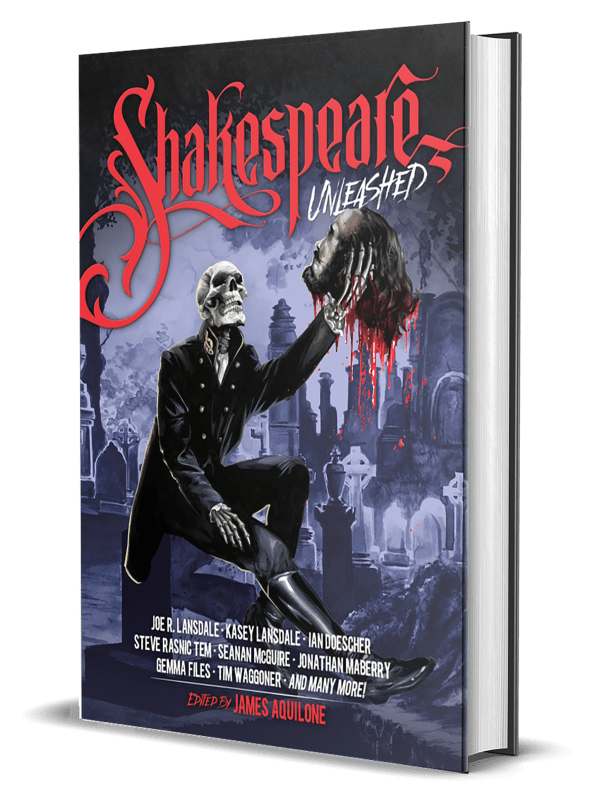
Photo: Shakespeare Unleashed, edited by James Aquilone for Monstrous Books and Crystal Lake Publishing, which I submitted to AND THEY LET ME IN!

It’s mid March, the sun is shining, I’m in a relatively good mood, and I’m thinking about self-rejecting–or, more accurately, NOT self-rejecting.

I hear a lot, and I used to say sometimes, “I’m not going to bother submitting to that. I’ll never get in.” Now I’m like, “How do YOU know? You aren’t the editor. Submit that story!” (Or poem or essay or manuscript.)

Have you ever submitted a story to a submissions call that seemed like it was MADE for your story? Like they were a perfect match–everything the editors wanted, your story had? And then, your story got rejected anyway? And you were thinking, WTF, I gave you everything! Yeah. I think we’ve all been there.

So here’s the thing: IT WORKS THE OTHER WAY AROUND, TOO.

You might think your piece isn’t “good enough,” or that it doesn’t quite fit a theme, or does in a WAY, but not in all the ways. Maybe you think the editor has a pronounced different style or aesthetic.

But. Like. What if your piece is just the variety they need? What if they don’t have that narrative arc or subject or theme in any of the other stories they chose?

Jenny Kiefer, author of That Wretched Valley (Quirk Books, 2024) and owner of the popular Kentucky horror bookshop Butcher Cabin Books, has gotten several publications with just that line of though. “Honestly most of my acceptances have been things where I just sent a story to a market I didn’t think would like it. I’ve experienced rejections more when I’ve thought it was perfect for the place I submitted to. I was recently accepted to F&SF for a body horror story–I would have never thought they would like it, but I submitted anyway.”

Especially if there is no submission fee (and whoa should I write a post just about submission fees), SEND IT. There is, for real, no risk. And, see blog post about #100rejections for why we should be trying to send out enough submissions to rack up 100 Rs by the end of the year, be they form or personal.

Rae Knowles, whose novel The Stradivarius will be out soon with Brigid’s Gate Press, knows this, too. “There was a pro-pay call that I knew was getting a ton of submissions,” she said. “It was outside of my usual genre, and I wrote a story, tweaked it, tweaked it, and tweaked it some more. I stressed so much, feeling it had NO chance of being accepted, but on one of the last days of the submission window, decided to send it in. To my SHOCK, it was accepted. Lesson learned, never self-reject!”

Author and editor Alexis DuBon keeps a hand over the mouth of her inner critic:

“Try to think about whose voice it is telling you your story doesn’t work,” she recommended. “Is it your own? Or is the reason you’re hesitant something other than ‘Yeah, this story about biblically accurate angels probably doesn’t fit this call about swamp monsters.’ We bring a lot of baggage into decisions where it doesn’t belong.”

Waylon Jordan, author, horror journalist, and EIC of Off Limits Press, talks over his self-rejection impulses; he drowns them out. “I don’t know how many times I’ve had to tell myself, ‘You have just as much right to submit your story as anyone else.’ I see authors invited to calls and talk myself out or submitting because I’m not ‘in their league.’ The imposter syndrome is alive and well and I deal with it all the time. The other thing I have to tell myself is: I’m not Stephen King (or whoever famous author your want to insert). I can’t do what he does. But you know what? He can’t do what I can. Someone wants to read what I can give them.”

Author Katherine Silva (The Wild Oblivion series) picks what she submits to carefully–if she needs to get other things done, or needs to take time for herself, she’ll skip a sub call. So, ask yourself: Are you self-rejecting because of a low-self-esteem day, or, do you just have other things that need to come first?

Zach Rosenberg, author of the forthcoming Hungers As Old As This Land, gives himself a pep talk: “This is a story only you can tell and it should be told.”

Also, related to the topic self-rejection, remember that if you burn yourself out or get too discouraged by a particularly rough R (or a volley of them), and you decide to QUIT writing altogether, you are self-rejecting from the entire world of publishing.

Kiefer has a way to manage that feedback–because yes, you will get more rejections than acceptances. That’s just reality. But, if you don’t want to see those Rs every day, do what she does:

“What did help [with rejections] though was to set up a separate author email address, so I could control how much I saw. At one point I even had a friend who would monitor it and only tell me good news so I could submit without having to see the waves of rejections.”

Final decisions on publication come down to the EIC or a small team. So, it’s not like the industry voted on your work. It’s one person’s subjective decision, in most cases. And subjectivity could mean anything: maybe they’re sick of zombies or whatever tropes your narrative features. Maybe they already have something similar for that issue or anthology. Maybe they just–and this sucks, but it’s also OKAY–didn’t’ like your story enough to put it in.

But someone else will.

Unless you don’t send it to them because you self-reject.

I guess what it comes down to is this, which I said to more than one struggling writing friend: Does writing (and everything that comes with the process–drafing and revision and feedbacking and submissions and rejections) bring you more pain or more joy?

If it’s the first one, go ahead and quit. Life is short. Find something you like better.

But if it’s the second one…

DRAFT, REVISE, EDIT, and SEND IT!!

Book Launch!

The day is here–and like most long-anticipated events, ot came on slowly and then all at once. I have a book in the world. It’s real. It exists. People are ordering it. (You can too: click here!)

Stephen King says, in On Writing, that publishing books requires talent, desire, ambition, and luck.

Luck.

He’s right. And I’m a lucky gal.

The collection only exists because, by chance, I saw a submission call from Mausoleum Press for their 2022 chapbook contest. I realized I had enough poems to form a little collection, and sent it in. While I didn’t win the contest, the editors wrote to me to say I made their shortlist (that’s like a final round, to some degree), which was very kind and also encouraging. I thought, why not send it to some other presses?

And I sent it to something like ten of them. Not long after I did, the publisher at Alien Buddha Press wrote back to me to say he’d like to publish it. When I opened that email I went into a kind of elation-panic. I was so happy that I was short-circuiting (I do that a lot, emotionally). I didn’t know what to DO.

But, luck gave me many wonderful friends in the writing community, and they guided me through what to say and send to whom, and in what order (I had to notify the other presses that I’d had an offer, give them a chance to make one or cut me loose, all while assuring Alien Buddha Press that I was excited and eager to get back to them). All was taken care of in a week or a bit more, and I signed a contract with ABP!

More luck: I’d come across the lovely cover art of Chad Lutzke, and it turns out that a cover I liked was available.

More luck: Every single person I asked to read an early copy of the collection and write me a blurb said yes. So I ended up with something like eleven or twelve blurbs that make me want to cry, they’re so kind.

More luck: The publisher at ABP just happens to be endlessly patient, and worked through lots of formatting questions and adjustments with me.

More luck: I have lots of supportive friends and family members, and as soon as they could, many of them ordered a copy. One friend ordered five copies!

Thank you to each and every person who has made these fabulous things happen for me, and who has cheered me on throughout the process (especially Joel). You all are my good luck.

Hard Work Works (thank you 2022!)

This is basically a “part two” to my recent “Failing at NaNoWriMo & Winning at Rejections” post.

This year (2022) has been pretty incredible. I’ve met dozens of cool writers, joined writers’ groups, and I’ve gotten more acceptances than I have in several past years combined. What made this magic? I worked my ASS off.

Which is really good news. That there is nothing ethereal or fate based that leads to writing success. Just good old-fashioned sweat and tears. And that also means there are no shortcuts (at least not for most folks).

Success is relative, I know. And people take different paths to the same or similar places. Mine went like this:

-Joined the Horror Writers Association in early 2022 (March?) after earning an Honorable Mention in the 2021 Etched Onyx Winter Contest. That story, “A Bargain at Twice the Price,” (a ghost story) earned enough that I qualified to join the HWA as an Affiliate Member.

-After joining, figured “What the hell? I’ll go to StokerCon” (May). I knew no one. I mean no one. But I had the best time there, and met so many wonderful people, from big-name authors like Brian Keene to other people like me, struggling to find a path.

-Was so inspired by StokerCon—the people and the presentations and the panels—that I decided on the way home to quit my second job as the managing editor of Leapfrog Press. I deserved time to write, and my writing deserved my time and attention. This realization hit me with a stunning clarity at about midnight on the plane from Atlanta to Buffalo.

-Wrote. Wrote and wrote and wrote. I produced so much new content in 2022, especially over the summer, when I was finishing up with Leapfrog and before the fall semester started (I teach at SUNY Fredonia).

-But I didn’t just write. I joined a workshop with other writers in the horror community who ended up with me the same way folks end up owning cats—I was dumb and hungry; they were kind. I started another workshop with a few people I’d met at StokerCon. I workshopped with other students from Lindsay Merbaum’s independent studies (we are her happy little cult members). And I continued to workshop with my friends from grad school. Outside of those groups, I also beta read for people who needed it and joined social media groups of people with similar goals. I learned so much from those other writers, by reading their work, getting feedback on my own stuff, and sharing our successes and challenges.

-Took every chance I got for affordable independent education. With Lindsay, I learned about Feminist Horror and Queer Speculative Realism, and more recently, witches. I’ll be taking another independent study with her in 2023 on ghosts. (If you are interested in joining us, let me know and I’ll connect you with Lindsay.) I paid for a few developmental editing sessions with an awesome writer and friend. I took workshops through Defunkt Magazine’s Litfest. And I went to other one-off virtual workshops and panel discussions I found through Event Brite.

-Along with all that, I submitted a ton, too. My goal for 2020 was #100rejections. That meant I’d have to submit over 100 times, because I had to factor in the likelihood of a few acceptances. I just hit 150 submissions, with about a ten percent acceptance rate. I sailed past 100 rejections. A friend called submitting work “sending tiny missives of hope out into the universe,” and that’s exactly what it feels like.

-Finished my manuscript of speculative and slipstream stories—you can call it quiet horror or eerie horror or feminist horror or dark fiction. It’s a collection of 13 stories, and I’m currently trying to find a home for it. Some of those stories patiently waited to be revised for ten years. I’m so glad I kept my faith in them.

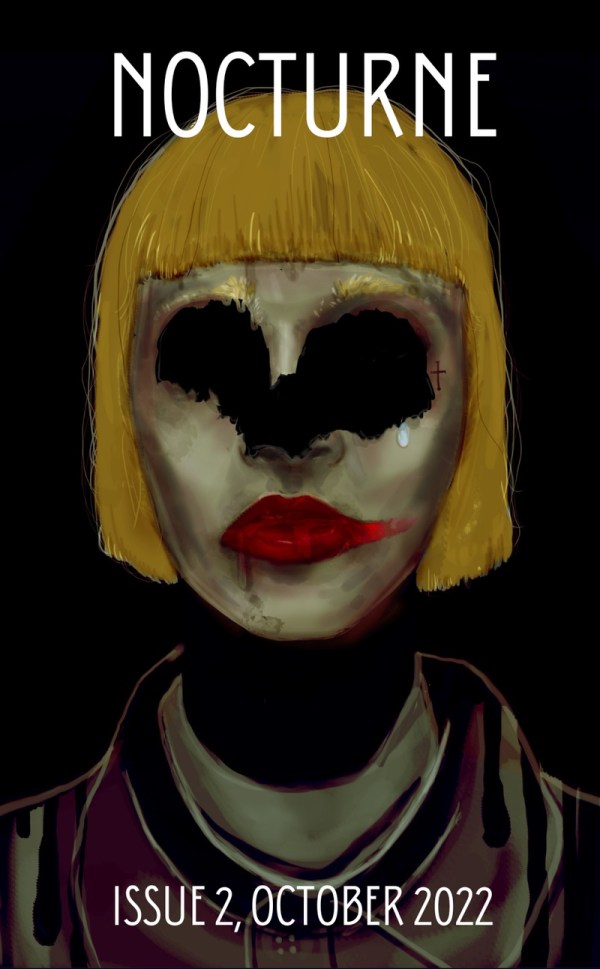
-I also put together a poetry chapbook manuscript, after being surprised I had enough poems to do so. (I’m primarily a fiction writer.) But I saw a chapbook contest being advertised by Mausoleum Press, and I took a chance. My poetry made their shortlist, but did not ultimately get selected. Getting that far, though, told me my poems had merit. That was further proved by Nocturne Magazine nominating my poem “Still Love” for a Pushcart Prize. The second press that got my poetry manuscript said it came close. Then I got an acceptance! More on that when I have details to share.

-There were so many “firsts” for me in 2022. In addition to being nominated for the Pushcart Prize, I was nominated for a teaching award at work. I was invited to be a part of an upcoming anthology-magazine hybrid (and my story was accepted). I was invited to be a guest on a podcast (still in the works, so no details right now). I made it into a dream anthology that I thought was such a longshot (Shakespeare Unleashed). And of course, there’s the to-be-published poetry collection that I’m so happy about.

-Oh! And I started and abandoned a novella, then started another novella that I’m happy with (and still need to finish), and the novel notes I mentioned before from my first NaNoWriMo.

I’ve got big hopes for 2023. I hope to get my collection picked up. I hope to finish my novella (spicy ghosty gothic), “Forgive Us Our Trespasses.” I hope to make lots of progress on the novel I tried to start during NaNoWriMo.

And I hope I will get another #100rejections.

Happy Writing to you all!

“Still Love”

Published in Nocturne Horror Literary Magazine, Issue 2, Fall 2022, and nominated for a Pushcart Prize

***

When my left hand turned to stone—
whorled gray marble smooth
as a promise, fingers fused in a cold clenched fist
too heavy for my husband to hold
he just switched sides, he loved me
still, we stayed connected
at the movies, the farmers market, shadows
melting into one wide shadow
stretching across the sun-dried pavement.

Visit Nocturne to keep reading!

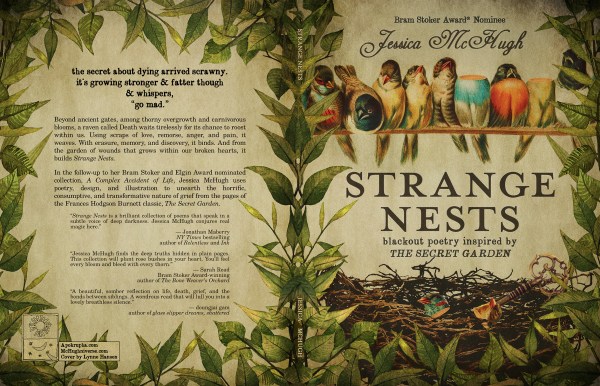
“[B]e surprised by the process,” an interview with Jessica McHugh

Jessica McHugh is a novelist, a 2x Bram Stoker Award®-nominated poet, and an internationally-produced playwright running amok in the fields of horror, sci-fi, young adult, and wherever else her peculiar mind leads. She’s had twenty-five books published in thirteen years, including her bizarro romp, The Green Kangaroos, her YA series, The Darla Decker Diaries, and her Elgin Award-nominated blackout poetry collection, A Complex Accident of Life. For more info about publications and blackout poetry commissions, please visit McHughniverse.com.

Here, she answers a few questions about her art, and how she got involved with blackout poetry.

Q: How is the experience of reading/absorbing blackout poetry different than that of traditionally written poetry?

A: I think the main difference is the amount of time you spend reading the piece, especially if the “blackout” portion is more complex and/or takes on the personality of the poem, which is what I try to do with my work. If the source material is apparent, I might spend even more time reading and re-reading, because the blackout poem sometimes honors and uplifts the original piece, whether it was intentional or not. And while I prefer to include a typed version of the poem with my pieces, not everyone does that, and if the blackout art doesn’t create a legible path for the eye, the poem might be more difficult to read/interpret and require a little more work to enjoy.

Otherwise, I think it’s a pretty similar experience. I’ve written poetry and monologues using blackout poetry techniques without actually creating a blackout piece, and I don’t think most readers would know I used a nontraditional method if I didn’t mention it. It’s an incredibly fun and versatile art form.

Q: With your unique work, you have carved out a niche in the horror writing community. How has the support of that community bolstered both your books/work and your sense of self as an artist?

A: It’s been an interesting journey, for sure. Since my first novel publication in 2008, I’ve had ups and down with my career and seen several iterations of the horror community. I’ve seen folks band together, I’ve seen them devour each other, I’ve seen people lose relevance due to an unwillingness to change with the times, and I’ve seen people going through darkness flourish with the support of their peers and come out better and brighter on the other side.

I count myself incredibly lucky to have found lifelong friends in this community and support throughout the phases of my career. Despite experimenting with playwrighting, my young adult series, and other mediums, I remained focused on horror novels and short stories and thought I’d stay on that trajectory. I never would’ve guessed that after 14 years and 25 published books, I’d be a 2x Bram Stoker Award nominee for my poetry, but I also never expected to fall in love with blackout art so quickly after I started playing around with it in early 2019. Nor did I expect such an outpouring of support from the community. While I will continue to write in whatever genre and format strike my fancy, the way blackout poetry rekindled my artistic passion after a long period of doubt, and how my horror friendos lifted me out of my gloom and doom to embrace my new artistic endeavors, makes me think blackout poetry will be a massive part of my life forever

Q: Can you tell us more about your Little Women blackout poetry? How it compares to or differs from your work in Strange Nests and A Complex Accident of Life?

A: Absolutely! My 3rd as-yet-untitled blackout poetry collection, inspired by Louisa May Alcott’s Little Women, is definitely my most ambitious project so far. It will have 155 poems to coincide with the novel’s 155th anniversary in 2023, which is triple the number of poems in both A Complex Accident of Life and Strange Nests. That wasn’t my original intention, but I’ve come to realize that “original intentions” don’t matter much when it comes to these collections. A Complex Accident of Life only became a collection because Jacob Haddon of Apokrupha saw me posting Frankenstein blackout poetry and reached out about compiling the pieces. Strange Nests wasn’t planned either; it was more of a coping mechanism after my brother passed away in January 2021 and transformed into something so much more. So I’ve rolled with the punches and allowed myself to be surprised by the process. Deciding to make a lot more poems from Little Women has opened up the narrative in a huge way and allowed me to explore weirder paths, giving the collection more of a cosmic horror feel while remaining a fierce tale of sisterhood, selfhood, and feminine rage. While an official release date has not been set yet, it will probably be available from Apokrupha around April 2023. 

Q: Finally, is there a text you have your eye on for a future project? Are you willing to share what that is?

A: For collections, I’ll likely keep using classics written by women for as long as possible, and while I’d have to verify these are in the public domain, I’d love to play with Rebecca by Daphne Du Maurier, A Wrinkle in Time by Madeleine L’Engle, and pretty much any Agatha Christie. Outside of that theme, I’m also eager to make some creepy holiday pieces from A Christmas Carol. But really, I’m open to giving anything and everything a shot. I’ve found beautiful poetry in the most unlikely places, and I never get tired of discovering the hidden treasures within. 

To commission your own blackout poem, contact Jessica here.

Writing Ninety-Nine Fire Hoops: Guest Post from Allison Hong Merrill

The blog took a spring break, but is back with Allison Hong Merrill, author of the bestselling and award-winning memoir Ninety-Nine Fire Hoops. Here, Allison tells us about the process of rebuilding and restructuring her memoir after receiving beta reader feedback, and shares some of her best writing tips. Thank you, Allison!

When reading a book, I like to see the hook, setting, character, and conflicts of the story set up within the first few pages. So I make sure to offer my reader the same gift.

Originally, my memoir, Ninety-Nine Fire Hoops, was written in a nonlinear structure. But several of my beta readers suggested that I revamp the entire manuscript and change the narrative into a chronological timeline, so I did. It was a huge undertaking. The manuscript went through twelve full revisions. On average, each pass took two weeks. And when I say, “I revamped the entire manuscript,” I mean I even changed the title. It went from Grafted Mandarin to Ninety-Nine Fire Hoops because the new structure is in ninety-nine short sections. But even after this major overhaul and subsequent edits, the first ten pages remained unchanged from the first draft to the published book. It’s because the inciting incident, setting, main characters, and conflicts of the story are established within those pages.

When writing a book, I like to do the following:

1. Imagine my book adapted into a film, then I write scenes and dialogue as if describing them from the movie.

2. Do book research and save images on pinterest.com to create a mood board for reference. For a visual person like myself, this method works really well.

3. I make myself a different writing-related promise and a reward every week. This is not a goal; it’s a promise. A goal is for reference, a promise is to be kept. Some examples of my promises are: write an hour every day, revise a chapter, create social media content. If I keep my promise that week, I reward myself. My top three rewards are: watch a movie, buy a cute notebook, sleep in on Sunday morning. If, for any reason, I fail to keep my promise, then I give myself a second chance in the following week to restore my integrity and try again. Sometimes it’s necessary to promise myself to practice the art of self-care. I’ll take a week off from writing to recharge my creative energy. I work with another writer as accountability sisters. We check in every Saturday morning to support each other and to celebrate our victories, big and small.

4. I’m a memoirist. To dive deeper into my memory, I keep a tin box of NIVEA crème on my desk. Its distinctive scent takes me back to my childhood years and, from there, I get to explore the past and find inspirations for my writing projects. Smell triggers memory. If you’re writing about your past, please consider keeping something (lotion, soap, shampoo, perfume, scented candle, essential oil, etc.) on your desk with a scent that reminds you of the olden days.

5. Because I’m a visual person, instead of setting a timer on my phone, I flip over a sixty-minute hourglass on my desk to help me stay focused on one-uninterrupted-hour of writing.

I hope you find these tips helpful. Happy writing!

“We don’t create feminist horror; it imposes itself upon us,” an interview with Lindsay Merbaum

Lindsay Merbaum is a queer feminist author, workshop leader, high priestess of home mixology, editor, and more. Her debut novel, The Gold Persimmon, is available now.

Q: Feminist Horror is not new, but it does seem to be experiencing a bit of a renaissance. Can you tell us a little about the genre and its unique opportunities, and why people are celebrating it right now?

A: Feminist horror is borne from the experience of femmes and/or the female-bodied. Often our first encounter with real-life horror involves subtle interactions with imposed gender norms, or not-so-subtle acts of violence such as bullying, assault, and rape. In this sense, we don’t create feminist horror, it imposes itself upon us. In a time of renewed fascism, where the right to abortion access is disappearing before our eyes, where rates of domestic violence have soared during the pandemic, as the Earth continues to heat up, causing death and destruction, there is a renewed interest in finding ourselves in the stories that employ speculative and horror elements to address real-life occurrences. Fiction often expresses the unspeakable and, in this case, feminist horror explores the monstrous nature of misogyny in all its forms. 

Q: Your novel The Gold Persimmon has just debuted, to rave reviews, and is unlike any other work out there. Helen Phillips said “The Gold Persimmon is a place where grief, sex, and mystery mingle,” and the novel has been called “dark,” “experimental,” “queer,” “feminist,” “horror,” “eerie,” “atmospheric,” and more. How did you conceptualize this? Did you consider its classification as the story developed, or did you leave all of that to sort itself out later? 

A: I spent many years writing and re-writing The Gold Persimmon, but the only classification I applied to it was fiction. Of course I knew it was a queer book, but I didn’t realize others would see it as experimental, or even feminist horror, until it started to reach a wider audience outside of my editors and former agent. I think I wrote it the only way I could, in the only way that made sense to me. It turns out what I wrote is shocking to some, and deeply unsettling not only in content, but form as well. Readers find the shift from Part I to Part II to be jarring. They find themselves lost at times. To me, this contributes to its effect as a work of horror. I also believe that every reader’s experience of the text is valuable and interesting, regardless of whether or not they pick up on the connection between the two narratives the book contains. 

Q: In addition to being an author, you are also a mixologist and a workshop leader. How do these different parts of your life fit together?

A: I like to say I have two passions in life: books and booze. Mixology provides an outlet for bringing the two together, as I continue building a library of booktails: cocktails and mocktails inspired by books of all kinds. This work actually involves so many more passions, however, like photography, sculpture, and playing with food. I’ve got white chocolate skulls and marzipan teeth lying around, not to mention all the pounds of sugar I’ve dyed and scattered about. What I read is now largely dictated by what drinks I want to make, or by the authors who commission me to booktail-ize their work. As a result, I’ve gotten the chance to expand the scope of my reading and delve into genres I’d never explored deeply, like romance and sci-fi. It is an expensive project, though, both in terms of time and materials.

[To find out more about Lindsay’s booktails, including personalized potions, Ostara cards, recipe packages, and book + recipe bundles, go to her website.]

Q: What are you working on right now? Why are you excited about it (or them)? 

A: I’m slowly building a proposal for a book of booktails. My next novel is also currently out with beta readers. It’s about a magical midwestern queer bar, a locus for the riotous convergence of witches and goddesses. Though I pull from several mythologies, Sumerian myth looms largest, with the goddess Inanna taking center stage. Fun fact: the earliest recorded poetry was composed by Enheduanna, a Sumerian high priestess of Inanna. Born around 2300 B.C.E., Enheduanna was the high priestess of the most important temple in Ur, a city in the south of Sumer that embodied the culture of the time. She lived eleven hundred years before Homer–around five hundred before Abraham–and wrote her poetry about three hundred years after the cuneiform vocabulary had just developed to a point where poetic phrase was even possible

My next-next novel was inspired by Sami ancestor worship and the belief in an afterlife that is right under our feet, our steps mirrored toe-for-toe by those who came before. It’s the story of a lesbian marriage and it’s kind of like a combination of Outlander and Being John Malkovich.

A WordPress.com Website.

Up ↑