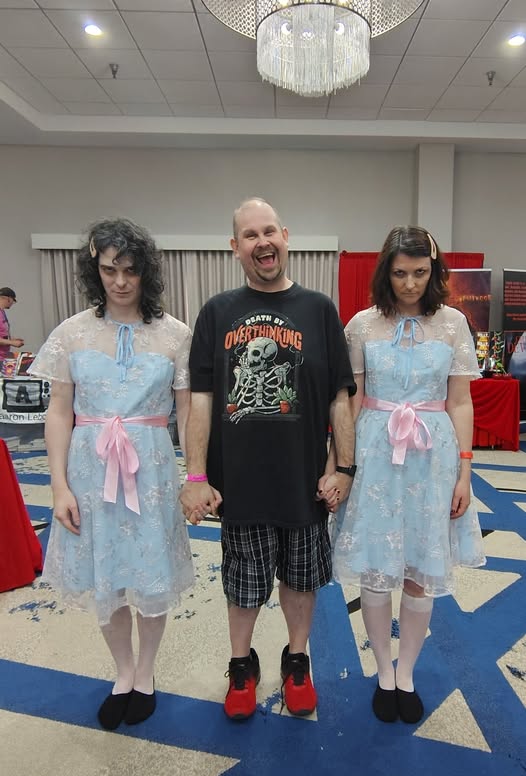
Photo, from left: Jamie Flanagan, James Sabata, and yours truly
This blog post needs to start with thanks. I appreciate, so much, that I got a chance to spend time with dear friends, and to meet readers, and to talk books, and to be just plain silly for a long weekend. Thank you to James Sabata for the invitation and to Scott Bradley and D.M. Guay and Jamie Flanagan for all the Spirited Giving magic; thank you to the con organizers and volunteers and charity coordinators, especially Brian Keene and Joe Ripple and Jake Lerner; thank you to all the attendees; thank you to all my fellow panelists and performers and to the staff at the Doubletree Hilton in Williamsburg, VA (and especially Regan and Chris!). Thank you to Sam Rebelein and Vin for being great tablemates (and for doing math for me). Thank you to all the lovely people I met. Thank you to readers and to folks who bought my books and folks who gave me or sold me their books. Thank you to everyone who helped us raise money for Scares That Care by putting cash in our jar to take pictures with us… I mean, with the twins from The Shining.
One of the panels I had the privilege of joining was on networking etiquette–what to do and not do, both online and in person at events (cons, readings, signings, etc.). This topic is important to me because I have some very strong feelings about it–the first being that I don’t really care for the word “networking.” It has, for me, the connotation of being shallow, self-serving, and fake, though the word’s denotation is more respectable, and hearkens back to (what I think are) its origins: it’s a chance to “work the net” with others–the way fishermen (and -women and -people) did for years. With many hands weaving and tying, together, these folks made one another’s nets bigger, and they mended any holes in the nets. While they sat around mending, they also talked, and got to know each other, and told one another stories of their trials and travels. I bet they laughed a lot, and sometimes cried together.
I use the term “community building” because that is what I’m doing at these events and online, with other writers and readers. It’s why I’m writing this blog post–to be helpful, and to help new writers (and seasoned writers) avoid some of the mistakes I’ve made, and that I’ve seen others make, often innocently or at least unknowingly.
The panel could have gone on longer this past weekend–I had three pages of notes (I’m a gal who brings notes). And while we covered a few topics, we had to (understandably) leave a lot on the table.
So I am writing this, now, to not only cover some of those things, but to reiterate the good points my fellow panelists (Joseph Pesavento: moderator, Rebecca Rowland, Robert Swartwood, Shane McKenzie, B.C. Lienesch, and John Lynch) made. I’ll number them to stay organized.
- Know why you are there. People come to conventions and other live events for many reasons. I came to help with a charity event (Spirited Giving) happening at AuthorCon V, to be silly and raise money with my friend (see photo), to spend time with the friends I already had (and miss), to talk to readers about books, to perhaps sell some books (I did!) and to meet other authors who do the thing I do. Yes, there were famous people there. Yes, I said hello to some of them. But, though I am, at times, a fangirl, fangirling wasn’t my intention for the weekend (though I hope I was as polite and respectful and appreciative as I meant to be–these are folks who succeeded at the very thing I am doing, and I look up to them as experts).
- Mind your substance consumption. If you like to have a few social cocktails (or whatever), cool, but keep it at that. (This is a mistake I’ve made–not trying to be a hypocrite here!) I have learned that events are way more fun if you know, for a fact, that you didn’t say or do anything you’d be embarrassed about later. Lots of folks get carried away at these things, having fun with their friends, but as my smart pal James Sabata said, if you wouldn’t do something around the coworkers at your day job, don’t do it around your colleagues at a convention. It’s still a professional space.
- Say thank you. Say thank you to everyone, all the time. Thank the host. Thank panel attendees and your fellow panelists and your moderator. Thank everyone who buys a book from you–thank everyone who even stops to look at your books or to chat with you. Thank the people from whom YOU buy books, or who give you books or swag. Etc. etc. The old adage applies: “Please” and “thank you” go an awful long way, and actually BEING grateful makes you feel kind of amazing.
- It’s okay to introduce yourself. Sometimes I forget this–I feel shy, or I can’t remember if we’ve met before so don’t want to sound silly, or I don’t want to interrupt the conversation happening. But it’s okay to just wave or offer to shake hands and say “Hi, my name is Rebecca. I don’t think we’ve met,” or, “Hi, I’m Rebecca, and I think we’ve met but I’m not certain.” That one is still a struggle for me, but I’m working on it.
- If you see someone sitting alone, invite them to your table or to your conversation. But if they say no, thanks, they’re alright, leave it at that. They may be purposefully taking a few minutes to themself, because sensory overload is a definite challenge at a big convention, or they are centering themself for something they are about to do–a reading or a panel or something like that.
- You don’t have to meet everyone every single time. It’s fine to say hello, or not, to the bigwigs in your genre. It’s okay to admire from across the room. If you have an opportunity and want to take it, that’s great. Tell them you admire a certain book or story or script–be specific–introduce yourself, and then let them get back to the event. They’re busy and you don’t want to monopolize their time. And if you don’t have an opportunity to meet them, or if you are too shy, or if it feels awkward, let it go. If they are having a closed conversation with their friends, definitely let it go. Remind yourself that it’s possible you’ll get a chance someday in the future to meet them. Overall, remember they are human. They get tired. They get overwhelmed. They get frazzled. They can’t be “on” all the time, nor should we expect them to be.
- Don’t prairie-dog. Some people have a cruder term for this, which rhymes with “jar-lucking,” but I won’t use it here. This is the unfortunate behavior I’ve seen exhibited many times whereby lesser-known authors or fans constantly pop their heads up to look around for the most famous person in the room, and make a beeline to them. And then they do it again, leaving that conversation if someone more famous walks in. And then they do it again, and again, and…you get the point. It’s tacky behavior and no one appreciates that kind of attention.
- Don’t mix networking with dating. Yes, some people meet at conventions and fall in love and live happily ever after. And that is nice. But most folks there are there to talk books and readings, not to find a bed-warmer for the night. Also, other people notice more than you may think they notice, and you might not want your personal “interactions” to become public gossip.
- Give the grace you get. This applies bottom to top. You forget people’s names, so don’t be annoyed or offended if someone forgets yours. If someone doesn’t remember your book’s exact title or cover or publisher, again, it’s not personal, and it happens to all of us. If someone needs to politely excuse themself from a conversation, say thanks and you hope they have a good night–because sometimes you need to politely excuse yourself, too. This applies to reading early review copies and writing blurbs and leaving reviews, too. Our good intentions are always going to outpace our capabilities. If someone thought they could help you and then couldn’t, well, take a look at how high your own TBR pile is before you get bitter about it.
- Support others, but do it genuinely. It’s the easiest thing, online, to hit the “share” button to help someone spread good news or promote their work. Share the posts of the successful people you admire, yes, but also share the posts of your peers and of people just starting out. If you have three more seconds, tell them “Congratulations” or “Very cool!” in the comments section. At events, tell readers and panelists they did well, and sincerely compliment what you liked about their performance or presentation. Don’t try to flatter or “kiss up” or gush (or whatever you want to call it) for the purposes of furthering yourself or your reputation. It’s transparently fake and no one is fooled by it, and you will only succeed in making people feel icky.
- Have a few conversational questions ready. This one comes from Jamie Flanagan. Instead of running up to people and saying “I love you!” and then going mute with embarassment (did I kind of do that to Jennifer McMahon in an elevator a few years ago? I did), have a few questions ready. They can be simple and should be appropriate. Examples: “What are you working on now?” (For writers.) “What genres do you like to read?” (For readers.) “What’s a good book you’ve read lately?” (For anyone.)
- At all costs, avoid public arguments, tantrums, and meltdowns. I don’t have to explain that one.
In summary, be polite to all, and be genuinely kind to anyone with whom you have interactions. If you meet people you admire, be careful not to linger if they are busy or perhaps looking a bit tired. Tell them what you love about their work and then let them get back to their activities. And don’t make every social encounter a transaction, seeing folks only as untapped resources for you to use.
I could go on and on, but for now, for what I wanted to talk about on my panel, for the smart things others said, for what I have noticed around me at many an event, I think that does it! Feel free to comment with anything I missed.

 Rebecca Cuthbert