What NOT to say to publishers or editors on social media

I’m writing this post because of comments I have seen recently on social media in response to publishers’ “open submissions” announcements. Of course I will not name names–it’s not a burn post. But many of us have had to learn the submissions process the hard way, and I hope this post will help folks avoid the mistakes I’ve seen and the mistakes I’ve made myself. Now I can’t cover every faux pas here, and most publishers will absolutely overlook small mistakes and mixups. (Like, if someone wrote to “Undertaker Press” by mistake rather than “Undertaker Books,” no biggie.) Here are a few things to try to avoid, though, with some tips on what to say or do instead.

  1. Do not announce yourself like a boxer jogging into the ring.

This imagery comes to you courtesy of Heather Daughrity of Watertower Hill Publishing and Parlor Ghost Press. It’s the perfect analogy for what I have seen on these social media posts and in emails I’ve gotten as an editor.

Some authors, before even mentioning their current project or submission, feel they need to yell through a megaphone, often exaggerating their accomplishments, and generally putting their ego first. Not a good look, I promise you.

The place for information about you is in a short, factual, third-person bio paragraph you would include in a cover letter/email with your submission. Stress on “short.” (And do not put it on social media in a comment on a publisher’s post.) Start that paragraph with a personal note about yourself and follow it up with a few publications/accolades and then where folks can find more information about you (hopefully, your author website).

2. Do not beg, grovel, put yourself/your work down, or share a sob story.

Be friendly, confident, and at least a little bit professional. I have seen statements in the comments section like “I have a book that is like Star Wars meets Anne of Green Gables but you probably wouldn’t want to read it.” Problems: zero confidence makes me think it’s probably not that good, but also, you made up my mind for me, which is kinda rude and presumptuous. So let’s revise that. It would be much better if the person said something like: “I have a novel manuscript ready that could be described as a mashup of Star Wars and Anne of Green Gables. Beta readers have told me it’s a fun read and not like anything else they’ve read. If you’d like to take a look, I’ll send it along.” Of course, only say that if it’s true.

Other cringeworthy comments, which of course I’m paraphrasing/imitating:

“Wow I’m so glad to see this sub call. I haven’t had anything published in over a year because I had to move and then my cat died and I lost my job. I wanted to self-publish but I never really got around to it and I thought I’d never write another thing but hey, I could send something to you!” (TMI, and a weird vibe right away; might also signal to the editor, rightly or wrongly, that you would be difficult to work with and/or clingy.) Instead, how about “This looks like a great submission call and I have something that would fit. I’m excited to send it!”

“Oh cool I love your books! You put out the best books in the industry and I tell everyone you’re the best! Publishing with you would be a dream come true and would be the best thing that ever happened to me!” (Even if that is totally true, it SOUNDS like corny flattery. Compliments are appreciated, but in moderation.) Instead, try “You put out great books and have an impressive reputation. I’m definitely sending you something!”

3. Try not to ask questions in the comments section that could be answered by the publisher’s post itself or by a quick look at their website or social media.

Comments in this category of “Please No” are “What kind of submissions do you want?” (That will be in the post or on the website.) “What books have you published?” (Go to the website.) “Who else has books with you?” (Again, go to the website.)

It is absolutely fine and great to ask questions. Just make sure the questions you are asking can’t be answered by a one-minute review of the post or a quick website search. And, of course, since we all miss things that are right in front of our faces (because I have done this a million times), when you realize your goof, offer a quick apology. “Sorry! That was right in the post. My bad!” Editors and publishers are humans too. But you want them to know you don’t take their time and attention for granted.

4. Do not say rude things.

I cannot count the times I have seen absolute rudeness in response to publishers’ submissions calls: “Why would I even submit to you? You’re a joke.” “My work is worth money. Recognition doesn’t pay my bills!” “You aren’t a professional magazine if you don’t pay writers!”

Lordy. This is one of those “Don’t like it? Keep scrolling” situations. It’s true that editors/publishers should announce whether or not it’s a paying publication. But when it does not pay, or when the payment is token, don’t be nasty, and don’t assume every other writer out there has the same publication goals you do. A friend of mine submits work to non-paying calls, because he’s just trying to meet other authors and folks in the industry, and get his name out there. I have submitted to non-paying calls because the publication’s theme is really cool, or I like what they put out, or it’s for a charity I care about , or because I know the editor to be great, or because I know that publisher submits authors’ work for awards like the Pushcart Prize and Best of the Net. Maybe a writer is just starting out, and getting a story or poem in a non-paying publication would mean the world to them. Do what you want to do, submit or don’t, but keep the vitriol to yourself.

“I’d never submit work to you! You’ve published [author I hate/author who has behaved badly]!”

Okay. I know this is a tricky one. But think before you type.

It could be that yes, a publisher has put out a book by someone who acted badly. We’ve seen it all too often in the horror community. But when did they put out the book? Was it BEFORE the author in question was known to be a jerk? Could the contract have been signed before that point? Contracts are legal documents, and before you type an angry comment to this here post lemme ask you: Are you a lawyer? A judge? If not, still those itchy fingers. Some publishers have what is often called a “behavior clause.” This usually means that, should an author behave badly, in any number of ways, the publisher can immediately cease production of their book and the contract is void. But if a publisher does NOT have this clause, they may be stuck with that author and that book, at least for the duration of the contract, which can range from six months to several years.

Here’s something else that a lot of righteously angry people won’t want to hear: People change. PEOPLE CHANGE. They are capable of personal growth, and learning, and repentance, and behavioral correction. It’s possible that a person did or said something terrible a long time ago, and has since become a better person. (This applies to like, non-felonies, of course–I’m not saying you should forgive every murderer and assaulter out there.) There is an expression I love: “When you know better, do better.” I’m not going to hate anyone because of something they said 20 years ago. I’m sure that I myself said horrible things 20 years ago, when I was young and ignorant and sheltered. I’m sorry for all of them, even the ones I don’t remember saying (because alcohol and I were way too close in my 20s). So I will give people the grace that I hope to receive. People. Change.

I’m going to stop there. Happy posting and happy commenting, everyone.

Submission Etiquette for Writers & Editors

Most writers and editors have received more than their fair share of less-than-polite treatment: from getting ghosted to being cursed in social media posts to finding angry email replies in their inboxes. Recently, I have been stunned by a mean rejection email and disappointed by the sound of crickets in the wake of follow-up queries. I thought it would be helpful to ask seasoned writers and editors for their thoughts, in hopes that this little blog post can help us all be kinder to one another. (Also, reading this is better than learning through trial and error, as I have!)

Manners for Writers:

Follow submissions guidelines. Yes, we all make mistakes, myself included–overlooking a detail or not double-checking the news from one of those submissions round-ups–but do make an effort to read the rules and follow them.

From Leon Perniciaro, Editor of Haven Spec Magazine and reader for Uncanny Magazine: “[M]ake sure you follow our guidelines, whether for Uncanny or Haven Spec, and make sure that the cover letter is addressed to the right person and that you get people’s names and pronouns right.”

Do not respond to rejections, unless it’s a “Revise & Resubmit” situation. Take the R and move on.

From Alexis DuBon, co-editor of No Trouble at All by Cursed Morsels Press: “Please don’t respond to rejections. Don’t ask why. Don’t ask for feedback that wasn’t offered. Once a story is rejected, the interaction is over and your story is free to send back out. If you’re curious how it could be improved, seek out beta readers who will give you honest and helpful suggestions. This is not the job of an editor who has rejected hundreds of other stories that they also haven’t given feedback on. It’s only fair.”

From Evelyn Freeling, editor of Les Petites Morts by Ghost Orchid Press: “[Responding to rejections with] demands about why your story was rejected, why it took so long to get a response, etc.–isn’t okay. At the end of the day, most editors also have day jobs so be respectful of their time and energy.”

And if you do get an R&R, appreciate it for the opportunity that it is.

Perniciaro: “If you get a rewrite request, work through the story in good faith (editors can always tell half-assed edits!) and don’t be afraid to ask clarifying questions.”

-Do not tweet (X?) or post about a specific editor who rejects your story. I admit it was super hard not to publicly post the name of the press who told me writers like me are a dime a dozen. (I absolutely told my friends in a closed thread!) By the next day I didn’t feel so bad about it, and I would have regretted a public tantrum.

DuBon: “Authors, please don’t tag publishers when tweeting about story rejections. It’s super awkward.”

Be patient. If the press or publication states that the wait time might be eight months, give them eight months. Give them nine. Then send a polite query if you still haven’t heard back–and to make it easy on them to answer you, include the title of your submission, its genre, and the date on which you sent it.

From Julie Stevens, editor of Deathcap & Hemlock: “I suppose just being a bit patient with us is my favorite thing. I have batches of acceptances to publish and so sometimes people scheduled later on don’t hear from me for a bit.”

Include reader advisories if and where the editors ask for them. Lots of folks call these “content warnings,” though at work (I teach college creative writing classes) I learned that the word “warning” is problematic, as it implies readers may not be in control of their own feelings and reactions. The word “advisory” is neutral and acknowledges the reader’s power of self.

Send only edited, proofread work. Mistakes and typos distract editors and slow down reading. Swap drafts with writer friends so they can catch what you didn’t.

Ask before announcing. This is another thing I had to learn along the way. Sometimes editors want to make their own big TOC announcements, or perhaps they haven’t made it through all the subs yet, so putting the news out there yourself can step on their toes.

Perniciaro: “[I]f you get a story accepted, shout it from the rooftops as soon as the editor gives you the go-ahead! They are just as excited to see your story out in the world as you are.”

Manners for Editors:

Communicate with authors. Fortunately, many editors are already great at this. Those who aren’t might find good advice here.

Jonathan Gensler, author (stories in Cosmic Horror Monthly, Soul Scream Antholozine 2, etc.): “I appreciate it when they notify you that your submission has been received (not all do that, even in this digital age); I appreciate knowing if/when a first reader has passed a story along for a second round of consideration; and if a story doesn’t quite make it to publication, but was close, I appreciate any notes about what might have made the story a better contender.”

Freeling: “Because I’m a writer, I did try to provide generalized feedback [for rejected Les Petites Morts submissions] on why the piece was being rejected–typically it was pacing, atmosphere, or not meeting the call somehow–not erotic enough, not directly or obviously inspired by a fairy tale/myth/folklore. I also tried to name something I did enjoy about the piece in every rejection because again, I’m a writer and I know rejections sting.

Perniciaro: “For Uncanny, we try to respond to every submission within 30 days, either with a hold notice or a pass. For Haven Spec, we try to reply within 10 weeks, and at this point, we manage that for about 95% of submissions. Some months are tougher than others, though.”

Stevens: “My very first submission as a writer a few years ago was one where I got no response, and only found out when I saw the TOC on Twitter. I can’t do much about the sting of rejection but I absolutely would never want to put someone in that position–it did not feel like my work had been valued. I read every word, I’m thankful I’ve been sent what I’ve been sent.”

Christopher Ryan, editor of Soul Scream Antholozine: “I explained all of my intentions [to Soul Scream contributors], and then I repeated them in our contract that expressly says I am buying one time rights to publish, and they own the copyright and everything else. I’ve researched several different contracts to make sure I had fair and very clear contract language that would protect the writers and, of course, protect my company and myself.”

And provide updates when possible. Writers know time is limited, but even a quick mass email of “We haven’t forgotten about you; we’re still reading!” is great. And if it’s a contest, let readers know where they can find results as soon as they are posted.

Perniciaro: “For Uncanny and Haven Spec, everyone who submits gets a receipt acknowledgement, with Uncanny having a system for letting people know where they are in the queue (and if their piece is under review, if rewrites have been requested, if it’s been rejected, etc.).”

Stevens: “One thing I think that has helped communication is that I now send a note after the contract is signed to let authors know what to expect next. I’m sure some more seasoned writers get that email and wonder why I am over-explaining but I think it helps newer writers not feel like they’re missing something!”

Ryan: “[W]hen adjustments were made [in the Soul Scream publication timeline], I sent out emails so that people could stay current with what the situation was.”

Avoid publicizing impossible timelines.

DuBon: “[D]on’t advertise timelines you can’t adhere to. Don’t set dates that you might not meet. Only announce when people should expect something to happen once you are certain. […] I say that because it creates unnecessary stress on both sides.”

Ryan: “I was very careful not to give a specific timeline, because I know that it is easy for small independent companies to run into difficulty with, for example, Amazon or other platforms. I needed to have that flexibility.”

Please accept simultaneous submissions. Unless you are promising to have responses out within a week of submission (see above), it’s crummy to tie up people’s work and hold them back from other opportunities. Responses take a long time and rejection is the most likely result: Allow writers to cast a wide net.

DuBon: No simultaneous submission is archaic and unreasonable and unless you’re The Dark, no one is taking it seriously.

If you can, pay authors, and be upfront about that information.

Gensler: “[T]he biggest thing I appreciate is when a publisher values your work enough to pay, even a token rate. Publication for free copies, or perhaps even for mere ‘visibility,’ seems to devalue the whole writing process, and helps contribute to the situation we are in, where even the most financially successful creative outlets in the world feel empowered to devalue the creations of writers. Even a token payment [goes] a long way to establishing the inherent value in our work as writers.”

Don’t send mean rejections. I won’t explain more; adults should know better.

On not self-rejecting…

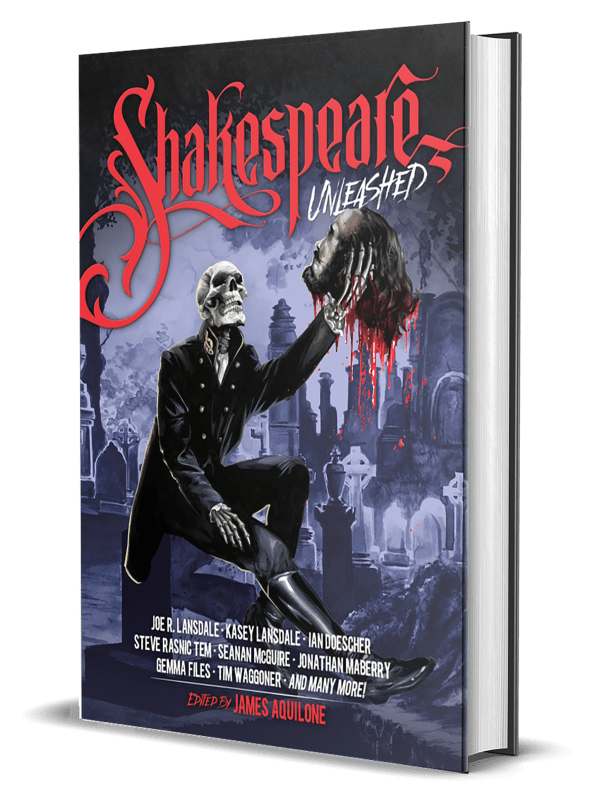
Photo: Shakespeare Unleashed, edited by James Aquilone for Monstrous Books and Crystal Lake Publishing, which I submitted to AND THEY LET ME IN!

It’s mid March, the sun is shining, I’m in a relatively good mood, and I’m thinking about self-rejecting–or, more accurately, NOT self-rejecting.

I hear a lot, and I used to say sometimes, “I’m not going to bother submitting to that. I’ll never get in.” Now I’m like, “How do YOU know? You aren’t the editor. Submit that story!” (Or poem or essay or manuscript.)

Have you ever submitted a story to a submissions call that seemed like it was MADE for your story? Like they were a perfect match–everything the editors wanted, your story had? And then, your story got rejected anyway? And you were thinking, WTF, I gave you everything! Yeah. I think we’ve all been there.

So here’s the thing: IT WORKS THE OTHER WAY AROUND, TOO.

You might think your piece isn’t “good enough,” or that it doesn’t quite fit a theme, or does in a WAY, but not in all the ways. Maybe you think the editor has a pronounced different style or aesthetic.

But. Like. What if your piece is just the variety they need? What if they don’t have that narrative arc or subject or theme in any of the other stories they chose?

Jenny Kiefer, author of That Wretched Valley (Quirk Books, 2024) and owner of the popular Kentucky horror bookshop Butcher Cabin Books, has gotten several publications with just that line of though. “Honestly most of my acceptances have been things where I just sent a story to a market I didn’t think would like it. I’ve experienced rejections more when I’ve thought it was perfect for the place I submitted to. I was recently accepted to F&SF for a body horror story–I would have never thought they would like it, but I submitted anyway.”

Especially if there is no submission fee (and whoa should I write a post just about submission fees), SEND IT. There is, for real, no risk. And, see blog post about #100rejections for why we should be trying to send out enough submissions to rack up 100 Rs by the end of the year, be they form or personal.

Rae Knowles, whose novel The Stradivarius will be out soon with Brigid’s Gate Press, knows this, too. “There was a pro-pay call that I knew was getting a ton of submissions,” she said. “It was outside of my usual genre, and I wrote a story, tweaked it, tweaked it, and tweaked it some more. I stressed so much, feeling it had NO chance of being accepted, but on one of the last days of the submission window, decided to send it in. To my SHOCK, it was accepted. Lesson learned, never self-reject!”

Author and editor Alexis DuBon keeps a hand over the mouth of her inner critic:

“Try to think about whose voice it is telling you your story doesn’t work,” she recommended. “Is it your own? Or is the reason you’re hesitant something other than ‘Yeah, this story about biblically accurate angels probably doesn’t fit this call about swamp monsters.’ We bring a lot of baggage into decisions where it doesn’t belong.”

Waylon Jordan, author, horror journalist, and EIC of Off Limits Press, talks over his self-rejection impulses; he drowns them out. “I don’t know how many times I’ve had to tell myself, ‘You have just as much right to submit your story as anyone else.’ I see authors invited to calls and talk myself out or submitting because I’m not ‘in their league.’ The imposter syndrome is alive and well and I deal with it all the time. The other thing I have to tell myself is: I’m not Stephen King (or whoever famous author your want to insert). I can’t do what he does. But you know what? He can’t do what I can. Someone wants to read what I can give them.”

Author Katherine Silva (The Wild Oblivion series) picks what she submits to carefully–if she needs to get other things done, or needs to take time for herself, she’ll skip a sub call. So, ask yourself: Are you self-rejecting because of a low-self-esteem day, or, do you just have other things that need to come first?

Zach Rosenberg, author of the forthcoming Hungers As Old As This Land, gives himself a pep talk: “This is a story only you can tell and it should be told.”

Also, related to the topic self-rejection, remember that if you burn yourself out or get too discouraged by a particularly rough R (or a volley of them), and you decide to QUIT writing altogether, you are self-rejecting from the entire world of publishing.

Kiefer has a way to manage that feedback–because yes, you will get more rejections than acceptances. That’s just reality. But, if you don’t want to see those Rs every day, do what she does:

“What did help [with rejections] though was to set up a separate author email address, so I could control how much I saw. At one point I even had a friend who would monitor it and only tell me good news so I could submit without having to see the waves of rejections.”

Final decisions on publication come down to the EIC or a small team. So, it’s not like the industry voted on your work. It’s one person’s subjective decision, in most cases. And subjectivity could mean anything: maybe they’re sick of zombies or whatever tropes your narrative features. Maybe they already have something similar for that issue or anthology. Maybe they just–and this sucks, but it’s also OKAY–didn’t’ like your story enough to put it in.

But someone else will.

Unless you don’t send it to them because you self-reject.

I guess what it comes down to is this, which I said to more than one struggling writing friend: Does writing (and everything that comes with the process–drafing and revision and feedbacking and submissions and rejections) bring you more pain or more joy?

If it’s the first one, go ahead and quit. Life is short. Find something you like better.

But if it’s the second one…

DRAFT, REVISE, EDIT, and SEND IT!!

So you think your story is done? Think again.

I have a story that I thought was done six months ago. I had read it again and again. Pinched and revised. Friends read it. I workshopped it. And I sent it out to contests and submitted it for publication–most recently, to a contest I felt pretty good about*. (Not that that meant I had a chance, but, you know how it is. Good feelings are worth something.)

Then, I was thinking about that story a couple weeks ago, and read it that night. I found myself making line edits. Little cuts–a word here or there. And then I realized that it had a couple bigger issues–it needed a change of dialogue here, a rearrangement of action there (“shuffled” instead of “stepped” type stuff). And the next day, while reading it for the 80,000th time, I was HORRIFIED to discover a major plot hole. Huge. A truck-sized plot hole that I had overlooked again and again.

It was a throwaway line on page two that got me–an offhand reference to a character’s son. He didn’t come up again. He didn’t matter. Except that he really, really did. Because–and don’t worry about the context–what kind of son leaves his 90-year-old mother to clean her own gutters if he lives close by? Why would he never come around? And that made the whole second half of my story kind of unbelievable. Not in a good way–I mean it lost its verisimilitude. It didn’t make sense.

The fix? Get rid of the son.

I laughed at all of this, along with nearly (but not) crying, because that same week, my Intro to Creative Writing students were focusing on revision: all the experiments a writer can do with their stories, all the questions they can ask themselves, all the possibilities they can open up.

I’ve always said to them, truthfully, that I practice what I preach, but that week, I lived it in real time. I told them all about my mistake and my dismay at its discovery–no delusions of grandeur here–and how it reminded me that sometimes, what we need most in the revision process is time. To let something sit for a while, in the proverbial drawer, until we’re ready to take it out again and see what we didn’t before.

Also, it made me think, “Damn. What else did I call ‘done’ too soon?”

I went back to my desk to find out.

*Update on this: After I first drafted this post, I decided there was no harm in reaching out to the editor of that contest, asking if I could swap the file for an updated one. He hadn’t yet opened the submission, so he allowed it! It’s still “in progress” on Submittable.

The skill of being rejected

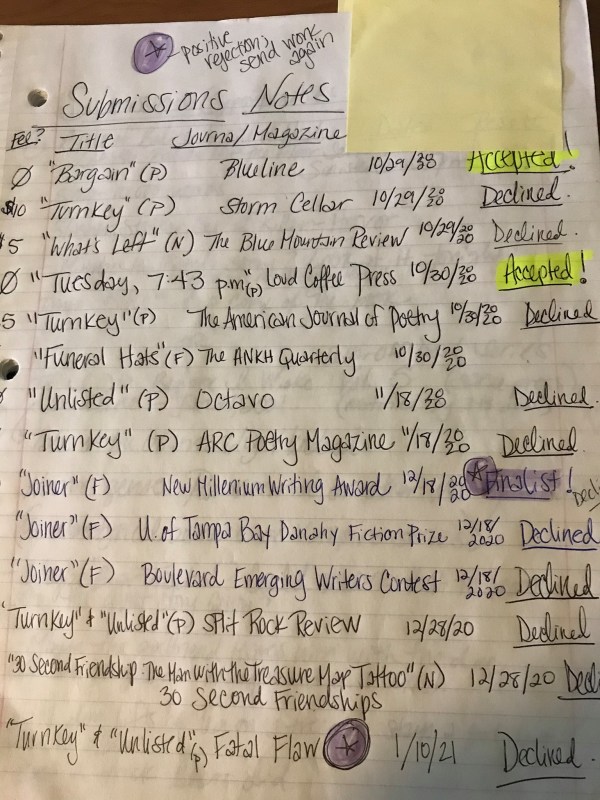
Pic: This is how I keep track of submissions. Low tech but effective.

I have found, pretty recently, that being rejected as a writer is a skill. And like any skill, you can get better at it.

During lockdown, I got back to work on my own writing, spending more time and energy on it than I had in years. Instead of finding the creative well dry, as I had feared, a couple of stories seemed to write themselves. I joined four friends in a Zoom writing workshop (we still meet). I made appointments with an excellent editor-for-hire, and we’ll schedule another session soon. I wrote and I revised, and then I wrote some more. I went on a personal writers’ retreat, renting a cabin in the Catskills with my wonderful friend N. West Moss for a few days, and drafted two new stories. For a while there, I was kicking ass.

In that time period, I also got back to submitting my work to journals and magazines and writing contests. I realized that the process energizes me–everything sent out is a chance that it will find a place in the world. Submitting stories (and sometimes, essays and poems) makes the process more real for me–it makes me feel more like a “real” writer, whatever that is.

And wow, did those rejections roll in. And they keep rolling in. And honestly, yep, sometimes they stung, and sometimes they still do. But they sting less all the time. I shrug at them now, mostly. If I get two in a day, I laugh. It sucks, even now, if I get a rejection on a submission I thought was a good fit–like if my story matched the theme, or aligned with the goals of the publication.

A few came close. “Joiner,” a story, was a finalist in the New Millennium Writing Awards. A flash piece, “Rest for the Wicked,” got a lovely rejection from the Parsec Ink contest, saying it made the longlist. Fatal Flaw rejected two poems, but encouraged me to send more (I will!).

I’ve gotten acceptances, too. For the year of 2021, my record is 5 acceptances, 43 rejections, with a handful of submissions still out. Most recently, The Elpis Pages, a print collective (with profits going to Planned Parenthood), took my essay “What’s Left.” That will be out this month. Then, I got an email from Last Girls Club, saying my story wasn’t a fit for their magazine, but could they read it on their podcast, Blood & Jazz? (The answer of course was YES.)

A lot of what has gotten accepted from 2020-2021 had been in the works for a while. Like a long-ass time. A poem that Blueline Magazine took (“Bargain,”) had existed in various forms for over seven years. “Tourist,” a flash essay Anti-Heroin Chic published, was first drafted about three years ago. Every time those pieces (and others) got rejected, I would take another look at them. Tinker. Fiddle. Tighten them up. And, not surprisingly, they got better. And then they found homes.

I was inspired by the article “Why you should aim for 100 rejections a year” from LitHub by Kim Liao. I was also motivated by a Facebook thread posted by the editor of a small press, which turned into a big conversation about why women tend to submit less often than men. (Spoiler: it’s because patriarchy.) The main idea with both of those? Submit, submit, submit.

I look for opportunities on various Facebook pages, through Reedsy, Newpages, and Erica Verillo’s blog, Publishing and Other Forms of Insanity. I don’t mind submissions fees–publications are expensive to run and print, and need to pay for staff and software, etc.–but I don’t break the bank. I look for cheap and free submissions opportunities, too. I keep track of everything in a janky notebook–see photo. (I tried keeping a tidy Excel file, but that’s just not me–I’m a pen-and-paper gal at heart.)

In 2022, I hope to hit the 100 rejection mark. If I double my rejections, I might just double my acceptances, too. Who’s in?

A WordPress.com Website.

Up ↑