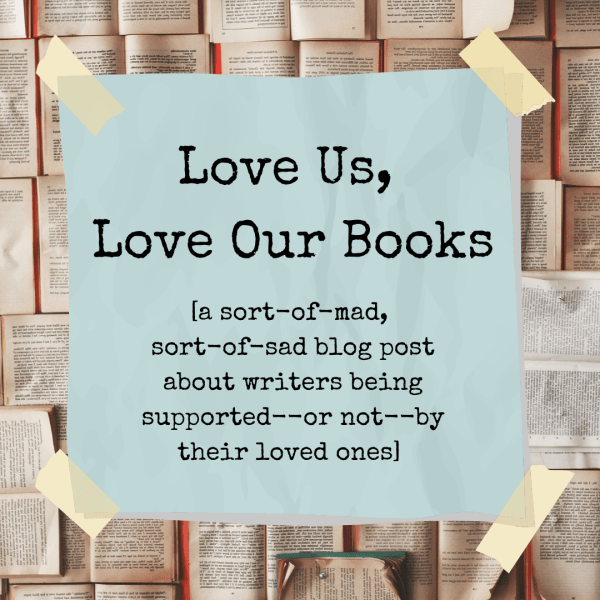
Love Us, Love Our Books!

Today I read a post on Facebook that made me so, so sad for a stranger.

A woman posted anonymously in an all-women authors’ group on Facebook, wanting advice and comfort. She has self-published two novels, and has done a few local events. She is proud of herself, or should be able to feel proud of herself. But her husband? Anytime she or anyone else brings up her books or her writing, even in passing, her husband sighs, makes a noise of disgust, rolls his eyes, turns his back or walks away. Like it makes him physically sick to hear it mentioned that his wife poured her heart into two works of literary art. The woman said, in her post, that her husband is “usually kind and loving;” just not about THIS.

But girl? If he doesn’t support your writing and isn’t excited about your books, he doesn’t support YOU.

My husband is awesome. He goes to all my author events, helps me carry boxes of books, helps set up and pack it in afterward, and then he schleps whatever’s left back to the car. He has a special stack of my books and anthologies containing my stories in his office, and he has me sign them all. He’s proud of me, and tells his coworkers about what I’m doing. In short, he’s a fantastic partner and my biggest fan.

When I thank him for this, he kind of shrugs and says he’s just doing what anyone else would do. That he doesn’t deserve praise for responding like a normal person to their partner’s success.

But that post I mentioned? In the comments, the number of “Me toos” and “Sames” that accrued as I scrolled showed me how many people are NOT responding to their partners’ successes like, well, like normal loving human beings.

So I asked a few authors friends: What does support look like from your families? When and how have you felt supported? Because maybe, if we tell more folks what is EXPECTED of “normal,” supportive, loving friends and family members, we can show authors like that anonymous poster what is actually and absolutely unacceptable behavior.

This is what author Tobin Elliott shared with me:

“My wife and daughter have both read and enjoyed my novels, and neither read horror, but they made the effort, which means so much for me. I’ve also had two cousins read them, one of whom also loved them, and the second who texted me after hitting about halfway through the first book: ‘Tobin, I just got to the part with the baby sister, and I had to close the book and put it down. I won’t be reading any more of your stuff. Tobin, I love you, but I can handle only so much of your madness.’ And I loved that. Because she tried, and then was honest, without being critical. Hey, it’s horror, and I horrified her. I win!”

Joshua Loyd Fox (who is an author but also one of my publishers!) shared his experiences:

“My wife read, reviewed, and then edited all of my books. I’ve read all of hers and re-published them. The only family member who has read my books is [my wife] Heather [Daughrity]’s father. Literally no one else in either of our families, including siblings, children, extended family…have read our books. And even though I dedicated one of my novels to the Boys Home I grew up in, they don’t support my work. But the strangers I’ve met in the book world!!!! THAT’s where I’ve gotten all of my fans and supporters!”

And from author Joe Scipione:

“My wife reads most of my novels before they’re published. She helps with endings and plot point that don’t quite work. She’s always been supportive and talks up my books any chance she gets.”

Support means different things to different people. This is what author and artist Susan Roddey said on the subject:

“My husband intentionally doesn’t read my stuff because he feels like he’s going to be ‘too honest’ and hurt my feelings (he won’t, but he doesn’t listen). But he often helps me brainstorm and get myself unstuck. He’s also good for heckling when he knows I’m getting too close to deadlines. As for friends–our little writers group meets once a week. We don’t take ourselves seriously AT ALL, but we’re constantly talking each other through plot holes and helping fix things. I count myself very lucky to have the little network that we do.”

The importance of those “found families” and friend-based support systems can’t be overstated (especially for those who aren’t getting reinforcement at home). I’ve got an embarassment of riches there, too: Jonathan Gensler, Moaner Lawrence, Lindsay Merbaum and the whole Study Coven, grad school MFA friends (Kelly, Keema, Heather, Sara), my buddies and partners at Undertaker Books (DL and Cyan), and the whole Watertower Hill Publishing authors’ group–thank you.

I want to add an extra note here, because in addition to the “me too” social media comments I referenced above, I am also seeing things like “expect nothing from others.” Those statements make me sad, too. I think we SHOULD expect our loved ones to support our passions and dreams, even if in small ways. Having someone say “Good job” or “I’m proud of you” or “I’m happy for you” is not asking too much.

So, here you go, even if I’m the only one saying it to you: You deserve to feel loved and appreciated by those you love and appreciate. You deserve for those people to encourage your passions. You deserve to have your heart’s work supported by those who tell you they love you.

And if they don’t or won’t? Don’t settle for less. Go find more.
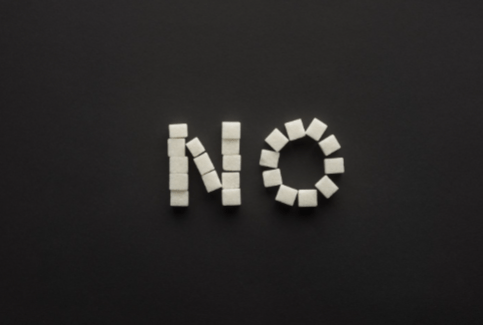
How the word “NO” made me a writer

Advisory 1: These thoughts are based on my own experiences; I am not a mental health professional. But if any of this sounds familiar, I encourage you to get professional help.

Advisory 2: This is a long story.

I’m a recovering people pleaser.

For those who don’t speak therapy, that means that I put others’ needs before my own, had a hard time saying no, and felt guilty when I did. I was overcommitted, but not to things I actually wanted to do.

I was miserable. And I came to resent the people around me.

Still, it took therapy to help me see this, and then, to make changes.

#

People pleasers are the way we are because long ago, often as children, we learned that our value (to others) came from being “good,” from not making trouble, and from helping whenever possible. It got us attention and recognition and love. Our self-worth came to depend on others being happy with us, and the way to make others happy with us was to smile, say yes, and never complain.

But what happens after decades of living this way, every day?

Negative returns.

I felt like a doormat. I WAS a doormat. I had trained people—friends, coworkers—how to treat me. Of course everyone asked me to do favors for them—I always said yes! And it’s important to note here, because friends might be reading this: they didn’t mean me harm. What’s a favor request here and there? To them, no big deal. But when ten of your friends are asking, it becomes a really big deal. It ruins your fucking life.

I’m not being dramatic.

I was ruining.

My own.

Life.

#

I don’t have my doctor’s permission to mention her name, so I’m going to call her Dr. Smith.

Dr. Smith asked me how saying yes to every request made me feel.

My answer? Used.

I resented my friends and coworkers. I resented the constant asks, even the invitations. I had very little time to myself, or to do the things I really wanted to do—hang out with my husband. Garden. Write.

“So why do you keep saying yes?” Dr. Smith asked.

“Because I feel bad saying no. Because I don’t really have anything else I have to do. Because he/she/they need me. Because he/she/they have no one else to ask. Because it’s only an hour/two hours/a day/the weekend…”

“But is there something you’d rather be doing?” she asked.

“Yes.”

“Then say no.”

Easier said than done. But I worked at it. We role played. At first, I said no with excuses or hedged my responses. Dr. Smith said no excuses—I needed to learn to say “No” or “No thanks” without feeling like I had to justify my response.

She taught me to give myself permission to have my own priorities. That not just my needs, but my wants, were more important than doing whatever other people were trying to get me to do. That the life choices they wanted my help with were not my life choices.

I worried people would like me less if I said no. I worried they would be mad.

“So?” Dr. Smith said.

Because, she explained, if they liked me less for having my own life, they weren’t my real friends to begin with. Also, if they were disappointed when I said no to favors and invitations, that was—and this blew my mind—okay.

I’ll say that again, for you and for me: It’s okay if people are disappointed.

And what she said next changed my life. It was like a thousand pounds fell off my shoulders:

“Your friends are allowed to have their own feelings,” Dr. Smith said. “But it’s not your job to manage those feelings for them.”

I cried then, mostly with relief, and with a little bit of sorrow for myself, too: at all the years I spent carrying what I didn’t have to.

#

Now, a little warning: If you have never had boundaries, and you start establishing them, there will be pushback. Some folks will be not just disappointed, but mad. Why are you saying no to everything all the sudden? Why don’t you want to do this or that favor, or go on this or that social outing? Why are you “ditching” them to just stay home? Ugh.

But, keep to your course. Do not give in to this pressure. Doing so will put you right back where you started.

(Oh! Know what I found out? Yes, I’m an introvert—which means while I like people, and can have fun out and about with others, it exhausts me—but I’m not antisocial. I socialize plenty. But these days, a lot of that socialization is online, through chatting with my writer friends in message threads or on group pages, or attending virtual workshops and classes with other writers, or exchanging feedback. These interactions give me energy rather than taking it away.)  

#

Saying no became easier and easier, and my life got better and better.

With encouragement from my husband (“Why not? Do it. Go.”) I applied for membership into the HWA in March of 2022 and got in, then went to my first StokerCon two months later, where I met a ton of fabulous people (who accepted me wholesale) and found so much inspiration.

So. Much. Inspiration.

So much that, on the plane ride home, at about midnight, realization hit me like a blessed punch to the face: If I was going to be a writer, I needed to prioritize that; to prioritize writing, I needed to quit my (stressful) part-time editing job.

This was a little scary, but I knew it was the right decision. I’d worked two or more consecutive jobs since I was a young adult, and money would now be tighter. (I grew up in a household that struggled with financial security, but that, and “class jumping,” is another topic.) It took me a few months to extract myself for a number of reasons, but in August of 2022, I was free.

And I threw myself into my craft. I took online classes, independent studies, and virtual workshops. I wrote and wrote and wrote (and revised and revised and revised).

It’s now July of 2023, and here’s what I have to show for it (since March ’22):

-Eighteen stories accepted and published/to be published in magazines, journals, anthologies, and read on podcasts

-Four Poems published in magazines, journals, and anthologies

-Two nonfiction pieces accepted; one published on a website and one read on a podcast

-A poem nominated for a Pushcart Prize (“Still Love,” by Nocturne Magazine)

-A win for Story of the Week (“Emissaries,” 50-Word Stories)

-A story chosen for a “Best of” anthology (“Falling to Pieces,” Defunkt Magazine; We’re Here: The Best Queer Speculative Lit 2022, Neon Hemlock Press)

-A collection of poetry (In Memory of Exoskeletons) accepted and published by Alien Buddha Press (My first book!)

-A second hybrid collection (Self-Made Monsters, fiction and poetry) accepted for publication by ABP in fall of 2024

-Plans for a co-edited anthology in the early stages (more news on this when I have it!)

-A novel more than halfway written (the first of a planned trilogy)

-A genre-blending, trope-celebrating novella manuscript written that’s now out on submission (Forgive Us Our Trespasses)

-Another novella halfway written (I’ll get back to it after I sell my other one)

-Two writers’ trips taken

-Two StokerCons attended

-Tickets bought for VoidCon and AuthorCon

-& more in the works!

#

None of these things would have happened if I hadn’t (with Dr. Smith’s help) taken a hard look at my life, realized what I was doing to actively harm myself (and what I was doing to allow others to harm me), taken responsibility, and decided to make changes—even when that was hard.

The best part of my recovery is that my self-esteem is now high and real. It doesn’t depend on anyone else’s valuation of me. I’m actually proud of myself for my own accomplishments (and my failures, too). I’m more resilient, I catastrophize less, and when bad stuff does happen, I can put it in perspective.

So much power in such a little word.

OMG I’m Writing a Novel

Photo of shark by freepik.com

During NaNoWriMo 2022, I wrote 20,000 words of absolute crap. But for the first time, I took an idea that had been swirling around my brain for a year and put some of it down on paper (the screen).

In December, I returned to an almost-finished novella and revised/edited/proofread hard, getting that sent out before the year’s final clock struck Done. Which meant that in 2023, I was ready to focus almost entirely on that pile-of-shit novel draft. (And Mae Murray’s goal-setting workshop in early January was great!) I got to work. I revised. I deleted (I deleted SO MUCH). I rewrote. I made note cards, which ended up being so helpful.

I signed up for a little writing retreat at the campus where I teach (thank you, Dawn!), and made quick progress. By the time that retreat ended, I had 70-ish pages of worthwhile draft. Not final, but promising.

Then, in an online horror group (sorry can’t share that, it’s Top Secret), I asked if anyone would novel-buddy with me. Because asking someone to slog through your novel draft with you is a HUGE ask–so someone else asking you to do the same makes the whole thing less heavy, and you don’t have to give anyone your first-born child, or in my case, your beloved chubby beagle. It’s a bartering of slogging. And I got a novel buddy! (Thank you, CO!)

To my utter amazement, he LIKED WHAT I HAD. He said it was interesting, engaging, and that the pacing worked. In fact, after he read the chunk I sent him (about 50 pages), his only suggestions were additions and expansions–which was wonderful, because the thing with novels is that you need a lot of words in them, and that can be tricky (you wouldn’t think it would be tricky for me–most of the time I can’t shut the fork up). I added a short scene near the beginning and expanded two others. Then I moved forward, revised some more, and I can’t wait to send him the next chunk–but, I want to hit 100 pages of decent material before I do. Then I will be at roughly the halfway point with the manuscript–I will end up with something like a 60k-word novel. It will not be a 400-pager–I’m a Chatty Cathy, but not that chatty.

In Mae’s workshop on Jan. 6, I wrote out a timeline–goal months by which I would have so many chapters done, because at that time, I thought I would try to get the novel done (a spiffy draft to send out to publishers for consideration) by the end of the year.

Now I have moved up those goals. I want to finish this sucker by the end of the summer. And I think I will actually do it. And that thought has had me floating around for a week.

I’m writing a novel.

I’m writing a novel.

I’m writing a novel.

(And it’s the first of a trilogy.)

Hard Work Works (thank you 2022!)

This is basically a “part two” to my recent “Failing at NaNoWriMo & Winning at Rejections” post.

This year (2022) has been pretty incredible. I’ve met dozens of cool writers, joined writers’ groups, and I’ve gotten more acceptances than I have in several past years combined. What made this magic? I worked my ASS off.

Which is really good news. That there is nothing ethereal or fate based that leads to writing success. Just good old-fashioned sweat and tears. And that also means there are no shortcuts (at least not for most folks).

Success is relative, I know. And people take different paths to the same or similar places. Mine went like this:

-Joined the Horror Writers Association in early 2022 (March?) after earning an Honorable Mention in the 2021 Etched Onyx Winter Contest. That story, “A Bargain at Twice the Price,” (a ghost story) earned enough that I qualified to join the HWA as an Affiliate Member.

-After joining, figured “What the hell? I’ll go to StokerCon” (May). I knew no one. I mean no one. But I had the best time there, and met so many wonderful people, from big-name authors like Brian Keene to other people like me, struggling to find a path.

-Was so inspired by StokerCon—the people and the presentations and the panels—that I decided on the way home to quit my second job as the managing editor of Leapfrog Press. I deserved time to write, and my writing deserved my time and attention. This realization hit me with a stunning clarity at about midnight on the plane from Atlanta to Buffalo.

-Wrote. Wrote and wrote and wrote. I produced so much new content in 2022, especially over the summer, when I was finishing up with Leapfrog and before the fall semester started (I teach at SUNY Fredonia).

-But I didn’t just write. I joined a workshop with other writers in the horror community who ended up with me the same way folks end up owning cats—I was dumb and hungry; they were kind. I started another workshop with a few people I’d met at StokerCon. I workshopped with other students from Lindsay Merbaum’s independent studies (we are her happy little cult members). And I continued to workshop with my friends from grad school. Outside of those groups, I also beta read for people who needed it and joined social media groups of people with similar goals. I learned so much from those other writers, by reading their work, getting feedback on my own stuff, and sharing our successes and challenges.

-Took every chance I got for affordable independent education. With Lindsay, I learned about Feminist Horror and Queer Speculative Realism, and more recently, witches. I’ll be taking another independent study with her in 2023 on ghosts. (If you are interested in joining us, let me know and I’ll connect you with Lindsay.) I paid for a few developmental editing sessions with an awesome writer and friend. I took workshops through Defunkt Magazine’s Litfest. And I went to other one-off virtual workshops and panel discussions I found through Event Brite.

-Along with all that, I submitted a ton, too. My goal for 2020 was #100rejections. That meant I’d have to submit over 100 times, because I had to factor in the likelihood of a few acceptances. I just hit 150 submissions, with about a ten percent acceptance rate. I sailed past 100 rejections. A friend called submitting work “sending tiny missives of hope out into the universe,” and that’s exactly what it feels like.

-Finished my manuscript of speculative and slipstream stories—you can call it quiet horror or eerie horror or feminist horror or dark fiction. It’s a collection of 13 stories, and I’m currently trying to find a home for it. Some of those stories patiently waited to be revised for ten years. I’m so glad I kept my faith in them.

-I also put together a poetry chapbook manuscript, after being surprised I had enough poems to do so. (I’m primarily a fiction writer.) But I saw a chapbook contest being advertised by Mausoleum Press, and I took a chance. My poetry made their shortlist, but did not ultimately get selected. Getting that far, though, told me my poems had merit. That was further proved by Nocturne Magazine nominating my poem “Still Love” for a Pushcart Prize. The second press that got my poetry manuscript said it came close. Then I got an acceptance! More on that when I have details to share.

-There were so many “firsts” for me in 2022. In addition to being nominated for the Pushcart Prize, I was nominated for a teaching award at work. I was invited to be a part of an upcoming anthology-magazine hybrid (and my story was accepted). I was invited to be a guest on a podcast (still in the works, so no details right now). I made it into a dream anthology that I thought was such a longshot (Shakespeare Unleashed). And of course, there’s the to-be-published poetry collection that I’m so happy about.

-Oh! And I started and abandoned a novella, then started another novella that I’m happy with (and still need to finish), and the novel notes I mentioned before from my first NaNoWriMo.

I’ve got big hopes for 2023. I hope to get my collection picked up. I hope to finish my novella (spicy ghosty gothic), “Forgive Us Our Trespasses.” I hope to make lots of progress on the novel I tried to start during NaNoWriMo.

And I hope I will get another #100rejections.

Happy Writing to you all!

“Dear Editor, thank you for considering…”

(Image: www.freepik.com)

I have 42 submissions out.

I want to say something about Schrodinger’s cat here, but I’m shit at anything to do with math or science, and would probably screw it up. My point is that I have 42 unknowns floating in the universe. They could get accepted, rejected, or languish in an abandoned email folder.

(Running total for the year is 70-something, with a handful of acceptances. Your girl can take rejection.)

All I want to do is write and revise, or chat with my writer friends about writing and revising, or read cool books. Every sub call sparks an idea, several of which I actually try to draft because I’m finally making time for it. I stay up late, ignore other obligations, and put off chores. I work with a mentor, enroll in classes and workshops, and have applied for a poetry scholarship. I have one story ready to go on the first, and another under construction for a different sub call.

And ideas for 4-5 book-length manuscripts, that I’ll write fuck-knows-when.

(This week, I’ve spent head time with a monster in a hotel, two women flirting over a fresh corpse, an amorous portrait, an Irish sea creature, and other creeps, I guess making me the biggest creep of the bunch.)

I hope there’s quality in all this quantity.

My “become a writer” game plan has three prongs. 1. Write and submit so damn much that by laws of probability, some stuff has to get accepted. 2. Write so much that my craft improves bit by bit. 3. Don’t stop.

Submitting work to magazines and anthologies is a demonstration of hope and stubbornness (and once or twice for me, spite). At this point, stubborness is in the lead.

Go, stubborness, go.

“[B]e surprised by the process,” an interview with Jessica McHugh

Jessica McHugh is a novelist, a 2x Bram Stoker Award®-nominated poet, and an internationally-produced playwright running amok in the fields of horror, sci-fi, young adult, and wherever else her peculiar mind leads. She’s had twenty-five books published in thirteen years, including her bizarro romp, The Green Kangaroos, her YA series, The Darla Decker Diaries, and her Elgin Award-nominated blackout poetry collection, A Complex Accident of Life. For more info about publications and blackout poetry commissions, please visit McHughniverse.com.

Here, she answers a few questions about her art, and how she got involved with blackout poetry.

Q: How is the experience of reading/absorbing blackout poetry different than that of traditionally written poetry?

A: I think the main difference is the amount of time you spend reading the piece, especially if the “blackout” portion is more complex and/or takes on the personality of the poem, which is what I try to do with my work. If the source material is apparent, I might spend even more time reading and re-reading, because the blackout poem sometimes honors and uplifts the original piece, whether it was intentional or not. And while I prefer to include a typed version of the poem with my pieces, not everyone does that, and if the blackout art doesn’t create a legible path for the eye, the poem might be more difficult to read/interpret and require a little more work to enjoy.

Otherwise, I think it’s a pretty similar experience. I’ve written poetry and monologues using blackout poetry techniques without actually creating a blackout piece, and I don’t think most readers would know I used a nontraditional method if I didn’t mention it. It’s an incredibly fun and versatile art form.

Q: With your unique work, you have carved out a niche in the horror writing community. How has the support of that community bolstered both your books/work and your sense of self as an artist?

A: It’s been an interesting journey, for sure. Since my first novel publication in 2008, I’ve had ups and down with my career and seen several iterations of the horror community. I’ve seen folks band together, I’ve seen them devour each other, I’ve seen people lose relevance due to an unwillingness to change with the times, and I’ve seen people going through darkness flourish with the support of their peers and come out better and brighter on the other side.

I count myself incredibly lucky to have found lifelong friends in this community and support throughout the phases of my career. Despite experimenting with playwrighting, my young adult series, and other mediums, I remained focused on horror novels and short stories and thought I’d stay on that trajectory. I never would’ve guessed that after 14 years and 25 published books, I’d be a 2x Bram Stoker Award nominee for my poetry, but I also never expected to fall in love with blackout art so quickly after I started playing around with it in early 2019. Nor did I expect such an outpouring of support from the community. While I will continue to write in whatever genre and format strike my fancy, the way blackout poetry rekindled my artistic passion after a long period of doubt, and how my horror friendos lifted me out of my gloom and doom to embrace my new artistic endeavors, makes me think blackout poetry will be a massive part of my life forever

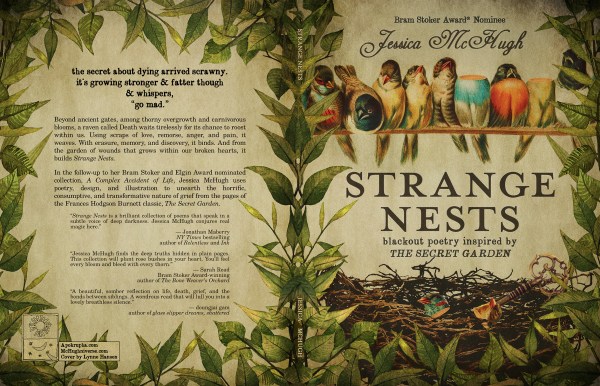
Q: Can you tell us more about your Little Women blackout poetry? How it compares to or differs from your work in Strange Nests and A Complex Accident of Life?

A: Absolutely! My 3rd as-yet-untitled blackout poetry collection, inspired by Louisa May Alcott’s Little Women, is definitely my most ambitious project so far. It will have 155 poems to coincide with the novel’s 155th anniversary in 2023, which is triple the number of poems in both A Complex Accident of Life and Strange Nests. That wasn’t my original intention, but I’ve come to realize that “original intentions” don’t matter much when it comes to these collections. A Complex Accident of Life only became a collection because Jacob Haddon of Apokrupha saw me posting Frankenstein blackout poetry and reached out about compiling the pieces. Strange Nests wasn’t planned either; it was more of a coping mechanism after my brother passed away in January 2021 and transformed into something so much more. So I’ve rolled with the punches and allowed myself to be surprised by the process. Deciding to make a lot more poems from Little Women has opened up the narrative in a huge way and allowed me to explore weirder paths, giving the collection more of a cosmic horror feel while remaining a fierce tale of sisterhood, selfhood, and feminine rage. While an official release date has not been set yet, it will probably be available from Apokrupha around April 2023. 

Q: Finally, is there a text you have your eye on for a future project? Are you willing to share what that is?

A: For collections, I’ll likely keep using classics written by women for as long as possible, and while I’d have to verify these are in the public domain, I’d love to play with Rebecca by Daphne Du Maurier, A Wrinkle in Time by Madeleine L’Engle, and pretty much any Agatha Christie. Outside of that theme, I’m also eager to make some creepy holiday pieces from A Christmas Carol. But really, I’m open to giving anything and everything a shot. I’ve found beautiful poetry in the most unlikely places, and I never get tired of discovering the hidden treasures within. 

To commission your own blackout poem, contact Jessica here.

Writing Ninety-Nine Fire Hoops: Guest Post from Allison Hong Merrill

The blog took a spring break, but is back with Allison Hong Merrill, author of the bestselling and award-winning memoir Ninety-Nine Fire Hoops. Here, Allison tells us about the process of rebuilding and restructuring her memoir after receiving beta reader feedback, and shares some of her best writing tips. Thank you, Allison!

When reading a book, I like to see the hook, setting, character, and conflicts of the story set up within the first few pages. So I make sure to offer my reader the same gift.

Originally, my memoir, Ninety-Nine Fire Hoops, was written in a nonlinear structure. But several of my beta readers suggested that I revamp the entire manuscript and change the narrative into a chronological timeline, so I did. It was a huge undertaking. The manuscript went through twelve full revisions. On average, each pass took two weeks. And when I say, “I revamped the entire manuscript,” I mean I even changed the title. It went from Grafted Mandarin to Ninety-Nine Fire Hoops because the new structure is in ninety-nine short sections. But even after this major overhaul and subsequent edits, the first ten pages remained unchanged from the first draft to the published book. It’s because the inciting incident, setting, main characters, and conflicts of the story are established within those pages.

When writing a book, I like to do the following:

1. Imagine my book adapted into a film, then I write scenes and dialogue as if describing them from the movie.

2. Do book research and save images on pinterest.com to create a mood board for reference. For a visual person like myself, this method works really well.

3. I make myself a different writing-related promise and a reward every week. This is not a goal; it’s a promise. A goal is for reference, a promise is to be kept. Some examples of my promises are: write an hour every day, revise a chapter, create social media content. If I keep my promise that week, I reward myself. My top three rewards are: watch a movie, buy a cute notebook, sleep in on Sunday morning. If, for any reason, I fail to keep my promise, then I give myself a second chance in the following week to restore my integrity and try again. Sometimes it’s necessary to promise myself to practice the art of self-care. I’ll take a week off from writing to recharge my creative energy. I work with another writer as accountability sisters. We check in every Saturday morning to support each other and to celebrate our victories, big and small.

4. I’m a memoirist. To dive deeper into my memory, I keep a tin box of NIVEA crème on my desk. Its distinctive scent takes me back to my childhood years and, from there, I get to explore the past and find inspirations for my writing projects. Smell triggers memory. If you’re writing about your past, please consider keeping something (lotion, soap, shampoo, perfume, scented candle, essential oil, etc.) on your desk with a scent that reminds you of the olden days.

5. Because I’m a visual person, instead of setting a timer on my phone, I flip over a sixty-minute hourglass on my desk to help me stay focused on one-uninterrupted-hour of writing.

I hope you find these tips helpful. Happy writing!

Should you create an author website? Yes.

I’ll keep this one short.

Recently, I stopped waffling about whether or not I should create a website and did it. Or, rather, I paid someone else to do it, because I’m from that in-between generation that didn’t grow up with computers but now we’re forced to use them for everything and to be honest, we’re still a little disoriented. (I had a word processor in high school that was, for then, top of the line.)

I dragged my feet about it because I thought, well, I don’t have a book. I’ll make one if I get my collection published. In the meantime, I racked up publications one by one, here and there, in smaller journals and online magazines, anthologies and even on podcasts (two of those forthcoming!). I realized I had plenty to put on a website, BUT, even if I didn’t, it still would have been worth making one. Create a website for the writing life you want, not for the writing life you have? Something like that?

If you create a website, you are basically making yourself “findable” via internet search. You are giving people a way to contact you. You are creating a professional presence, so that WHEN you get published (gotta believe, right?), you already have that piece in place. When you get stories or poems picked up by journals, small or large, you can actually fill in the “website” box on the bio form. And if you’re a blogger (whether it’s shouting into the void or talking to a few people or to many), it gives you a handy place to keep posts.

One of my favorite things about having a website, though, is a thing just for me. I love having one place where all of my publications and little accolades get to live. It’s like a digital creative resume. An online scrapbook. It’s nice to see all of my work together–like the last, oh, decade and a half of writing and revising and submitting has amounted to more than nothing.

If you don’t have money to spend on a website right now, create one for free on WordPress or a similar platform. You can upgrade it later and update it as you go.

(Also, it’s worth noting that there have been very few days with zero website visitors.)

If nothing else, I bet your mom/partner/best friend/dog/cat will think your website is cool.

“Comparisons are a waste of time,” an interview with Ellen Birkett Morris

Award-winning author Ellen Birkett Morris, whose titles include Lost Girls, Abide, and Surrender, shares here her philosophy on writing and the ways in which her career has continued to change and evolve, always coming back to words and their power. Find out more about Ellen, see her list of publications, and check out other interviews at ellenbirketmorris.ink.

Q: One thing I often remind myself and cheer on other writers with is this idea of determination and resilience–belief in one’s work, stubbornness even. Your own publications and projects are impressive in both their number and variety–you write and teach and publish in so many genres. How have you developed persistence? What can you share with others on the topic? 

A: My work is fueled by the fact that I really love to write.  Before I pursued creative writing seriously I worked my way into jobs in journalism and freelance writing that allowed me to write. Once I started to write creatively I learned how hard it is to get published and how much rejection was involved. I started by taking classes and working with a writing group. I made my work the best it could be. Then I reminded myself that each writer brings a different style and level of talent to the work so comparisons are a waste of time. I focus on what I do best. When it comes to rejection I realize that different editors like different things. It isn’t a reflection of my worth as a writer. If I get a no then I revise the work and send it elsewhere. No one is going to work harder than me to get my voice in the world, so I believe deeply in my work.

Q: Do you have a “home genre,” one you are more comfortable with than others? If so, which is it, and what about it appeals to you? 

A: I love the short story form the most and think I am good at it, but poetry is where I began as a writer. Poetry is my home. I love how crystalized poems are, how they capture experience through just the right image and in so few words. As a writer you have to bring the camera in very close in poems so you reflect both an outer world and an inner existence. Each poem is a beautiful puzzle. I have a new chapbook out called Abide from Seven Kitchens Press.

Q: What are your current projects or undertakings, and why are they energizing you right now? 

A: I am currently working on a collection of stories centered on the theme of home. Home is something we can all relate to and it can be looked at through so many different viewpoints.

I am also working on revising novel-length work. I just hired a developmental editor and I can’t wait to learn a lot from him about how to make my novel work better.

Q: If developing and writing and revising are one side of a coin, the other side is submitting and querying and promoting. That second side is the one many of us struggle with–either because we don’t have the skills or the inclination. How have you found a balance between the two over the years, or at least the tools and time needed to market and publicize your work? Do you have any advice for the rest of us? 

A: I had the advantage of working in journalism and getting used to seeing my work in print. I brought that same drive to my creative writing. As a reporter, I was on the receiving end of pitches and got to learn a bit about marketing. I’ve spent over 15 years doing contract public relations for a women’s foundation so that has helped build my promotion skills. I remind myself that my work won’t get published unless I put it in front of an editor. Once it is published it won’t catch reader’s eyes unless I promote it. That keeps me going. It is hard to find the time, but worth it. There are great resources on social media, especially The Writer’s Bridge run by Allison K. Williams and Ashleigh Renard. I also love “Before and After the Book Deal” by Courtney Maum.

“We do have a certain responsibility to be truthful,” an interview with Kelly Sundberg

Recently I had the opportunity to talk to Kelly Sundberg, author of the memoir Goodbye, Sweet Girl, (Harper Collins) about truth, bravery, and authenticity.

Q: What is the project you are working on now? How does it different from your debut memoir, and how has your craft evolved since then?

A: I’m working on a collection of linked, lyric essays that is tentatively titled The Witching Hour: Essays From an After. This collection is very different from my memoir. My memoir was mostly narrative in terms of style, and though there were flashbacks, the story generally unfolded in a chronological manner. The Witching Hour, first of all, is essays because I’m writing about PTSD. I don’t believe that any narrative of PTSD can be told in a linear fashion, because PTSD doesn’t unfold in any linear way. The essays use form to mimic the obsessive thought patterns that accompany PTSD. There is a lot of repetition and circling back. One essay is an erasure of my ex-husband’s apologies that he wrote to me. Another one is about single parenting, and it’s written entirely in couplets. Accompanying the essays are artifacts and snippets from my life. It’s a weird book, but I think it’s good weird. I haven’t seen anything else quite like it. I think my craft is deepened and more sophisticated in this book. I’m really excited by what I’m doing in it, and it’s almost ready to send out. My biggest dream for this book is that it finds a publishing home where it’s really cherished and allowed to be the book that I dreamed it would be. I worried a lot about sales with the first book (even though folks advised me not to), and that worry didn’t serve me well. Worrying about sales forces you to completely project your hopes and aspirations onto something that’s out of your control.  I know now that all I can do is write the book that I want to write, then trust that it will find the readers it needs to find.

Q: You are known for being open and honest on social media. How does that relate to your work as a nonfiction author? Is that sort of radical honesty something that takes practice, like a tool to keep sharp?

A: I am known for being open and honest on social media, and though I’m not sure that’s always served me well, it is who I am. When I was in an abusive marriage, I had to keep a lot of secrets. I kept secrets to protect my ex, myself, my child, and because of shame. What happened is that my physical body got ill. I genuinely believe that secrets are like poison. Since then, I’ve committed myself to truth telling and to being my authentic self as much as possible. What that means is that I’m radically honest, even if that hurts me or puts me in a bad light. Ultimately, I’d rather have people in my life who like me as I truly am than people in my life who like a mirage of what I want to be. I mean, I’m not saying that I never lie. That would be completely disingenuous. What I’m saying is that I’ve identified honesty as a value that I care about, and I work very hard to live by my values.

I will say that the nonfiction world is small, and I think that all of us know of certain writers who embellish or are “truthy” or who outright lie, and that frustrates me a lot because folks in the community just kind of step aside and watch it happen. It’s easier to keep the peace than to speak out, you know? As nonfiction writers, I think that we do have a certain responsibility to be truthful, and if you’re not able to be truthful, then why not just write fiction?

I think it’s important to note that, because of my history, I have a genuine and sincere belief in accountability culture. I believe that folks should be held accountable, whether that’s through a call-out or a call-in, but I’m not some kind of vigilante. I’m someone who was harmed by an individual, then harmed even more by the people who covered for and/or defended him. I have a personal stake in this. I worry sometimes that folks think I’m inflexible or judgmental. I expressed this worry to a friend recently, and she said, “Kelly, you’re very generous and allow folks all kinds of room to be human. You just draw the line when it comes to liars and abusers.” I found some consolation there because I’m human, and I’ve harmed people in ways that sometimes keep me up at night. No one is perfect, and I’m not even close. But because of my history, I have to draw some lines for myself.

Q: Your essay and memoir topics often inspire others to share their stories with you, AND you’re a writing instructor who reads a lot of student work. How do you maintain your emotional boundaries and your empathy? How do you avoid burnout? 

A: Oh man, Wellbutrin? I don’t know that I have an answer for that question. The truth is that I don’t have great emotional boundaries. I cry in workshop when my students read something hard. I cry at home when I’m reading their essays. I feel for them. I wish that I could adopt some of them. I’m an instructor, and my job is to help their writing get better—not to fix their lives—because what I’m not is a therapist. Still, that doesn’t mean that I don’t feel it all in my heart and deeply wish that I could step in and help. I do help in the ways that I can. I listen, I offer advice that’s within the realm of my experience, and I make referrals to mental health providers when necessary. My classroom environment is very safe and inclusive, and I know that my students would back me up on that. And for every sad story that I read, there is a story of joy or triumph. I also get to see most of these students at the beginning of their adult lives, and I know that they are not defined by anything that has happened to them. One of my greatest joys is getting to see a student thrive years after graduation.

And as for burnout, it’s not reading student papers or holding their stories that causes me burnout. It is a gift to hold space for all of those stories. What causes me burnout is the world that we live in where so many of my students are not born into circumstances that are designed to help them succeed. Watching them struggle in the face of capitalism, institutionalized racism, ableism, etc., etc., etc. (while I struggle alongside them in many of the same ways), that’s what causes me burnout.

Q: Finally, would you offer some advice for those of us who are working on personal essays or memoirs? 

A: My advice would be to trust yourself and your voice. The best writers aren’t afraid to take risks because they trust themselves. If you take a risk, and you fail, you’ve still grown as a writer, and every risk gets you closer to success. It was when I really trusted myself to explore and experiment and question in my writing that it bloomed into something I was proud of. And honestly, trusting yourself and your ability to fail and come out alive is good advice for just about anything.

A WordPress.com Website.

Up ↑