Writing resolutions: yes or no?

We’re two days into the new year. We’ve all seen the memes–walk quietly, don’t claim this will be your year, don’t tempt fate, it can always get worse, etc. We thought 2021 would be better than 2020, and we were disappointed. So.

We’ve also all seen the range of social media posts about resolutions–why they are helpful, and why they are terrible, and the folks in the comment sections are really feeling some feelings. So.

Where do you fall? Are you making any resolutions this year, particularly for your writing or reading or research?

A while back, a friend of mine said she doesn’t call them “resolutions,” because she thinks there is a succeed/fail dichotomy inherent in the term. A resolution is a promise, and you either keep a promise or you don’t. Instead, she sets New Year “goals,” which are a little more malleable. You work toward goals, you make progress toward goals, and goals are adjustable. The “reaching for” is the whole point. I love that, and though I also use the word “resolutions,” I think of them as goals–as long as I make progress, I have nothing to beat myself up over at the end of the year.

This year, some of those goals are vague, and some are more specific. I want to write more, and I want to work on getting 100 rejections (and so submitting my butt off). Credit for that last idea goes to Kim Liao at LitHub. I also want to finish my story collection and start sending it off to whole-manuscript contests and publishing houses that don’t require an agent (I’ve heard from other writers that it’s an extraordinary feat to get an agent with a story collection; my energy is likely better spent elsewhere). I’m signed up for an awesome class in February (Feminist Horror with Lindsay Merbaum), and in June, I’m taking myself on a five-day writing retreat at a cottage near a lake. I want to read at least one book each month and lift up other writers whenever possible. I also want to post to each of my blogs twice per month, with one of those being an author interview or guest post. And I’ll keep tracking my submissions, fees, and responses, so I can compare 2022’s numbers to those of 2021.

I know now that I will reach some of those and not reach others. But that’s fine. I’ll be reaching all year.
“I really need a deadline and accountability to be my most productive,” an interview with Heather Frese

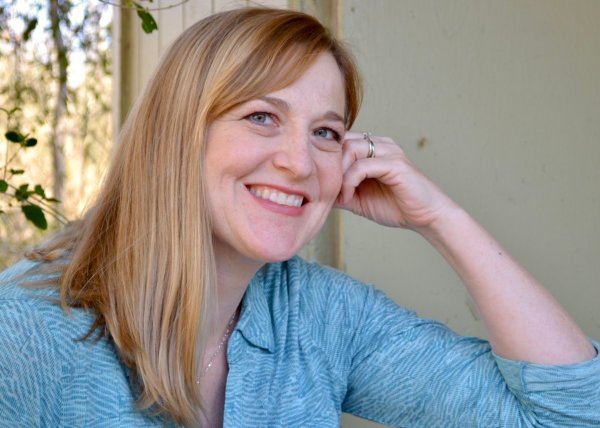
Recently I had the chance to talk to my pal Heather Frese, author of The Baddest Girl on the Planet (Blair) about the challenges of writing while parenting and the importance of finding your “people.”

Q: What are some of your recent and current projects? What are you working on now?  

A: My debut novel, The Baddest Girl on the Planet, won the Lee Smith Novel Prize and was released in spring of 2021 (Blair). Prior to that, I’d published short stories and essays, and was shortlisted in the Pushcart Prize Anthology and Best American Essays. I’m currently working on, or trying to work on, a big revision to a novel that’s been sitting in a metaphorical drawer for a long while now. I’ve got a few essays underway and I have some ideas percolating for a new novel, but nothing has solidified yet.

Q: Recently, we formed a small writing support/workshop group. What does that do for you or your writing? 

A: I really need a deadline and accountability to be my most productive, and this group gave me that. And it was an extra bonus to have that accountability provided by some of my favorite people! 

Q: Including our workshop group and friends outside of it, why is it important to you to connect with other busy writers? 

A: I think for me, after I finished my MFA program and moved, I had a bit of an identity crisis that was compounded by my transition into the overwhelming-ness that was early motherhood. So connecting with other busy writers was a really vital way to remind myself that I was, indeed, a writer. Even when I wasn’t really writing (and I had a good chunk of years where I was intensively mothering and not really writing), that connection was so important to me in maintaining the idea of myself as a writer, and kept me holding on to a near future where I would write again.

Q: What else is competing for your time? What other priorities and obligations are you trying to write around? 

A: I’m the primary caregiver to three young kids. They’re awesome little humans. They’re sweet and smart and hilarious, and oh boy do they take up nearly everything I have, mentally and physically. I came to realize pretty early into motherhood that I couldn’t write while they were awake and/or in my near vicinity. You can catch tiny snippets of time that way, like a sentence or to jot a note, but the sustained flow of creativity and concentration to really dig in and shape something? No. And I give mad props to all those authors who wake up at 3 or 4 or 5am to write, or who stay up until 3 or 4 or 5am to write, but I can’t do it. I’m just too exhausted. This fall my youngest started preschool a few mornings a week, so I drop everyone off at school, dash to a coffee shop, and try to switch gears and slam myself into writer-mode for a few hours. And it’s working! I’ve been so much more productive in those few kid-free hours than I’ve been in years of trying to work with kids in the house.

Q: How has being a part of communities helped your projects come together in the past? 

A: Having trusted critique partners has made a huge, huge, massive, giant impact on my writing. Oftentimes when I’m stuck on something, a writing partner will be able to quickly see what needs to happen or have an idea of how to fix things. Without that help, I’d be struggling for months before figuring it out, if I ever did. It’s also so important to have moral support and to know that I have people in my corner who understand what I’m trying to accomplish and are giving feedback based on getting the project to the vision that I have in mind, you know? Feeling like I’m not alone in this often overwhelming and demoralizing process of writing, revising, and publishing is so helpful.

Q: What recommendations do you have for writers out there who want to find a community of their own? 

A: Honestly, connecting online through social media was really powerful for me when I was living far away from my in-person communities or hadn’t found local writing friends yet. I know Facebook can be problematic, but it’s been a big positive for me in staying connected with other writers. I’d also say that it’s really important to find people who connect with your work and get what you’re trying to do. You don’t even have to write in similar styles or genres, but feeling that sense of connection or gelling with where the other person is coming from helps a lot.

The skill of being rejected

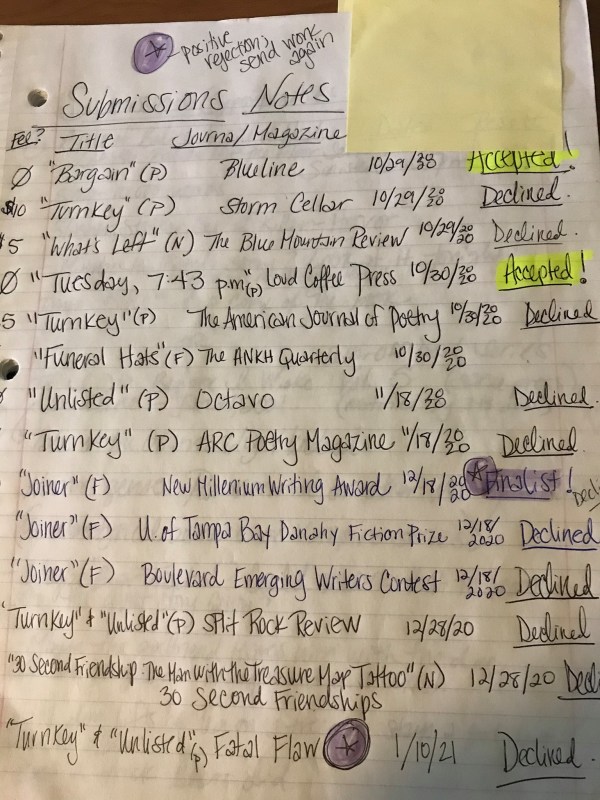
Pic: This is how I keep track of submissions. Low tech but effective.

I have found, pretty recently, that being rejected as a writer is a skill. And like any skill, you can get better at it.

During lockdown, I got back to work on my own writing, spending more time and energy on it than I had in years. Instead of finding the creative well dry, as I had feared, a couple of stories seemed to write themselves. I joined four friends in a Zoom writing workshop (we still meet). I made appointments with an excellent editor-for-hire, and we’ll schedule another session soon. I wrote and I revised, and then I wrote some more. I went on a personal writers’ retreat, renting a cabin in the Catskills with my wonderful friend N. West Moss for a few days, and drafted two new stories. For a while there, I was kicking ass.

In that time period, I also got back to submitting my work to journals and magazines and writing contests. I realized that the process energizes me–everything sent out is a chance that it will find a place in the world. Submitting stories (and sometimes, essays and poems) makes the process more real for me–it makes me feel more like a “real” writer, whatever that is.

And wow, did those rejections roll in. And they keep rolling in. And honestly, yep, sometimes they stung, and sometimes they still do. But they sting less all the time. I shrug at them now, mostly. If I get two in a day, I laugh. It sucks, even now, if I get a rejection on a submission I thought was a good fit–like if my story matched the theme, or aligned with the goals of the publication.

A few came close. “Joiner,” a story, was a finalist in the New Millennium Writing Awards. A flash piece, “Rest for the Wicked,” got a lovely rejection from the Parsec Ink contest, saying it made the longlist. Fatal Flaw rejected two poems, but encouraged me to send more (I will!).

I’ve gotten acceptances, too. For the year of 2021, my record is 5 acceptances, 43 rejections, with a handful of submissions still out. Most recently, The Elpis Pages, a print collective (with profits going to Planned Parenthood), took my essay “What’s Left.” That will be out this month. Then, I got an email from Last Girls Club, saying my story wasn’t a fit for their magazine, but could they read it on their podcast, Blood & Jazz? (The answer of course was YES.)

A lot of what has gotten accepted from 2020-2021 had been in the works for a while. Like a long-ass time. A poem that Blueline Magazine took (“Bargain,”) had existed in various forms for over seven years. “Tourist,” a flash essay Anti-Heroin Chic published, was first drafted about three years ago. Every time those pieces (and others) got rejected, I would take another look at them. Tinker. Fiddle. Tighten them up. And, not surprisingly, they got better. And then they found homes.

I was inspired by the article “Why you should aim for 100 rejections a year” from LitHub by Kim Liao. I was also motivated by a Facebook thread posted by the editor of a small press, which turned into a big conversation about why women tend to submit less often than men. (Spoiler: it’s because patriarchy.) The main idea with both of those? Submit, submit, submit.

I look for opportunities on various Facebook pages, through Reedsy, Newpages, and Erica Verillo’s blog, Publishing and Other Forms of Insanity. I don’t mind submissions fees–publications are expensive to run and print, and need to pay for staff and software, etc.–but I don’t break the bank. I look for cheap and free submissions opportunities, too. I keep track of everything in a janky notebook–see photo. (I tried keeping a tidy Excel file, but that’s just not me–I’m a pen-and-paper gal at heart.)

In 2022, I hope to hit the 100 rejection mark. If I double my rejections, I might just double my acceptances, too. Who’s in?

A WordPress.com Website.

Up ↑