“Show love. Shop local.”

Published by Buffalo Spree Magazine.

Shopping local this holiday season is about so much more than great prices and personalized service. Buying from area vendors and manufacturers boosts our hometown economy during the most important retail months and keeps it strong all throughout the year. 

When viewing any bustling Buffalo marketplace or friend-filled tavern, it may be hard to believe that just a few miles away, hulking machinery and abandoned factories are testament to the fact that the Queen City has seen better days. 

But Buffalo is on the rise! 

The “Buffalo Billion,” the rebirth of Canalside, and the ever-growing downtown medical campus are just a few large-scale projects that are breathing life back into Western New York, and hundreds of tiny inhalations and exhalations are happening, too, with small businesses and local vendors. When you buy gifts or party supplies from small businesses, you’re helping Buffalo boot ’n’ rally. 

According to Sustainable Connections (sustainableconnections.org), an award-winning not-for-profit organization that promotes local shopping for its financial, community, and environmental benefits, supporting local merchants encourages local prosperity and gives young people a reason to settle and raise families in their hometowns: 

A growing body of economic research shows that in an increasingly homogenized world, entrepreneurs and skilled workers are more likely to invest and settle in communities that preserve their one-of-a-kind businesses and distinctive character.” 

Quite possibly, Buffalo, with its surrounding communities, is one of the most unique cities in the state, perhaps even the North. The Queen City’s rich history has left an imprint on downtown building facades, lakeside topography, and even its people—who remain fiercely loyal to their hometown traditions and especially their hometown sports franchises. Isn’t that a heritage worth preserving?

Say so! Bay-6, Buffalo Clothing Co., located in the Southgate Plaza on Union Road in West Seneca, is a boutique carrying plenty of apparel to show your Buffalove. The store is a one-stop-shop for fan gear and more, making it easy to check names off your holiday gift list. 

“We get a lot of people coming in from out of town who lived here before and moved away,” says owner Suzanne Miller. “Other customers are looking to send Buffalo gear to out-of-town relatives; they’re people looking for hometown gifts and who want to celebrate our city. “We get people who say, ‘I have to stop in to get my Buffalo gear.’ These are displaced Western New Yorkers, and Buffalo will always be their home.” 

For many of these homesick transplants, Bay-6 is a scheduled stop when they come home for winter holidays. “We have dog apparel, too, so the whole family can show their love for Buffalo!” Miller adds.

Bay-6 also supports other small businesses by stocking books by local authors and clothing items by Buffalo designers. They even have infants’ and kids’ sizes, so parents can start the initiation into Buffalo fandom early. Get all the updates on newly stocked items, including holiday ornaments, by finding Bay-6 on Facebook.

Going to area craft shows, vendor festivals, and farmers’ markets is an excellent way to support the local economy, and ensures that you’re purchasing fresh, high-quality products. Because there is no middle man or expensive shipping involved, prices are great, too.

The Buffalo Saturday Artisan Market (SAM) at the Central Wharf, Canalside, got started in 2012. Its mission, according to its website, is “to provide an affordable venue for artists to display their work and bring the community together to experience local art.” Every Saturday, dozens of artists and artisans set up booths and sell handmade jewelry, woodcarvings, soaps, glasswork, stationery, candles, children’s toys, pottery, and more. 

The SAM shopping experience is unique, too, in that it is the only consistent art market in Western New York. “All of the artisans are local and they do the selling themselves, which provides an opportunity for the buyers to meet the makers of the work they love,” continues Leatherbarrow. “Selling directly to the customers gives the artisans immediate feedback and affects what they make before the next market—this creates a symbiotic relationship where the art becomes a reflection of the community that supports it.” 

As the Sustainable Connections website explains, meeting specific local needs and wants is a common benefit of small marketplace vending: “A multitude of small businesses, each selecting products based not on a national sales plan but on their own interests and the needs of their local customers, guarantees a much broader range of product choices.”

Leatherbarrow also points out that spending money at SAM keeps dollars in the neighborhood. 

“Shopping local gives a much-needed boost to our local economy,” she notes. “SAM is a market of artists, but these are all small businesses that need and deserve support. These are your neighbors! When you shop local, the funds go right back into the local economy, which has proven to improve life in communities that hold these types of events.” 

For a complete schedule of market dates, driving directions, and a list of vendors and available items, go to buffalosaturdayartmarket.com or visit the Buffalo Saturday Artisan Market facebook page

Plenty of other unique shopping experiences are coming to Buffalo neighborhoods. “Green Friday” (as an alternative to Black Friday) is being held November 27 in the village of Hamburg, with free trolley rides (from noon to 6 p.m.) taking shoppers around to participating local stores and restaurants for great deals and one-of-a-kind gifts! Shoppers aboard the trolley will also get special coupons and a chance to win prizes with the “Passport to Prizes” game. For event details, go to facebook.com/HamburgGreenFriday.

Also happening, on November 27, is the fifth annual Black Friday Boutique Crawl on Elmwood Avenue, organized by the Elmwood Village Association (ELA). More than thirty businesses will participate in this holiday shopping season kick-off, which began as a way to celebrate the neighborhood and its shopkeepers.

“The event was started to provide a shopping experience away from the mall madness that allows shoppers to buy local, and support independent Buffalo businesses,” says Jennifer White, community engagement manager for the ELA. Local spending keeps three times more money in Buffalo, and locals create the most new jobs.” 

Sign up for the ELA e-newsletter at elmwoodvillage.org to keep up with all the neighborhood news! 

On December 4–5, Hertel Avenue businesses will open their doors and hang up wreaths for the twentieth annual “Hertel Holidays,” presented by the Hertel Business Association. This crowd-pleasing event brings hundreds of Buffalo shoppers to the Hertel neighborhood every year, with restaurants and shops offering the seasonal deals that leave shoppers jolly, joyful, and laden with packages. The event runs from 5 to 9 p.m. on Friday and 11 a.m. to 5 p.m. on Saturday. Santa himself will be there, perhaps literally with bells on. See hertelholidays.com for the photo gallery and all the latest news. 

If it’s a day trip you’re after, head west on Route 20 to the Crossroads Market in Westfield. This “mall-ternative” destination is open every Saturday from 9 a.m. to 5 p.m. through December 19 and on Black Friday. Dozens of vendors ensure something for everyone, including hard-to-find gluten-free baking and soup mixes. In December, live music will make the market extra jolly, and Santa will drop by to check on nice (and naughty) shoppers. For more information, including directions, go to thecrossroadsmarket.com.

Along with its festivals, sports teams, and reputation as one of the snowiest places in the United States, Buffalo is known for some of its landmark businesses, large and small: General Mills, Anchor Bar, Duff’s, Pearl Street Brewery, and, of course, Spot Coffee.

The Spot Coffee legacy began in 1996, and has grown to include nine cafes in and around Buffalo, with US central headquarters taking pride of place on Delaware Avenue.

Locations include Buffalo, Orchard Park, Glens Falls, Clarence, Williamsville, Saratoga Springs, and now Rochester, so this “neighborhood café” really is in (or close to) your neighborhood. Stop in and try a signature entrée, then relax with a cup of Buffalo’s best brew after a long day of cookie baking or tree trimming.

Staylocal.org, another nonprofit dedicated to strengthening communities through local entrepreneurship and neighborhood support, says that money spent at businesses like Spot Coffee have a ripple effect on the local economy: “Your dollars spent in locally owned businesses have three times the impact on your community as dollars spent at national chains. When shopping locally, you simultaneously create jobs, fund more city services through sales tax, invest in neighborhood improvement and promote community development.”

In addition to that, small businesses and neighborhood merchants are far more likely to support local fundraising efforts, donate to community improvement projects, and volunteer free time to everything from staffing soup kitchens to organizing mitten drives. 

The next time you’re planning a date, scheduling an outing with friends, or making your holiday shopping list, contemplate for a moment where you want your hard-earned money to go. You cast a vote with every dollar you spend. Why not vote for quality, for your neighbors, and for Western New York? And it’s not just about strengthening the local community and economy. Shopping local will preserve the character and restore the dignity of the Queen City, turning rust into gold—maybe tarnished, but beautiful and valuable all the same. Don’t forget to go to your local farmers’ market and neighborhood events. Visit nearby orchards and vineyards. These are relaxing ways to fit in holiday shopping, spend afternoons with friends, or have a fun and flirty first date.

Who does chicken wings better? Whose fans remain fiercely loyal no matter how many Bills games are lost or won? Whose proud townies wear three, four, five sweaters and a parka to come curl at Canalside every week this winter? Which city’s residents inhale the scent of Cheerios every morning and shovel their sidewalks every evening and think “There’s no place like home,” and mean it? 

There’s only one Buffalo.  
“MADE WITH LOVE: Give a little of yourself with these DIY gifts”

Published by Forever Young.

These DIY projects are so easy and inexpensive to make—and kids love to help. Spa certificates and store-bought sweaters will always be appreciated but if you’d like to wrap up something a little more personal this season, consider one of these fun-to-make (and receive) gifts.

Chalkboard wall art

What you’ll need:

Old silver-plated or chromium tray (check your local thrift store or an estate sale)

Painter’s tape

Chalkboard paint (find at any home improvement store)

One-inch angled paint brush

Chalk

Picture frame bracket and super glue (*or ribbon)

This one is simple to make and right on trend. Wipe the tray clean and dry then lay flat. Cover the silver edge with painter’s tape for a framed look. Coat the inside with chalkboard paint. It takes three to four coats to get good coverage. Let the surface dry completely between coats then remove tape. If the tray has a “laced” edge with cutouts*, use pretty ribbon to make a hanging loop, and add an extra bow for flair. If the tray doesn’t have cutouts, use super glue to attach a metal bracket to the back and let it dry overnight. Now add a sweet message with chalk and present it to one of your favorite people!

Wine charms

What you’ll need:

Wire wine charm rings

Small glass or plastic beads

Assorted charms

You can find these supplies at any craft store or order them online; try orientaltrading.com or joann.com. Just select a color scheme and a charm and thread the beads onto the wire ring. Stop halfway to add the charm, then finish it up with more beads in the same pattern. Choose special charms to easily personalize this gift. Give them in sets of four, six, or eight and, to show some extra love, include a bottle of great local wine! For pretty presentation, tie the charms around the wine bottle’s neck with ribbon or twine and a gift tag.

Fabric animal ornaments

What you’ll need:

Fabric (you may have some scraps from projects lying around)

Buttons

Needle and thread

Ribbon

Yarn

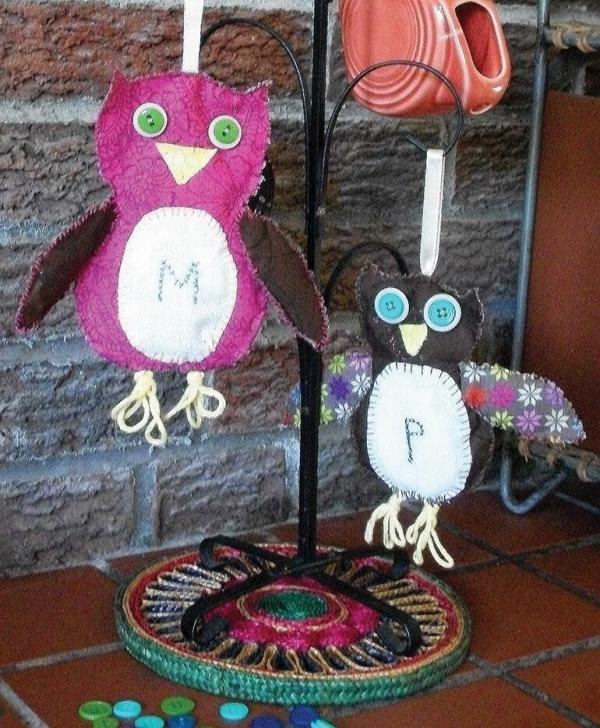
This whimsical gift is perfect for loved ones of any age—and it’s almost impossible to mess up. The more homemade-looking it is, the better. Choose any animal that can be represented with a few color blocks, like a bird, turtle, or fish. Cut out the animal’s base shape then cut out its wings/shell/fins using different fabrics. Sew these to the base shape with contrasting-colored thread— don’t worry about perfect stitches. Keep the little cloth pieces you trim off; you’ll use them later for stuffing. To make the animal really special, stitch on a year or monogram. Add button eyes. The owls I made for babies Molly and Parker have feet made from yarn loops. For the backing, lay the animal down on a contrasting piece of fabric and trace the same shape but a little larger. It’s easier to trim as you go than to realize, too late, that the back is too small. Sew the animal to the backing, leaving the top open to add your “stuffing,” which is more fabric scraps (or anything else you’ve got: cotton balls, shredded junk mail, a cut-up stray sock). Right before you close it up, tie a loop in a piece of ribbon and sew the knot inside. Now this little creature can take its place on the tree year after year!

Every time your friends or family members change the chalkboard message, get out the wine glasses for a party, or decorate the Christmas tree, they’ll remember how much you love them. Isn’t that the best gift of all?

“Write for Life”

Published by Forever Young.

Self-expression doesn’t have an age limit, and living long and well means seniors have many stories to tell. There are myriad benefits of creative writing for those over fifty and plenty of resources in Buffalo for anyone who wants to give it a try.

Robin Jordan, writing center coordinator for Just Buffalo Literary Center, stresses the profound benefits of creative writing for scribblers of all ages. “Creative writing can heal, inspire, create communities, spur essential feelings of empathy, and play an integral part in sparking political and social change. For so many, without creative writing, we are nearly voiceless,” Jordan says.

Olga Karman, JBLC board member, is one of the founders and group leaders of the Stadnitski Workshop, a weekly senior citizens writing group. She says participants have developed a sense of community there, which is so important for seniors who can become isolated due to health issues and far-flung friends and family. Stadnitski writers are also building confidence and developing agency in grappling with sometimes-painful memories.

“The emotional benefits are several and they are the reason I continue to dedicate time and effort to this project,” Karman says. “Participants are encouraged to remember and describe times, places, persons, and events that formed them. This activity helps to integrate their past with their present. In giving form to memories, they get a chance to ‘write their histories’ and thereby to control them.”

Mimi Dow, another founder and JBLC board member, says the workshop helps seniors recognize their value. “(Participants) are writing things down, and we’re paying attention,” she says. “We all write and we all share. It’s a confidence-builder.”

To see everything Just Buffalo has to offer, including the Writers’ Critique Group, Studio Poetry Series, and Literary Buffalo, visit justbuffalo.org.

Amy Christman, librarian and manager for the Kenilworth branch of the Buffalo and Erie County Public Library System, started an adult journaling workshop in 2002, and that small community of writers—many of them seniors—remains strong.

The group meets monthly on the first Tuesday from 7 to 8:30 p.m. “The group is open to all adult writers, and the goal is that their writing leads them back to some self-knowledge. Journaling is about learning who you are, and you can do that at any age,” Christman says. For more information on Christman’s journaling group, call the Kenilworth branch at 834-7657.

Mary Jean Jakubowski, library director for the Buffalo and Erie Public Library System, recognizes the importance of creative writing for seniors, and points to the library’s author resources. “Our homepage has a plethora of materials on creative writing and getting published, both in print and online,” she says. “We have tools to enhance the writing process and contact information for adult education programs and workshops in the community.”

She adds that the Buffalo libraries have many creative writing events, like poetry slams and read aloud nights. The library also houses local author collections, so writers can bring their books in to get them put into circulation! Events are free and open to the public, and Jakubowski always welcomes new ideas for programming. For the full schedule of events or to peruse online writers’ resources, go to buffalolib.org.

Many senior authors are penning their memoirs; recording their storied lives for future generations to laugh, cry, or gasp over. Sarah Einstein, who recently published Mot: A Memoir (University of Georgia Press, 2015), has some helpful tips for memoirists-in-the-making. “Read and study work you admire,” she says. “Study the way the author smooths out the vagaries of memory and finds larger meaning in the (remembered) events. Memoirs can be organized in all sorts of interesting and useful ways, and chronology is only one of them. Structure should follow the needs of the main narrative arc, not simply the timeline of events. Take a class or two, but mostly, read, and then write many, many drafts!”

It doesn’t take much to incorporate creative writing into your life. Start a journal, attend a poetry reading, or join a workshop group or start your own. The experience can be life-changing, eye-opening, and instrumental in building a healthier, more connected life. Pick up a pen or flex your typing fingers. Your stories are worth telling.

“A Few Days in the Dale”

Published by Buffalo Spree Magazine.

When it comes to day trips and weekend getaways, Western New Yorkers are rich with possibilities, from antiquing trails to agri-tourism festivals to the treasures of small towns. One of these not-so-hidden gems is historic Lily Dale: “City of Light” and the world’s largest Spiritualism community. Lily Dale is located in Chautauqua County, on the shores of Cassadaga Lake. And though more and more visitors “discover” Lily Dale every summer season from late June to early September, the quaint Victorian village has existed since 1879, when the community’s founders purchased the first few acres.

Lily Dale has been featured in several documentaries by both U.S. and overseas filmmakers, and in countless newspaper and magazine articles. Full-length non-fiction works on Lily Dale can be found on bookshelves across the country, their pages lined with tales of the community’s rich past and examinations of the often-debated religion of Spiritualism — a belief of which is that the living can communicate with the dead. Readers may also recognize the the village from Wendy Corsi Staub’s bestselling thrillers — she admits that Lily Dale is one of her favorite settings — and from After Life, by Ithaca writer Rhian Ellis (rhianellis.com).

Donn Smeragliuolo is the CEO and president of the board of directors for the Lily Dale Assembly. He explained why Lily Dale makes the perfect weekend destination.

“We have so much to offer, aside from being a spiritualist community. It’s beautiful here, and peaceful. For a $12 gate fee, visitors can visit the museum and library, attend workshops, and participate in the outdoor activities. One of the best things is just walking around the village and taking in the atmosphere. It’s truly like stepping back in time,” he said. “And we’re going to keep it what it is.”

History buffs will get a thrill from the turn-of-the-century architecture and the celebrities who have stayed in the hotels and spoken in the Auditorium — people like Susan B. Anthony, Reverend Anna Shaw, and Houdini. In fact, the wooden stage in the Auditorium is original, as are many of the seats. Some visitors say they can still feel the energy of those long-gone personalities and events; it’s as if they have seeped into the wood and become part of the structures.

Several of Lily Dale’s permanent residents admit it was that very energy that drew them to the community in the first place, and the reason they now call it home. One of them is Ron Nagy, the village’s historian and caretaker of the museum.

“You’ll never forget your first day (in Lily Dale),” Nagy assured. “As soon as I got here and put my feet on the ground I felt a tingling. I knew it was something special.”

Whether visitors are “believers” or not, there are plenty of reasons to spend a weekend (or longer!) in Lily Dale.

“People come here with different things in mind; some want answers, messages from Spirit about their loved ones. Some are looking for healing. Others love history, or are out just enjoying the day and the ambiance.”

On a Friday evening, guests can stroll the grounds and enjoy dinner at one of the village’s eateries, like the centrally located Monika’s Delites. Then, walk to the beach with someone special and appreciate the sunset before retiring for the night!

Accommodations in Lily Dale include two hotels, The Leolyn and the Maplewood Hotel. Rooms fill up fast; make reservations as soon as possible by calling (716) 595-8721 ext. 2005. For a more home-like feel, visitors can stay in one of the many privately run guest houses in Lily Dale. There are also camp sites available in the park-like grounds near Inspiration Stump, one of the village’s most famous locations. The nearby Dunkirk/Fredonia area offers many hotels for those who prefer more modern amenities.

Start Saturday off with breakfast at Cup-a-Joe’s Coffee Shop, then participate in the day’s many activities and workshops. Topics vary, but are often related to healing, mediumship, empowerment, and connections with the afterlife (for the full schedule, see lilydaleassembly.com). Go on a walking tour with Ron Nagy to learn the history and philosophy of Lily Dale — visitors may be surprised at the similarities between “then” and “now.” Have dinner early enough to get a seat in the Auditorium for the night’s special presenter or concert!

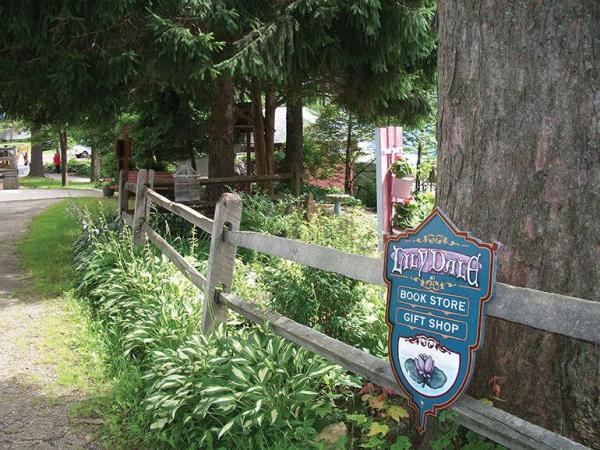
Sunday is perfect for visiting the Marion H. Skidmore Library and walking the Woodland Trail. Take a moment to absorb the peace and calm surrounding Inspiration Stump, then turn back for lunch at The Sunflower Cafeteria. Be sure to get a reading by one of the village’s registered mediums for an unforgettable experience; appointments are strongly recommended during peak season. Before heading home, stop by the Lily Dale Bookstore and Souvenir Shop to pick up a little remembrance of Lily Dale — where history lives and the dead are never really gone.

“Afternoon, 1988”

Published in Allegro Poetry Magazine, Issue #5, themed “Childhood.

For Jeff

I’ve been meaning to tell you:
That day the crayfish darted backward to their silty secrets—
when I caught one with pincers too small to nip my small palms,
when the creek-smell caught in my throat and stuck,
toes squeezing slippery bed-sand,
minnow schools disturbed, winking soft bodies in sunlight,
when I ran across Route 20 and the blue sedan swerved—
I saw your face from the safe side of the road,
but I couldn’t see your chest expand then deflate;
I didn’t understand my weight,
the harsh sounds your voice made, for me.

“Keeping us in suspense”

Published in the Dunkirk Observer and online at observertoday.com.

Editor’s note: Last week writer Rebecca Cuthbert reported about local writer Wendy Corsi Staub’s newest accomplishment, having a Wendy Markham chick-lit book adapted for the Hallmark Channel. This week Cuthbert focuses on Staub’s suspense thriller, “The Black Widow” and the author’s thoughts about writing in that genre.

“The Black Widow,” (HarperCollins) features protagonist Gaby Duran, and concludes Staub’s cyber predator trilogy. Gaby Duran has many qualities that Staub’s dedicated readers will recognize. However, as the author said, the star of this book is also somewhat of a departure from other recent characters.

“Gaby is, like my other protagonists, resourceful, strong, and intelligent,” she said, “(but she is) a little younger than my recent heroines, lives in the city as opposed to a small town or suburbia, and is single instead of married with children, though she once was a wife and mother. Her past is more painful than some – she married the love of her life, but their marriage didn’t survive the tragic loss of their infant child.”

Staub also explored Hispanic culture in writing this novel, and is grateful for the experience. “Gaby also happens to be my first Latina heroine: she’s Puerto Rican-American. I have many Hispanic family members and close friends, so I embraced the opportunity to explore the vibrant culture, and it was a crucial element within the context of this particular plot,” she said.

Staub explained that her recipe for success isn’t so much a recipe as it is knowing her fans, knowing her genre, and balancing expectations with creativity.

“Because I write within a specific genre – domestic psychological suspense – my readers have certain expectations about the kinds of characters who are going to populate the books and what’s going to happen to them,” she stated. “My protagonists tend to be ordinary people whose lives are turned upside down and jeopardized in some way. In real life, when you plug different people into an identical set of circumstances, the outcome is going to be unique every time because of who they are as individuals and how they react to conflict and interact with others. The same is true in fiction.”

Staub said this is not only true of convincing, well-rounded protagonists, but of exciting plots, as well.

“Look at it this way: if I tell you that I woke up this morning and got out of bed – well, that’s not very interesting, is it? You did the same thing. We all did. But the manner in which an event unfolds-and whether others might find it interesting-depends not just upon how it happens, but to whom it happens. Thus, when I conceive a basic plot, I think about how various personality types might behave within the confines of a specific scenario, and how that behavior might influence the plot,” she said.

Staub even gave an example of how drastically circumstances can differ for two characters, influencing the choices they make:

“A happily-married suburban stay-at-home mom with three children is going behave differently than, say, a painfully shy, recently bereaved pregnant widow working two jobs to pay the rent on an inner city apartment,” she said. “Thus, every protagonist I create is unique and comes with a unique background and circle of unique characters with whom she interacts.”

Some of the characters Gaby Duran interacts with – for better or worse – are people she meets online. Staub frequently uses current technologies to help fuel her plots and make her fictional worlds more realistic, but she admitted that these advances in communication can also hinder certain narratives, especially in the suspense genre.

“It’s impossible to write realistic contemporary fiction without addressing technology – or the lack thereof. If you need your characters to operate in a tech-free bubble, then there should be a good reason – like a power outage in a storm, for example – or you set your story in an earlier time or an alternate universe,” she said. “Just as electronic communication can enhance some plots, it can hinder others. For example, in this era of ubiquitous smartphones, it’s difficult to truly isolate a character or setting-always an effective device in a suspense plot – because most people carry or have access to electronics and even the most remote locations tend to have Internet and cell signals. So it’s not easy for a person to disappear without a trace – willingly or unwillingly – without leaving an electronic footprint via the Internet, surveillance footage, banking or credit transactions, or travel security measures. That makes it tricky to create a plot that depends on that particular scenario.”

So how does Staub navigate the tricky waters of writing thrillers in the year 2015, when AAA is always a phone call away and GPS can get any heroine un-lost in a jiffy? By exploring the dangers of the same technology that often makes life so convenient.

“My books tend to feature ordinary people made vulnerable by being in the wrong place at the wrong time,” she revealed. “Technology can create vulnerability because otherwise savvy people can momentarily let their guard down on social media, sharing things that they wouldn’t dream of telling close friends or family in person. That creates the illusion of familiarity. If we trust strangers based on who they appear to be online -overlooking the fact that our perception can be easily manipulated – we become vulnerable. Even when we restrict electronic communication to people we know, we’re assuming that the person on the other end of a text or email is our friend, and not a predator who gained access to the device. I’ve used that very device to create frightening, realistic fiction.”

Staub’s readership is used to heroines who get into trouble and make mistakes – as she says, “perfection is dull!” But it’s those same flawed protagonists who rescue themselves, solve the mysteries, and come away from their battles as stronger, smarter, more capable individuals. Staub credits her upbringing as her inspiration for her heroines, along with the women who populated her formative years.

“I was a little girl in the era of Women’s Lib, and watched my mom, my aunts, and their friends – who were stay-at-home wives and mothers – go on to get college degrees and launch successful careers,” she said. “That left a strong impression on me, and I learned that we traditionally expect women to nurture others, but they must also be capable of taking care of themselves. My own strong sense of feminism and independence is often reflected in my heroines. As a result, my female ‘victims’ are rarely truly victims – they’re strong, resourceful women who try hard to save themselves when circumstances become dire.”

Staub also tries, in her way, to be kind to her villains. They’re not caricatures or stereotypes, but people who, in their pasts, suffered traumas they couldn’t rise above.

“I want my readers to come away with the sense that my novels are complex in part because just as in real life, no character is all good or all bad,” she began, and added, “my villains have usually been victimized somewhere in their past. I don’t believe in creating killers who were born pure evil – you need empathy in order to write scenes from a character’s viewpoint. So I do a lot of research into deviant psychology with each book, and my villains must possess some glimmer of redeeming characteristic in order for me to channel them.”

Whether it’s cyberworld stalkers, heroines’ blunders, dead Smartphone batteries or buried secrets, Staub’s plot twists consistently keep her readers on the edge of their seats, and in line for her newest releases. But even with so many titles to her credit, Staub isn’t slowing down. In fact, the more books she writes, the more ideas she gets for new books.

“I’ve been writing thrillers for over 20 years, so it’s like any other skill – constant practice makes you adept,” she said. “Sustaining the excitement has become second nature to me – if I’m bored when I’m writing something, then I know my reader is going to be bored reading it, so it isn’t hard to gauge the excitement level. Inspiration is everywhere. All novelists have an ingrained “What If” mechanism that’s triggered all day, every day, by what we read or watch, by things that happen to us, by events we witness or even snippets of strangers’ conversations we happen to overhear. I will never run out of inspiration – only time.”

Next week: How Staub’s local connections affect her writing.

“Things my 74-year-old Father Says That Do Not Mean What He Thinks They Mean, With Helpful Notations For Those Who May Be Similarly Confused”

Published in Crab Fat Magazine, Issue #4, page 104.

  1. Cir·cle Jerk \ ’sǝrkǝl, ‘jǝrk \ n: Not a traffic circle, like the one recently built at Routes 5
    and 20 in Irving, NY, right next to the Seneca Hawk smoke shop, gas station, and casual
    eatery (home of all-you-can-eat spaghetti).
  2. Hand Job \ ‘hand, ’jäb \ n: Not a hand-operated tool or piece of machinery, i.e. “Eric, I’m
    already using the nail gun so it’ll have to be a hand job for you” is incorrect, misleading,
    and gross.
  3. Dou·ble-team \ ‘dǝbǝl-tēm \ vb: Not when both dogs beg for one’s sandwich.
  4. Blow Your Wad \ ‘blō, ‘yōr, ‘wäd \ vb, adj, n: Not when one spends all of his/her money
    on one item, and no, “blow your load” isn’t any better.
  5. This Guy’s Jerk·ing Me Off \ ‘ this, ‘gīz, ‘jǝrk-iŋ, ‘mē, ‘ȯf \ pron, n+vb, vb, pron, adv: Not
    when the man selling his lawn mower in the Classifieds won’t accept one’s offer of half the
    asking price, (and no, telling him “because I already have six lawn mowers” doesn’t make
    him more inclined to accept the offer; if anything, it just makes him realize you are a
    hoarder and that you will, in fact, pay the asking price).
  6. Get·ting F’d To Death \ ‘getiŋ, ‘eft, ‘tü, ‘deth \ vb, adj, prep, n: Not when one’s youngest
    children are swearing too profusely at the dinner table for one’s liking, and really, Dad, it
    was at the Seneca Hawk.

“Happily Ever Laughter”

Published in the Dunkirk Observer and on observertoday.com.

Every long-married couple will tell you that a successful marriage takes patience, forgiveness, understanding, and hard work. They might also tell you that it takes a lot of laughter. Some couples found that out early – on their wedding days, actually. And these stories go beyond your run-of-the-mill embarrassing Best Man speech or too-tipsy bridesmaid.

JUAN AND BETTY(ECHEVARRIA) PAGAN: JAN. 29, 1977

The year was 1977, and the month was January in Western New York. For anyone with a long memory, these facts alone spell trouble-but Bedsaida “Betty” Echevarria and her groom-to-be Juan Pagan would find out just how much trouble they would face on their winter wedding day during the infamous Blizzard of ’77.

The government declared a state of emergency. Factories, schools, stores, and the mail service shut down. Roads were closed and emergency shelters were set up along busy routes. But as the snow fell, Betty continued to get ready for her wedding at St. Elizabeth Ann Seton Church in Dunkirk. After all, the biggest challenge was over – finding a partner to love for the rest of her life. So she and Juan rolled up their sleeves and made their wedding happen, despite mounting obstacles brought on by the storm.

Those obstacles included Juan’s family getting stuck 30 miles from Dunkirk, the couple’s wedding cake being MIA, the wedding party left without their rented tuxedos, an unheated church, and a DJ who couldn’t make the drive to the reception.

“We didn’t think we were going to make it, with everything going against us,” Juan admitted of the whole fiasco.

But love conquers all, right?

Juan and his groomsmen battled 50 mph winds to pick up the manager of the tuxedo shop at her home and drive her to the store, where they stripped mannequins and mixed and matched different-colored suits until they were at least clothed-the groom in a white suit; the best man, Robert Hernandez, in a black tuxedo; Harry Echevarria, the bride’s cousin, in a black tuxedo and red shirt; and the late George Pagan, the groom’s brother, in a brown tuxedo. The ring bearer wore his own khaki pants and a brown jacket. Generations from now, if this story has been lost, their family members might see those wedding pictures, shrug, and chalk that color scheme up to the ’70s.

Juan and company made it to the church, albeit 30 minutes after the ceremony was scheduled to start. After 20 hours of being stranded, his New Jersey-based family members also arrived, and the wedding was on!

“Normally the bride makes the groom wait,” Betty quipped of that day. While she waited for her soon-to-be husband at the church, Betty joked with her mother and posed for pictures in which both women point to their watches and smile.

Though most of the men in the wedding party had to deal with pins pricking them throughout the ceremony due to makeshift tailoring, the women didn’t fare much better. Anyone without a parka and ski boots would have shivered in that unheated church, and in thin dresses designed for beauty instead of warmth, shiver they did. Remember, too, that Catholic ceremonies aren’t known for their brevity! Perhaps the “Amens” at the end of that service were particularly enthusiastic.

For reception music, the couple ransacked their own apartment for records and 8-tracks.

“We had to make our own music,” Juan said.

Small miracles happened. The cake magically appeared at the then-Puerto Rican Social Club, located on Central Avenue in Dunkirk. The rest of the guests, who hadn’t made it to the church, found their way to the reception and stomped off their boots in time to celebrate with the newlyweds. Music, cake, friends, and young love: all the ingredients for a great wedding were present. So what if all of this happened during a record-breaking blizzard?

The Rev. Kenneth Menge, who performed the Pagans’ wedding ceremony, told them that day “if you made it through that storm, you can make it through any storm in life.”

Richard and Tammy (Panek) Winder: Aug. 25, 1984

Another couple kept their guests waiting on their wedding day, but instead of an epic storm, the cause of the delay was a smoking limousine.

Tammy waited that day with all of the nervous excitement of a young bride: she’d been coiffed, perfumed, and fitted into her wedding dress. She held a beautiful bouquet and knew the man of her dreams waited for her at the altar at Holy Trinity Church in Dunkirk. All she had left to do was get to the church, which should have been no problem. After all, they had rented a limo to get her there on time and in style. She was all smiles.

Until the limousine’s hood poured steam into the hot August air like an angry dragon ready to torch a brave knight-or in this case, a distressed damsel.

Like the Pagans, though, Tammy rallied. She gathered her dress’s train and hitched a ride, arriving only about 15 minutes late for her wedding. Let’s hope Richard takes comfort in the fact that it was a hot engine, not cold feet, that made his bride late that day.

Paul and Theresa (Barone) Leone and Jim and Jan (Meyer) Ellman: May 29, 1965

The Leones and the Ellmans were married on the same day in May of 1965 – and on the same street. The stage was set for a comedy of errors, but this play had two happy endings.

The Leones’ wedding was at Holy Trinity Church, which at that time was located on Ruggles Street in Dunkirk. The Ellmans’ wedding was at Sacred Heart Church, also on Ruggles Street. Paul Leone’s mother, Anna, lived in Angola, and wasn’t too familiar with the area. She made it to Dunkirk, found Ruggles Street, saw a church that was obviously filling up with wedding guests, and assumed she had found her son’s wedding ceremony.

She was wrong. She walked into the church, expecting to see her son beaming on the altar and family members filling up the pews. Instead, she saw strangers, and made a graceful exit. She found the correct church, and told her son what happened. The couple had a good laugh, and became friends with the Ellmans. After that, the two couples celebrated their joint anniversary together.

Surely, the “Remember when my mother crashed your wedding?” story remained a favorite for many years.

Tony and Betty (Maziarz) Arcoraci: Sept. 4, 1965

Betty and Tony Arcoraci were married at St. Hedwig’s Church in Dunkirk, and unlike these other couples, they got hitched without a hitch. The trouble came after the wedding, on their honeymoon.

The Arcoracis stayed at a Howard Johnson motel in Hamburg, and, when the clerk handed them a room key, they accepted it without question, got their bags, and were ready to turn in for the night.

But when Tony fitted the key to the lock and opened the door, he didn’t find a neatly made-up bed with an “Enjoy your stay!” card propped against plump pillows. He found a bed already occupied by a sleeping couple. He left the room quicker than an un-tipped bellboy and told the apologetic clerk that “people get shot for less!”

Charles R. and Margie (Fuentes-Perez) Dye: July 4, 2009

Like the Arcoracis’ night, the trouble for the Dyes didn’t happen until after the wedding was over and they arrived back at their home. Margie had visions of being carried across the threshold, a long-standing tradition that, among other things, wards off bad luck and symbolizes a fresh start together as a couple. But that didn’t happen.

“We realized we were locked out of our house as soon as I got out of the car!” Margie said.

They weren’t ready to laugh about it that night.

“We were both frustrated at the time because we were so tired,” she said. “I wanted to stay at a hotel.”

But Chuck had another idea.

“It was definitely Chuck’s idea to break in through a window,” Margie said. “I didn’t want to go through the window.”

Good humor prevailed. Instead of carrying his bride in through the doorway, he pushed her, wedding dress and all, in through a window.

They laugh about it now.

“We really wish the photographer would have been around at the time!” Margie said. “The funniest thing is we actually found the house key the next morning underneath the seat in the car!”

Joel and Rebecca (Schwab) Cuthbert: Sept. 7, 2014

This story is my own, but has the same ending as the others: Happy.

I admit that I like to do things my way. I even prefer self check-out so that I can pack my own groceries. Nine times out of ten, when people ask if they can help me, I say no (unless it’s my sister, then she’s the boss). But here’s the trouble: not everything will always go the way I want.

More than a year before my wedding, I ordered what I thought was my dream dress from a company in China. The dress came, and was a horrible fit. The company wouldn’t take it back, and I never did get to talk to a customer service representative. Thinking I had months until my wedding, I ordered a similar dress from another company, also overseas. This one fit worse, and was covered in sequins. “I can fix this,” I thought. I took the sequins off, and worked with a local tailor, who did her best to piece together parts from the two dresses. I ordered vintage lace to trim the neck and sleeves. It didn’t match. I ordered more. It still didn’t work. The Franken-dress just wouldn’t live, no matter how many times we zapped it.

With only weeks to go until my wedding, I brought the dresses, now reduced to heaps of indistinguishable lace, to another seamstress. She looked at them, shook her head, and told me she couldn’t promise anything. So, as a last-ditch effort, I drove by myself on a Wednesday afternoon to the David’s Bridal by the McKinley Mall to look at the sale rack. At this point, I’d already spent over $500 on the two awful dresses.

A sales clerk approached me, giving me the standard “Can I help you?” script. When I opened my mouth, I started to cry. I managed to choke out “No dress” and “Wedding in three weeks.” When she asked if I’d brought anyone with me, I cried a little harder. This was not how wedding dress shopping was supposed to go.

But I decided, as I stood beneath fluorescent lights with hopeful brides and their mothers all around me, that crying doesn’t solve problems. I explained that I liked vintage-style dresses. I explained that I had a very limited budget. I think I used the word “now” a lot. I found a beautiful dress with a lace back for $326, two sizes too big, and called the seamstress from the parking lot. She said “If I fix one of the old dresses, it’ll be a lot of work. If I make this new dress smaller, it will be a lot of work. It’s the same to me. Do what your heart says. Maybe a fresh start will be good.”

I bought the dress and brought it to the seamstress. I picked it up from her days before my wedding. It fit perfectly. She asked if I wanted the old dresses back. She tailors and then donates wedding dresses to a charity, though, and the proceeds help human trafficking victims try to rebuild their lives. So I told her to keep them-let my bad memories turn into good memories for someone else.

For my dress, the third time was the charm. If only I had found a husband that easily!

The End

P.S. The wedding dress seems so important-you think it has to be just right. Now, though, my “perfect” dress is lying in a rumpled heap in a hamper, almost forgotten-but, even as I type this, my husband calls to me from the next room, asking me what I want to do for dinner, offering to wash the dishes.

The tears I shed over one day’s outfit were wasted. I could have gotten married in a thrift store sundress, and the outcome would be the same: I got to marry Joel Cuthbert.

Snow melts. Food is eaten and forgotten. Guests remember how much fun they had dancing, but not who pressed “play” on the stereo. A wedding is one day, and then the rest of your life starts. So make sure it’s your best friend boosting you in through the window.

“Dear Ms. Bradigan”

Published by Treehouse Magazine

***

Dear Ms. Bradigan,

It’s not that your efforts went unnoticed—the “private” journal only you would read, the soulful “Are-you-okays,” the invitations to visit the school counselor.

It’s that I was ten, or not quite, and my mother had just died, and I felt flayed open, peeled flesh exposed to stinging wind, and even before that, before I was half-orphaned, I was an introverted child.

When you insisted I see the counselor—because swallowed sadness hurts, you said—I talked about my yellow parakeet, who would later get cancer and be put to sleep by my older brother with a pillowcase and an exhaust pipe, which is not at all how my mother died, and for which I was at least prepared, though I loved the bird too, a little, which is why when that tumor grew on his face and he could no longer eat, I said “Do it” without stuttering or regretting the words.

I did not talk to the counselor about the parakeet as a substitute mother, or of you as a substitute mother, or whatever you had hoped I’d say. I did not call myself the parakeet’s mother, or it my baby, because, Ms. Bradigan, it was a parakeet, and because I didn’t understand, I could not measure, I’d not yet tossed a stone into the yawning black hole my dead mother left; I did not know that for the rest of my life I would throw parakeets and miniskirts and seven-dollar bottles of wine into it, never to hear anything bounce off a damp-sounding rock face or hit hard on a silty bottom.

I was not ungrateful then because I didn’t understand gratitude, but would not have thanked you if I did, or not sincerely, because sometimes when you see a potato bug curled into a ball you should just leave it there, let it take comfort in its protective roundness, or, if you must interfere, Ms. Bradigan, pull a curtain of lush green grass away from a stone step and drop the gray ball into the deep, loamy recess where it will be safe from crushing boot heels and predators’ beaks and too many questions about its feelings, which, at that point, Ms. Bradigan, it had not known how to articulate.

All my sincerity,
Rebecca Schwab

“Three Tears in a Bucket”

Published by Slipstream Press, Issue #34, “Rust – Dust – Lust.”

Poetry by: Shanalee Smith, Marc Pietrzykowski, Andrea O’Rourke, Noah Kucji, Harvey J. Baine, Cait Weiss, Courtney Leigh Jameson, Christopher Warner, Quinn Rennerfeldt, Rich Heller, Michelle Valois, Pat Phillips West, David Denny, Leona Sevick, Dawn Corrigan, Michael Walls, Eliese Colette Goldbach, Irena Praitis, Katie Darby Mullins, Mary Kathryn Jablonski, Rachel Squires Bloom, Michael Gatlin, Dan Sicoli, Peter Ramos, Leland James, Les Bares, Bill Edmondson, Ed Taylor, Donna L. Emerson, Alison Stone, F.G. Mulkey, Max Shanley, Lynn Pederson, Doug Draime, Maggie Blake, Paul French, Rebecca Schwab, Katharyn Howd Machan, Jenna-Nichole Conrad, Jody A. Zorgdrager, Nicole Zuckerman, Anthony Seidman, Livio Farallo, Mather Schneider, Yosef Rosen, Terry Godbey, Chelsea Dingman, Jim Daniels, Karen J. Weyant, Katie Longofono, Brian Fanelli, Eric Gelsinger, Jared White, Kimberly Eagen Latko, Bryan Thomas Rice, Janet Warman, John Marvin, Kita Shantiris, Lyn Lifshin, Margo Davis, Carol V. Davis, Aidan Ryan, Lockie Hunter, Beth Bateman Newborg, Regina Murray Brault, Brett Armes, Odessa Denby, M.K. Meder, David Chorlton, and Gerald Locklin.

A WordPress.com Website.

Up ↑