
When you can’t write or revise, read.

This will be a short one, because I’m feeling flattened and hollowed out. It’s the endless pandemic with its grief and worry; it’s the end of a tough semester throughout which I juggled too much and burnt myself out; its the approaching holidays with their stressors and reminders that my mom is dead and my family is scattered. Blergh.

So, now that I have some time to get a bit of writing and revision in before the start of the spring semester, I find myself with no energy to do so. Creative thoughts seem to run, head first, into a brick wall. My brain is a blank Word document, complete with blinking cursor. And that makes me feel like a bad writer–not the quality of my writing, but bad as in not dedicated enough to my craft. I don’t get up early or stay up late to write. I don’t have a day in the week set aside for it, though I keep meaning to do that, to make a schedule and stick to it.

Instead, I have been reading. Reading for fun (mysteries), reading for work (excellent manuscripts for Leapfrog Press), and reading my own works-in-progress. I’m feeding all of these words into my subconscious. Or that’s what I think I’m doing. Hoping that something will click, that I will come up with an idea for a way to remedy a problem in an existing draft (I’m talking about you, ghost story). And I think it’s a not-that-unlikely possibility.

I wrote a story in grad school that I loved and that hasn’t worked ever. I love the characters and the setting. I love the narrative voice and the dialogue. I even love the plot. It’s basically a one-sided conversation in the present moment, narrating events that are also happening on the same timeline, but a step behind; so on Monday, the speaker is explaining what happened Saturday, etc. It has always been clear in my mind, but on the page, it’s a damn mess, and no one knew what was going on. Recently, I read it again, just for fun, and got an idea. Why not give it a really obvious structure? Label the days? Indicate the speech of another character, the side of the conversation we don’t get to hear? And I may have solved it; I may have pulled this story back from the clutches of story death. Then again, maybe I didn’t; maybe it’s too much of a schtick, too gimmicky. Or too odd for the collection I’m working on, since it’s the only story with a weird structure. The only way to tell is to workshop it and find out.

Okay so this wasn’t that short. Oops. Back to my point, reading is always a part of writing, so if you’re doing that, you’re not doing nothing for your craft.

Here’s hoping that all those words I’m feeding into my soggy, tired brain will arrange themselves into good ideas I can put on a page, and soon.
The skill of being rejected

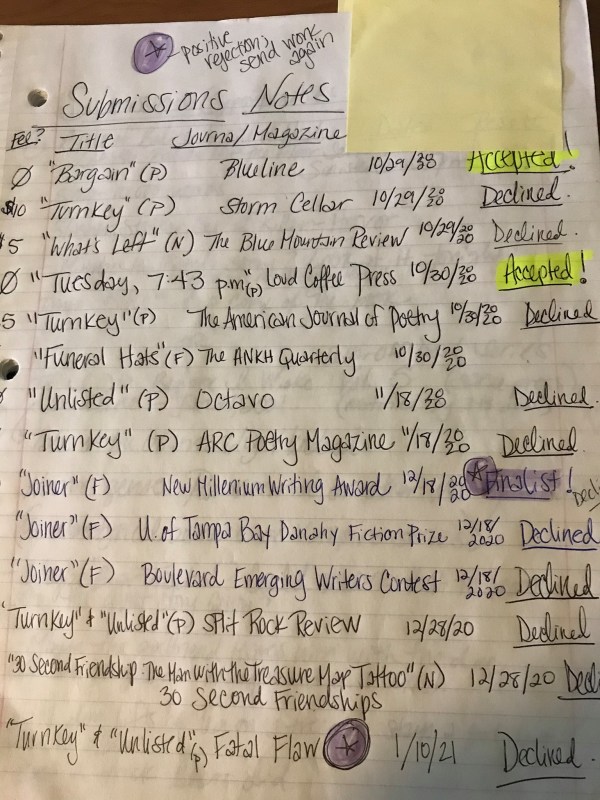
Pic: This is how I keep track of submissions. Low tech but effective.

I have found, pretty recently, that being rejected as a writer is a skill. And like any skill, you can get better at it.

During lockdown, I got back to work on my own writing, spending more time and energy on it than I had in years. Instead of finding the creative well dry, as I had feared, a couple of stories seemed to write themselves. I joined four friends in a Zoom writing workshop (we still meet). I made appointments with an excellent editor-for-hire, and we’ll schedule another session soon. I wrote and I revised, and then I wrote some more. I went on a personal writers’ retreat, renting a cabin in the Catskills with my wonderful friend N. West Moss for a few days, and drafted two new stories. For a while there, I was kicking ass.

In that time period, I also got back to submitting my work to journals and magazines and writing contests. I realized that the process energizes me–everything sent out is a chance that it will find a place in the world. Submitting stories (and sometimes, essays and poems) makes the process more real for me–it makes me feel more like a “real” writer, whatever that is.

And wow, did those rejections roll in. And they keep rolling in. And honestly, yep, sometimes they stung, and sometimes they still do. But they sting less all the time. I shrug at them now, mostly. If I get two in a day, I laugh. It sucks, even now, if I get a rejection on a submission I thought was a good fit–like if my story matched the theme, or aligned with the goals of the publication.

A few came close. “Joiner,” a story, was a finalist in the New Millennium Writing Awards. A flash piece, “Rest for the Wicked,” got a lovely rejection from the Parsec Ink contest, saying it made the longlist. Fatal Flaw rejected two poems, but encouraged me to send more (I will!).

I’ve gotten acceptances, too. For the year of 2021, my record is 5 acceptances, 43 rejections, with a handful of submissions still out. Most recently, The Elpis Pages, a print collective (with profits going to Planned Parenthood), took my essay “What’s Left.” That will be out this month. Then, I got an email from Last Girls Club, saying my story wasn’t a fit for their magazine, but could they read it on their podcast, Blood & Jazz? (The answer of course was YES.)

A lot of what has gotten accepted from 2020-2021 had been in the works for a while. Like a long-ass time. A poem that Blueline Magazine took (“Bargain,”) had existed in various forms for over seven years. “Tourist,” a flash essay Anti-Heroin Chic published, was first drafted about three years ago. Every time those pieces (and others) got rejected, I would take another look at them. Tinker. Fiddle. Tighten them up. And, not surprisingly, they got better. And then they found homes.

I was inspired by the article “Why you should aim for 100 rejections a year” from LitHub by Kim Liao. I was also motivated by a Facebook thread posted by the editor of a small press, which turned into a big conversation about why women tend to submit less often than men. (Spoiler: it’s because patriarchy.) The main idea with both of those? Submit, submit, submit.

I look for opportunities on various Facebook pages, through Reedsy, Newpages, and Erica Verillo’s blog, Publishing and Other Forms of Insanity. I don’t mind submissions fees–publications are expensive to run and print, and need to pay for staff and software, etc.–but I don’t break the bank. I look for cheap and free submissions opportunities, too. I keep track of everything in a janky notebook–see photo. (I tried keeping a tidy Excel file, but that’s just not me–I’m a pen-and-paper gal at heart.)

In 2022, I hope to hit the 100 rejection mark. If I double my rejections, I might just double my acceptances, too. Who’s in?

A WordPress.com Website.

Up ↑